
For many marketing teams, scaling still looks like a media-buying formula. If they increase the budget, they’ll expand the reach and get more users.
After all, if a campaign performs well at one level of spend, the natural assumption is that a larger budget should produce a larger result.
But in mobile acquisition, that logic is becoming harder to rely on.
ROCKAPP’s new industry overview, Mobile Acquisition Under Pressure, explores what happens when acquisition moves beyond its most efficient scale.

Our report shows that growth problems rarely come from one weak channel or one isolated campaign decision. More often, they appear when the entire acquisition system starts operating under pressure.
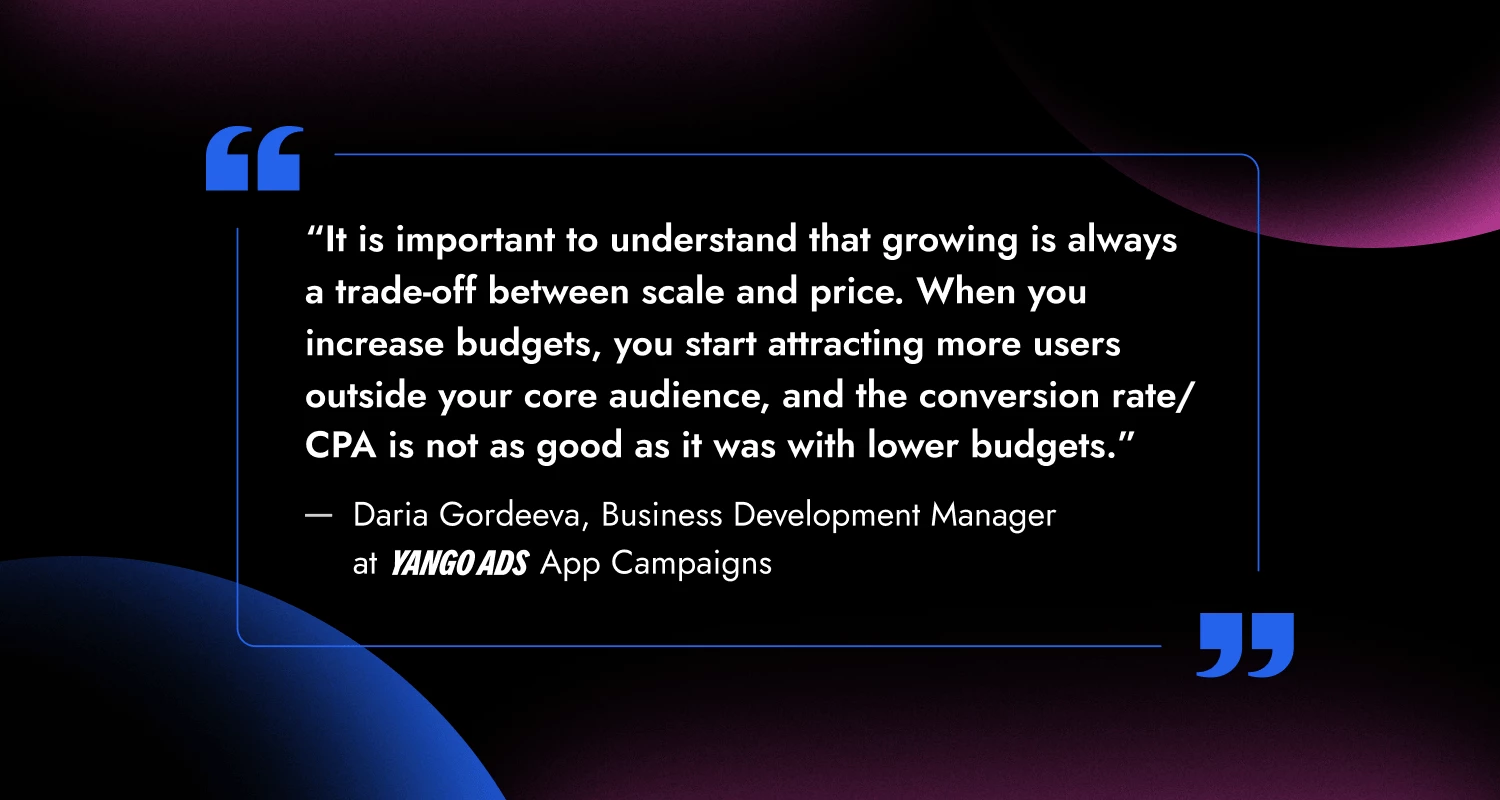
At lower spend levels, teams usually have more room to test, optimize, and find efficient pockets of traffic. But as budgets grow, that flexibility narrows.
Competition increases, audience capacity tightens, creative performance becomes harder to sustain, and traffic quality becomes less predictable.
Campaigns may continue to deliver volume, but the economics behind that volume can start to change.
The first signal is usually cost. The real issue is control.
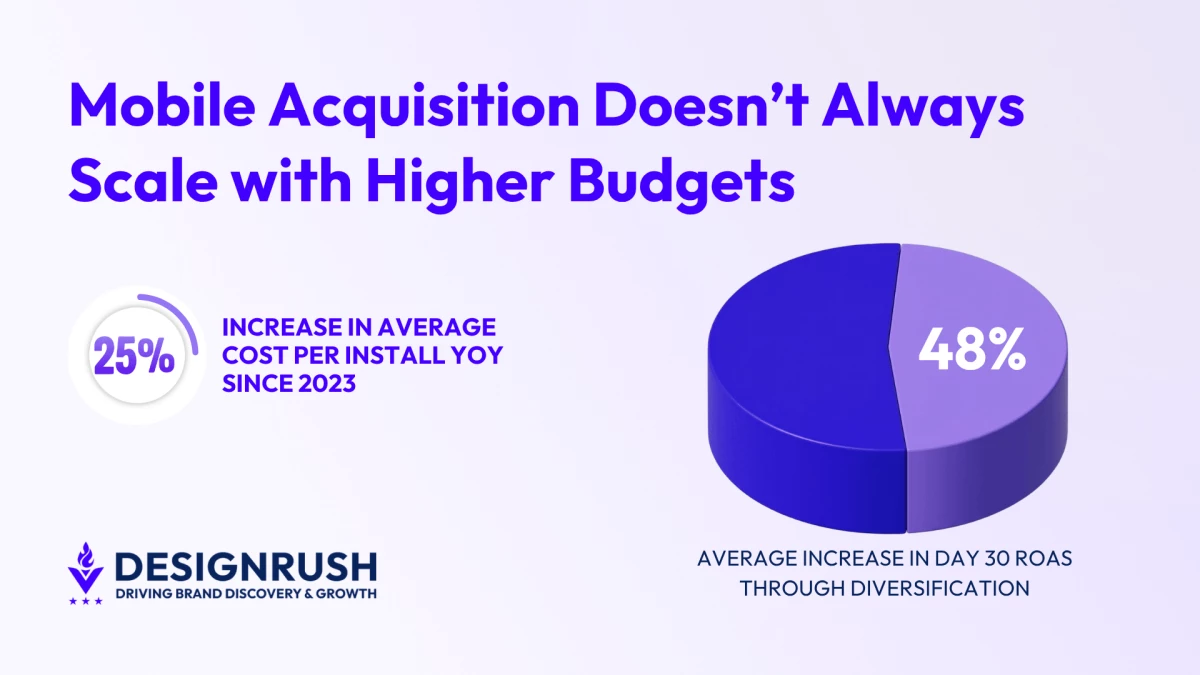
Rising cost per install (CPI) is often the first visible symptom of scaling pressure. But it rarely tells the full story.
When acquisition expands, teams often move beyond their most responsive audience segments.
The same users may be reached more frequently across overlapping channels, while additional spend starts buying broader and less predictable traffic.
At the same time, creative fatigue can manifest earlier as existing assets are exposed to larger audiences and higher frequencies.
This creates a difficult situation for marketing leaders.
The campaign may still be spending. It may still be delivering installs or early conversions. But the quality and value of those users may start changing underneath the surface.
The pressure point for brands is the ability to increase spend while keeping traffic quality, measurement, and downstream performance under control.
Top-level metrics can hide deeper performance shifts
One of the key ideas in the overview is that acquisition performance needs to be evaluated beyond the top of the funnel.
Install volume, CPI, and early conversion rates can still look acceptable while deeper metrics begin to weaken.
For many mobile products, the real performance signal appears later in purchases, deposits, payments, retention, LTV, or ROAS.
This is where measurement becomes more strategic. If attribution data, platform reporting, and internal analytics do not tell the same story, budget decisions become harder to trust.
A source that looks efficient at the install level may not be the one creating the strongest long-term value.
For C-suite and brand leadership, the implications go beyond UA and directly affect how growth budgets are evaluated, how channels are prioritized, and how much confidence teams can place in reported performance.
Scaling requires a connected acquisition system
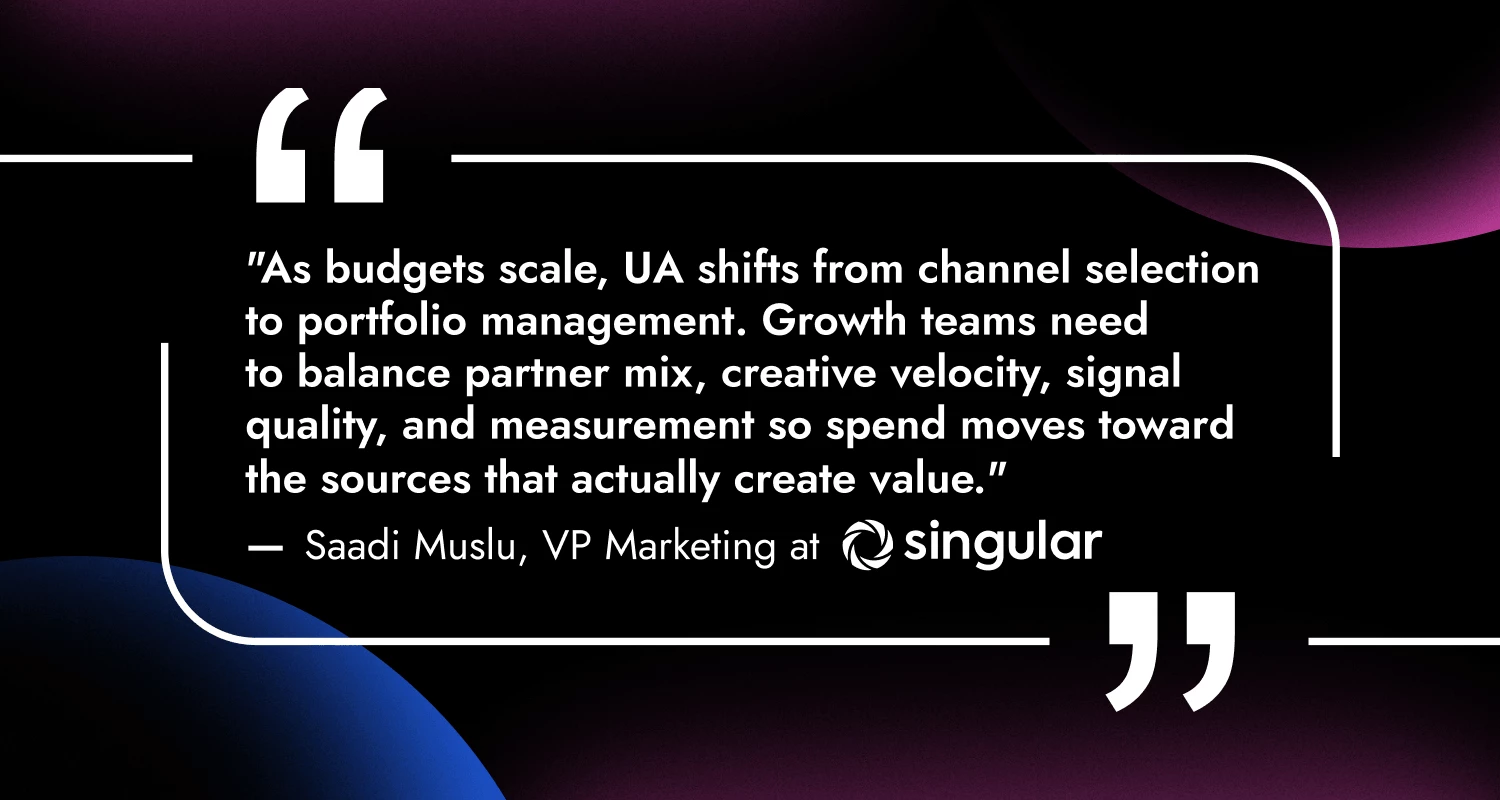
The overview brings together ROCKAPP’s market analysis and practical perspectives from Singular, Tenjin, Xiaomi Ads, Yango Ads, and FraudScore.

Their commentary highlights how scaling pressure appears across several operational layers, such as auction dynamics, creative refresh cycles, In-App inventory, traffic validation, attribution gaps, and long-term acquisition economics.
The broader message is that mobile growth can no longer be managed as a set of disconnected tactics.
Paid social, In-App traffic, retargeting, anti-fraud, creative production, measurement, and optimization all influence one another at scale.
In fact, an analysis of 2,000 apps found that diversifying beyond Google and Meta drove an average increase of 48% in Day 30 (D30) ROAS, per data from Singular.
For example, in a retail-focused In-App case pattern covered in the overview, campaigns generated 10,000+ purchases per month, with install-to-purchase conversion above 40%, and D30 ROAS reaching 480–520%.
But without event tracking, source-level control, publisher filtering, and validation against downstream behavior, more inventory can also add complexity.
Retargeting can improve acquisition economics by working with users already inside the funnel, but only when segmentation, timing, and conversion signals are clear.
At higher volumes, weaknesses in one part of the setup can directly affect overall acquisition efficiency.
What leadership teams should take from the report
Mobile Acquisition Under Pressure frames sustainable mobile growth as a system challenge: budgets, creatives, traffic sources, validation, and measurement must scale together.
Before increasing spend aggressively, leadership teams should ask several questions:
- Are we still reaching high-intent audiences, or are we paying more for weaker incremental users?
- Do our creative refresh cycles keep pace with our media scaling?
- Are we evaluating sources by downstream value, not only by install-level metrics?
- Do we have enough visibility into traffic quality and attribution gaps?
- Are In-App, retargeting, and validation integrated into the broader acquisition strategy?
These questions matter because scaling often weakens gradually as costs rise, quality becomes less consistent, and decision-making becomes less clear.
For marketing leaders, UA managers, app publishers, and agencies, the challenge has shifted toward scaling with enough visibility and control to protect long-term performance.
The brands that grow sustainably will be the ones that understand where their acquisition system starts to bend under pressure and know where to adjust before performance breaks down.
Download your complimentary copy of ROCKAPP’s Mobile Acquisition Under Pressure overview.