
Marketing budgets are finally climbing back up, but the ground underneath our feet is moving faster than most executive teams can keep up with.
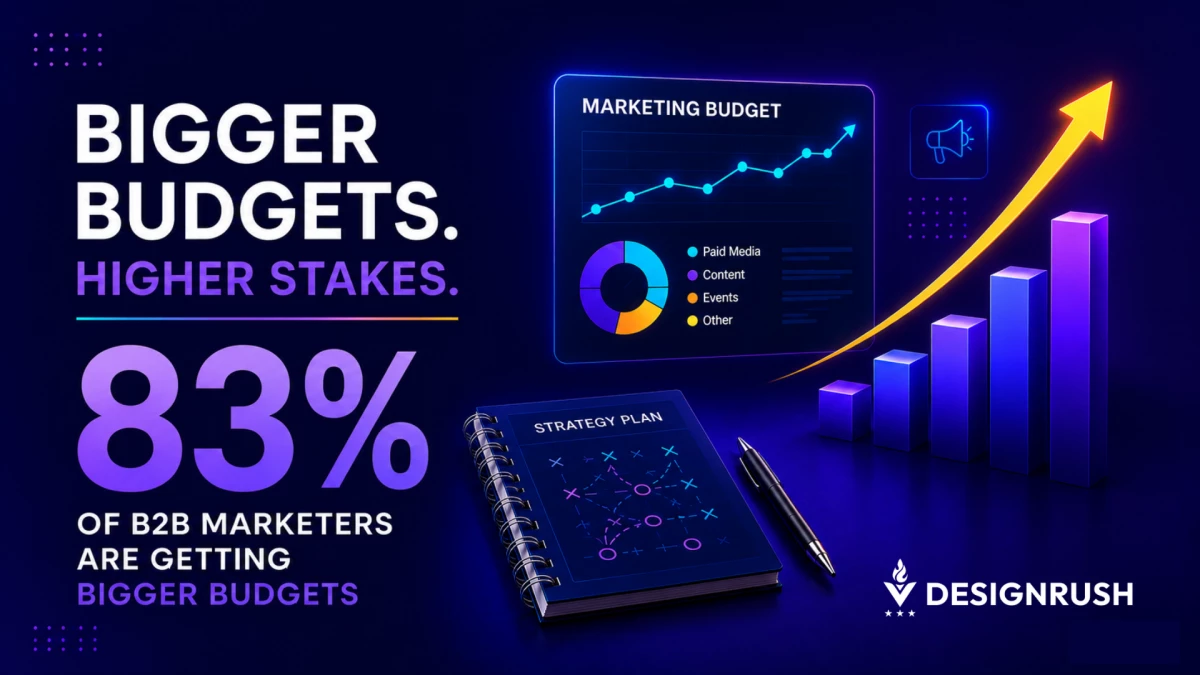
A staggering 83% of marketing leaders expect their budgets to increase this year, per Forrester’s Budget Planning Guide for B2B marketing executives.
On the surface, that sounds like a massive win. More money should mean more pipeline, more market share, and happier sales teams.
But as money pours back into the market, we are seeing a historic consolidation of ad spend.
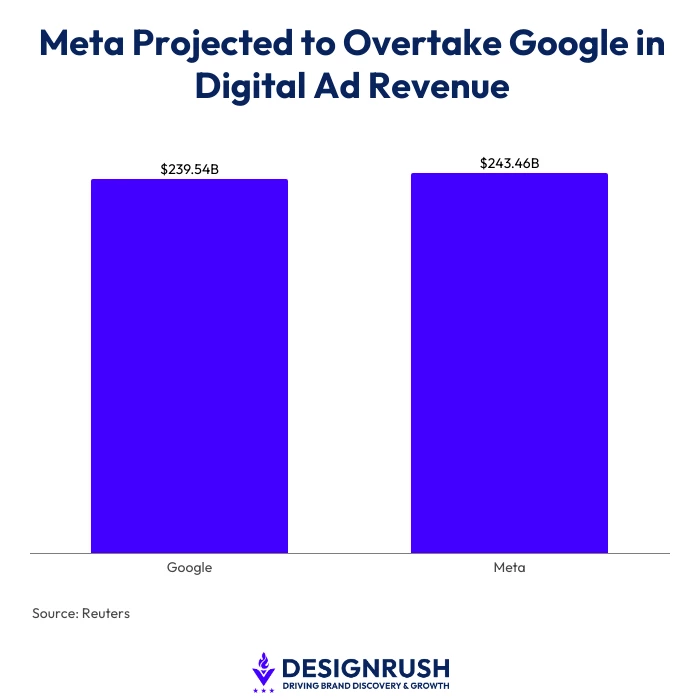
Reuters reports that Meta is projected to surpass Google in digital ad revenue for the first time, reaching $243.46 billion compared to Google’s $239.54 billion.
To capture this spend, these platforms have fully automated their delivery networks.
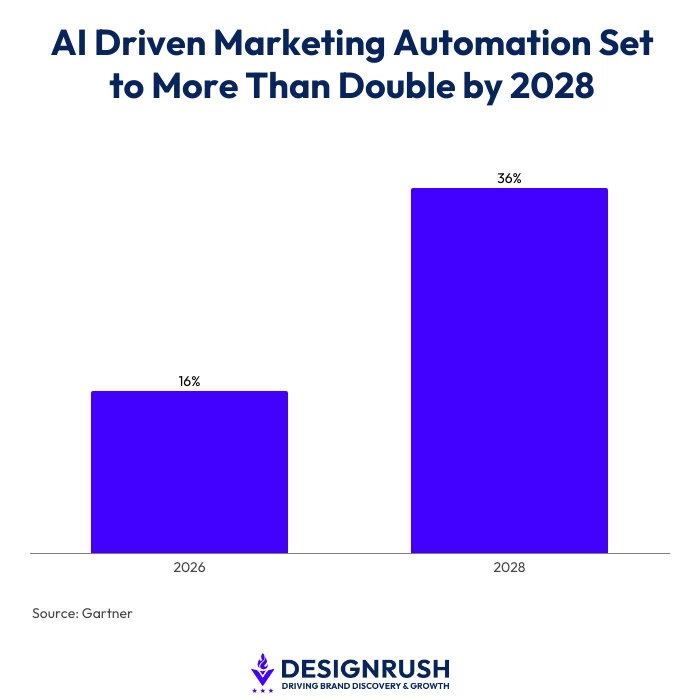
Insights by Gartner shows that AI-driven automation of marketing tasks is set to more than double, jumping from 16% in 2026 to 36% by 2028.
If you are running a business, having more money to spend in an automated, low-click world is a dangerous double-edged sword.
More spending without a rock-solid, written strategic vision simply means you are going to burn through your budget faster than ever.
Why Bigger Marketing Budgets Don't Create Competitive Advantage
The temptation with bigger budgets and smarter platforms is to let the algorithms do the heavy lifting. Platforms like Meta’s Advantage+ automated ad suite have gained massive adoption because they make launching campaigns incredibly easy.
When discussing Meta’s growth, Emarketer Principal Analyst, Max Willens, explained that in surpassing Google, Meta has essentially had many of its core strategies validated.
But there is a massive difference between efficient campaign execution and profitable brand growth.
When you hand your budget over to fully automated ad networks without a clear strategic boundary, you fall directly into what Gartner calls an AI competency trap.
Kristina LaRocca-Cerrone, VP analyst at Gartner’s marketing practice, warned of a widening split among marketing leaders, stating that AI experimentation has become table stakes.
What’s emerging now is a widening gap between CMOs who are still testing use cases, and those who are confident enough to use AI to create real brand differentiation.
Those who fail to make that shift risk blending into a sea of sameness.
If your marketing strategy is just to spend more on automated platform ads, you are going to look exactly like your competitors.
The machine learning models will optimize your budget for clicks and views, but they won't build a unique brand that customers actually seek out by name.
The Death of the Click and How AI Search Breaks Our Measurement Models
For more than two decades, marketing has relied on a simple, comfortable bargain with executive leadership. If we can prove that buyers clicked on our ads or visited our website, then our marketing is working.
Because of this, dashboards are completely dominated by engagement metrics.
Forrester’s analysis reveals that eight of the top 12 criteria used to judge marketing are built entirely on proof of direct buyer engagement, things like marketing-sourced leads and web traffic.
But when buyers use generative AI tools to research business software or services, they get complete, direct answers right on the search page. They don't need to click through to your website, download your whitepaper, or fill out your form.
Ross Graber, VP and principal analyst at Forrester, warns that B2B marketing leaders are already seeing web traffic and lead volumes drop by 20% to 30% because of this zero-click behavior.
This creates a terrifying paradox for marketers.
Your campaigns might be doing a fantastic job of building brand preference and getting your company recommended by AI search engines, but that influence won't show up on your Google Analytics dashboard.
If your board evaluates marketing success using legacy engagement metrics, your highly effective strategy will look like a failure.
How to Build a B2B Marketing Strategy for the AI Era
When platform data becomes volatile and web traffic drops, executive rooms panic.
Without a stable anchor, leadership teams fall into a highly reactive cycle, including changing campaign goals, swapping agencies, or slashing budgets the moment a monthly lead target is missed.
The only way to survive this transition is to establish a written, formalized Strategic Vision Document signed by the CEO, CFO, and CMO. This isn't a fluffy mission statement, but a hard operational contract that protects your budget from panic-driven decisions.
A high-yield Vision document must codify three specific rules:
1. Agree on Down-Funnel Business Contribution
Agree that marketing will be evaluated on pipeline value, customer acquisition costs (CAC), and sales velocity, not on volatile top-of-funnel clicks or website traffic.
2. Define Demand Creation vs. Demand Capture
Explicitly separate your budget into two buckets. Document which campaigns are built to build long-term buyer preference (which AI search will obscure) and which are built to capture immediate, active searchers.
3. Establish Platform-Agnostic Benchmarks
Decide upfront how you will measure marketing's impact when buyers don't click. Commit to running lift studies and customer surveys rather than relying strictly on platform-reported attribution dashboards.
If you are currently managing an increased budget, stop testing more ad formats and start restructuring how your marketing department operates.
How to Reallocate Your B2B Marketing Budget for AI-Driven Growth
Insource Your Data and Narrative
Do not outsource your customer data, your brand positioning, or your strategic vision to an agency. Keep those elements strictly internal. Your external partners should be used as an elastic execution layer, not your strategic brain.
Bridge the Gap Between Sales and Media Buyers
Set up a rigid weekly feedback loop between your sales development reps and your paid media managers. If your sales floor reports that lead quality is dropping, your media buyers must adjust the conversion signals inside the ad platforms immediately.
Invest in Skill Preservation
To keep your internal team from falling into the sea of sameness, actively fund external education and cross-industry masterminds. If you don't invest in keeping their strategic skills sharp, your brand will pay the price of their obsolescence.
The combination of larger B2B budgets and highly automated ad networks means that unstructured, reactive marketing is more expensive than it has ever been.
Long-term market profitability does not belong to the brands with the largest spending power, but to the organizations that have the discipline to back their budgets with an unyielding, documented strategic vision.