
Key Takeaways:
- Middleware solutions for ERP integration often lead to costly sync failures and reduced performance.
- Building your own ERP integration offers better control, stability, and long-term cost savings compared to middleware.
- Building a native ERP connector ensures flexibility and alignment with business growth, avoiding third-party delays.
For fast-growing eCommerce businesses, integrating an Enterprise Resource Planning (ERP) like Epicor Prophet 21 (P21) is a must-have for managing inventory and orders.
But because ERPs are complex, using third-party middleware to handle data often leads to problems. Connectors may not meet business needs, resulting in sync errors and delays.
This is why ecommerce agencies, like Bighorn Web Solutions, recommend building your own ERP integration, especially when complex eCommerce platforms are involved. Because plug-and-play tools may encounter issues with platforms like Magento.
“Owning the implementation aligns your integration with your roadmap,” said Bighorn Web Solutions CEO Caleb Bradley.
Editor’s note: This is a sponsored article created in partnership with Bighorn Web Solutions.
He outlined three reasons why building your own ERP integration makes more sense than relying on third-party middleware solutions:
1. Complete Control Over Your Integration
By building an in-house ERP integration, businesses can take full control of how data flows. This makes it easier to customize the system to fit business needs.
This is particularly important for complex ERP systems like Epicor Prophet 21 (P21), where off-the-shelf integrations often fall short in performance, reliability, and flexibility.
While middleware solutions are built to handle many different use cases and platforms, they often don’t fit the specific needs of business processes.
“That generalization creates an unavoidable gap: your business processes are specific, but your integration isn’t.
Owning your ERP integration, especially when building it natively within your eCommerce platform like Magento, offers significant advantages over relying on third-party middleware connectors,” Bradley said.
From a technical perspective, building the connector directly inside Magento gives you full control and key advantages, such as:
- Customizing how products, prices, orders, and inventory are synced.
- Avoiding confusing third-party software, so teams can fix issues, make updates, and improve the system as needed.
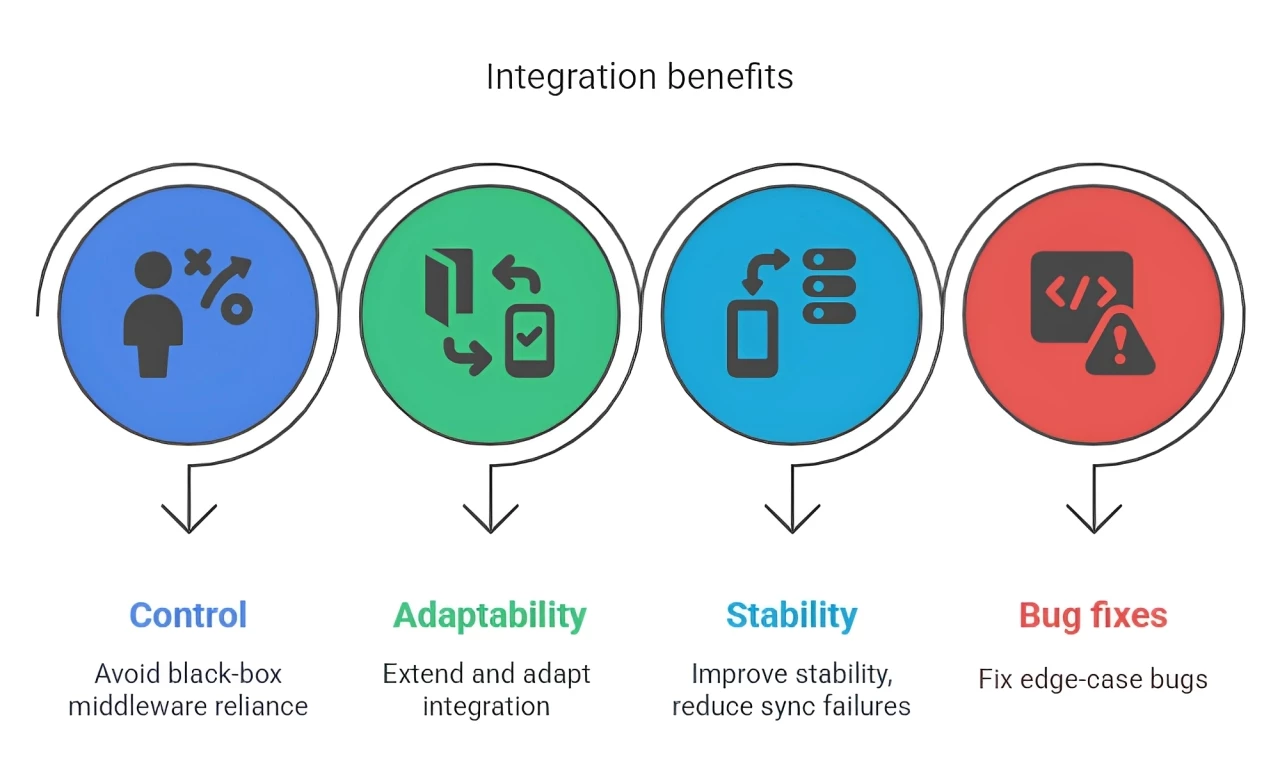
The solution is to build a native ERP connector inside your eCommerce platform to control data, avoid sync issues, and grow on your own terms.
2. Lower Long-Term Costs and No Surprise Fees
Middleware might seem like the easy choice at first, but it comes with ongoing subscription fees, usage charges, and extra costs for features that should be standard.
“These recurring costs compound over time, often exceeding the upfront investment it would take to build and maintain the connector in-house,” Bradley said.
Simply put, you’ll be renting a connection you can’t customize. But with an in-house connector, the only cost is the development and maintenance time.
3. Alignment with Business Growth
Owning an in-house ERP integration ensures the system grows with the business, rather than relying on a vendor’s timeline.
“Whether you’re scaling to new regions, adding features like customer-specific pricing, or improving speed-to-ship by optimizing fulfillment logic, a self-owned connector ensures that your ERP and eCommerce platform evolve in lockstep,” Bradley explained.
This approach allows businesses to set their own pace for upgrades and optimizations. And for teams that view their tech stack as a key advantage, the ability to adapt quickly is crucial.
The main takeaway? Owning the ERP integration puts businesses in the driver’s seat, allowing growth and flexibility without relying on third-party solutions.