
Key Takeaways:
- The shift from Skype to Teams highlights the growing demand for all-in-one communication solutions that streamline workflows.
- Businesses must continuously evolve their products to stay competitive, as even popular platforms can lose relevance.
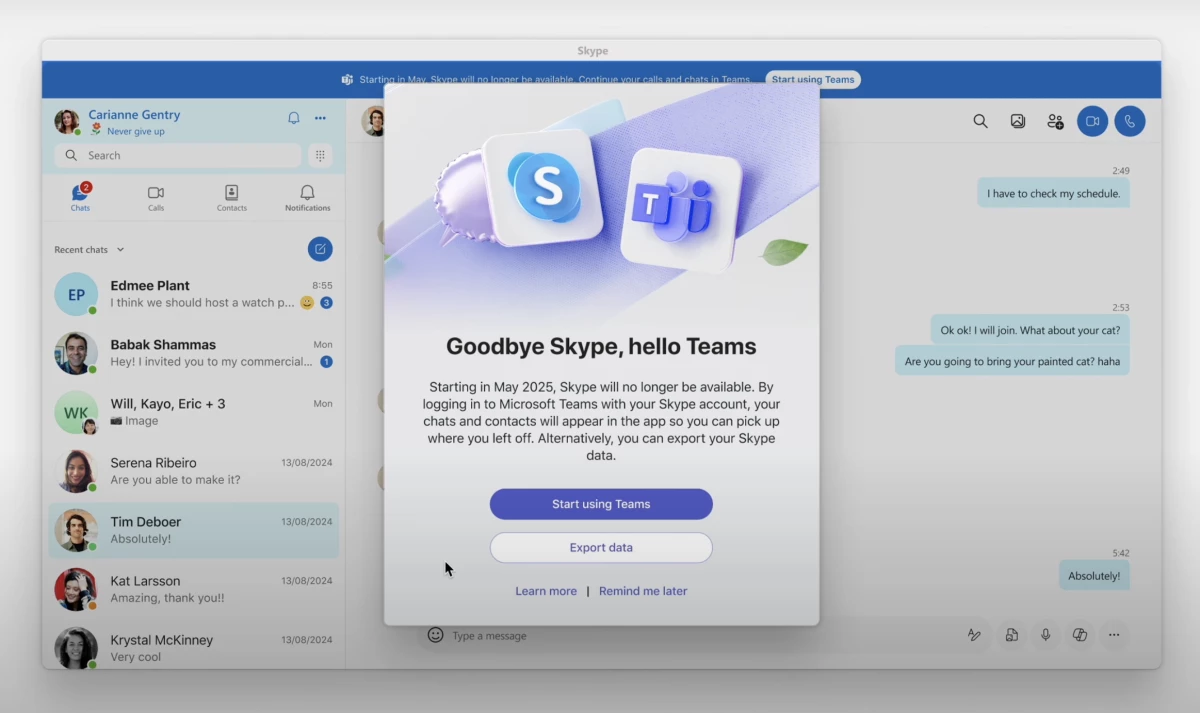
Microsoft has announced that it will retire Skype after a 14-year run with the tech giant.
The service will officially shut down on May 5, and Skype users are encouraged to migrate to Microsoft Teams.
Starting in May 2025, Skype will no longer be available. Over the coming days you can sign in to Microsoft Teams Free with your Skype account to stay connected with all your chats and contacts. Thank you for being part of Skype pic.twitter.com/EZ2wJLOQ1a
— Skype (@Skype) February 28, 2025
Skype was launched in 2003 and was a pioneer in internet-based voice and audio communication.
It was acquired by Microsoft in 2011 for $8.5 billion. However, it saw a massive decline in relevance in recent years.
Jeff Teper, president of Microsoft 365 collaborative apps and platforms, shared with CNBC the reason for the shutdown:
“We’ve learned a lot from Skype over the years that we’ve put into Teams as we’ve evolved teams over the last seven to eight years.
But we felt like now is the time because we can be simpler for the market, for our customer base, and we can deliver more innovation faster just by being focused on Teams.”
Users will be able to migrate their accounts by signing in to Teams using their Skype credentials, automatically transferring contacts and chats.
Any remaining Skype credits can also be used on Teams.
Meanwhile, those who do not wish to move to Teams will be able to export Skype data at a later date.
Businesses that depend on Skype should start planning their migration to Teams to avoid disruptions and ensure a smooth transition.
Merging communication tools into a single platform reflects a growing demand for efficiency and streamlined collaboration.
This is especially true in a digital-first world where users don’t want the inconvenience of juggling multiple single-purpose apps.
End of an Era
In 2017, Microsoft launched Teams, which overlapped with many of Skype’s functionalities and was more widely adopted, especially by corporations for internal communication.
Skype was also unable to capitalize on the growth of digital communication during the pandemic, further diminishing its market position.
Pour one out for Skype. I only use it now to call my parents every Saturday, but for a time there, it was an important tool in my toolbox.https://t.co/SgAimlEUUEpic.twitter.com/pwDfVbP813
— Richard Seroter (@rseroter) February 28, 2025]
Overall, Microsoft's move underscores the importance of staying ahead in tech innovation.
Even well-established platforms can lose relevance if they fail to adapt to market changes and evolving user expectations.
Companies that prioritize agility and proactive innovation stand a better chance of maintaining longevity.
Skype is shutting down?
— Creature Author (@CreatureAuthor) February 28, 2025
While I knew the day would come... It's still sad. A lot of good memories there in an era when it was needed the most. pic.twitter.com/jsyAILsoRH
Additionally, the decline of Skype serves as a reminder that brand awareness and recognition alone aren't enough to guarantee success.
Continuous improvement of user experience and alignment with user needs are critical for long-term success.
This isn’t the only surprising announcement Microsoft has made this week.
Recently, the tech giant canceled several of its data center leases to slow down its AI expansion.