
Key Takeaways:
- Microsoft’s Majorana 1 chip introduces a new quantum architecture that overcomes qubit instability, a major barrier to mainstream quantum computing.
- The chip’s unique design makes large-scale, stable quantum computing more practical.
- This breakthrough has the potential to revolutionize industries like business, advertising, medicine, and environmental science through big-data analysis.
Quantum computing has long been touted as the future of technology, but one major hurdle has kept it from becoming mainstream: the instability of quantum bits or qubits.
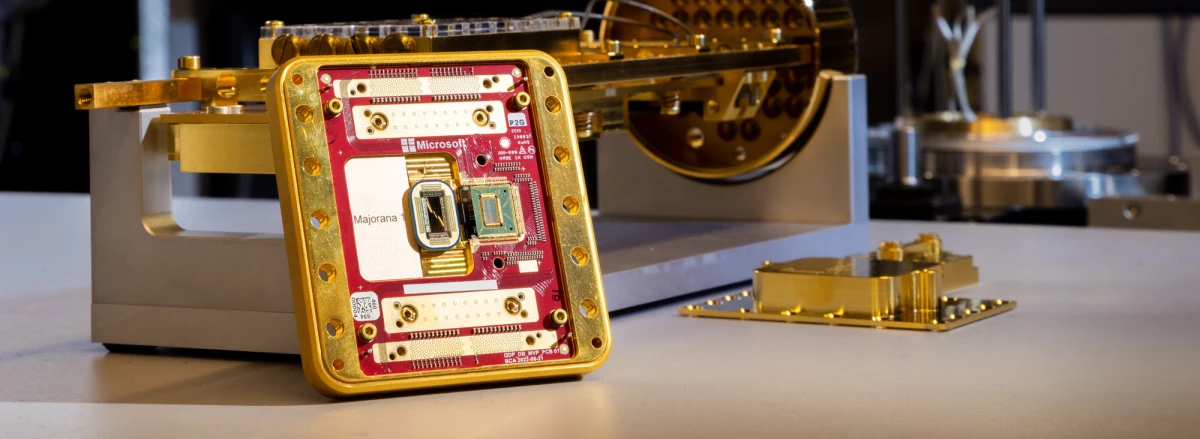
Microsoft has just unveiled a breakthrough that could solve this problem: Majorana 1, a new chip that operates on a completely new type of quantum architecture called the Topological Core.
Unlike traditional computer chips that use silicon-based transistors, Majorana 1 is built using an entirely new material called a "topoconductor."
View this post on Instagram
This enables the chip to generate and control particles known as Majoranas, which provide a more stable and reliable way to process quantum information.
What makes this even more groundbreaking is that Microsoft has effectively discovered a new state of matter — not a solid, liquid, or gas, but a topological state.
This stability enables scaling quantum computers to the million-qubit level, which experts say is necessary to tackle real-world industrial and scientific problems.
Why This Matters
The potential applications of a million-qubit quantum computer are staggering, particularly in business and advertising.
Brands could use quantum-powered AI to optimize marketing strategies in real time, hyper-personalize customer experiences, and solve complex logistical challenges at unprecedented speeds.
By simulating consumer behavior and market trends with extreme precision, quantum computing could revolutionize advertising efficiency, product development, and even supply chain management.
This could then lead to smarter, data-driven decision-making across industries.
Beyond this, its most important use may be in the fields of medicine, engineering, environmental science, and agriculture.
To unlock these possibilities, quantum computers need a stable and scalable foundation — something Microsoft’s Majorana 1 chip can provide.
Traditional quantum computers require fine-tuning and analog control of each qubit, which limits how large they can grow.
View this post on Instagram
However, Microsoft's new approach allows qubits to be controlled digitally, simplifying how quantum computing works and making it more practical for large-scale use.
With Majorana 1, it is evident that quantum computing may soon become a reality that could reshape most industries.
This shift brings quantum computing closer to real-world applications, bridging the gap between experimental technology and transformative business solutions.
Meanwhile, last December, Google already launched Willow, its most advanced quantum computer chip yet.