
Buyers need a reason to remember your content.
In fact, Gartner found that 65% of consumers believe brands are producing too much AI-generated content.
Another 57% say it has made them less trusting of brand messaging overall.
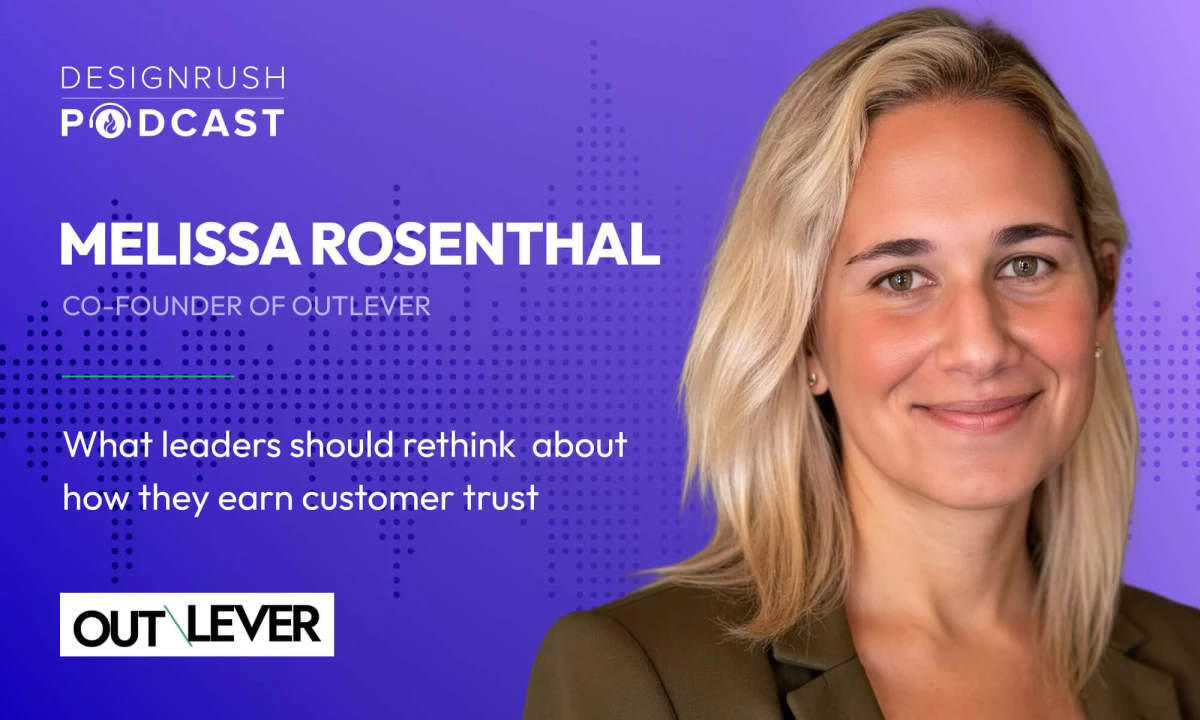
I spoke with Outlever Co-Founder Melissa Rosenthal on the latest DesignRush Podcast about why many brands mistake constant activity for real customer attention.
Rosenthal believes that many B2B companies are already falling into that trap.
She explains what leaders should examine before filling another editorial calendar.
That starts with who controls access to their audience and whether the brand stands for something that customers can identify with.
This view comes from a career that started during BuzzFeed’s early growth, continued at Cheddar, and later took her to ClickUp as Chief Creative Officer.
On where B2B content is heading, Rosenthal is blunt:
"It's written for no one, and it says nothing."
Watch the full episode on YouTube or listen on Spotify.

Who Is Melissa Rosenthal?
Melissa Rosenthal is Co-Founder of Outlever and previously served as Chief Creative Officer at ClickUp, CRO and EVP at Cheddar, and Global VP of Creative at BuzzFeed.
Her experience covers media, advertising, B2B software, creative leadership, and audience ownership.
Start With a Reason for Someone to Care
Rosenthal’s concern is not the publishing frequency itself.
The problem appears when companies fill editorial calendars without deciding who the content is for or why anyone would pass it on.
Her BuzzFeed experience taught her to judge content through human behavior.
"What is the trigger in which that person would actually send that content to someone in their Slack or their email or their WhatsApp group?" Rosenthal asks.
Before approving another article, executives can ask whether the intended reader would send any part of it to a colleague.
If the answer is unclear, increasing output does little to fix the underlying problem.
DesignRush recently examined why mass content production can hurt search visibility when companies publish pages that repeat what already exists elsewhere.
Rosenthal sees another issue inside B2B teams. She says many marketers operate from a checklist and rarely question why they are following it.
Her background in content and virality meant she entered ClickUp without the usual B2B assumptions.
Marketing leaders need to decide what content is for before it goes on the editorial calendar.
Each piece needs a defined reader, a useful idea, and a reason to exist.
Know Who Controls Access to Your Audience
Rosenthal had already seen what can happen when a company depends heavily on distribution it does not control.
At BuzzFeed, the audience became increasingly dependent on Facebook and other platforms for distribution.
When these platforms changed what users saw, traffic fell.
"We started to lose traffic when platforms would make algorithm tweaks."
Her conclusion about the relationship was blunt: "They had all the power, and we didn't."
Companies that rely on outside platforms face the same dependency.
A company may have search traffic, followers, impressions, or website visitors.
How many of those people would still know where to find the company if an outside platform changed how distribution worked tomorrow?
The lesson is not to abandon outside channels.
Leaders need to understand whether these channels are creating a lasting connection with customers or simply supplying temporary access to them.
Give Buyers Something They Can Associate With You
Rosenthal eventually brings the problem back to the company itself, and she says leaders should be able to answer four basic questions:
- Who are we?
- What's our perspective?
- What do we care about?
- What do we stand for?
The answers to these questions affect what a company publishes and whether customers associate it with an idea they recognize.
Customers decide fast, too.
DesignRush recently reported that 69% of customers give brands five seconds or less to capture attention, based on Adobe's 2026 consumer research.
Rosenthal points to a second reason that company identity is important.
She says product features can now reach parity within months, which limits how much features alone separate one business from another.
This leaves executives with a harder question: When customers encounter your company, what idea should they associate with it?
The full conversation goes much further.
Rosenthal also discusses:
- Why ClickUp spent $5M+ on a Super Bowl campaign
- How a $250,000 in-house ad saw 99% positive sentiment
- Why she warned ClickUp to expect 5% to 7% negative sentiment from polarizing ads
- How a five-minute CBS feature sent ClickUp traffic soaring
- Why B2B marketers should question rigid checklists and rented distribution