
As many as 97% of marketing leaders use AI in their daily creative work, according to Canva’s 2026 State of Marketing & AI report.
Yet 41% say brand intuition and creative judgment are among the things AI will never fully replicate.
ForeFront Web sees that problem in work for clients across healthcare, legal services, financial services, housing, and insurance, where changing a few words can change what a business appears to promise.
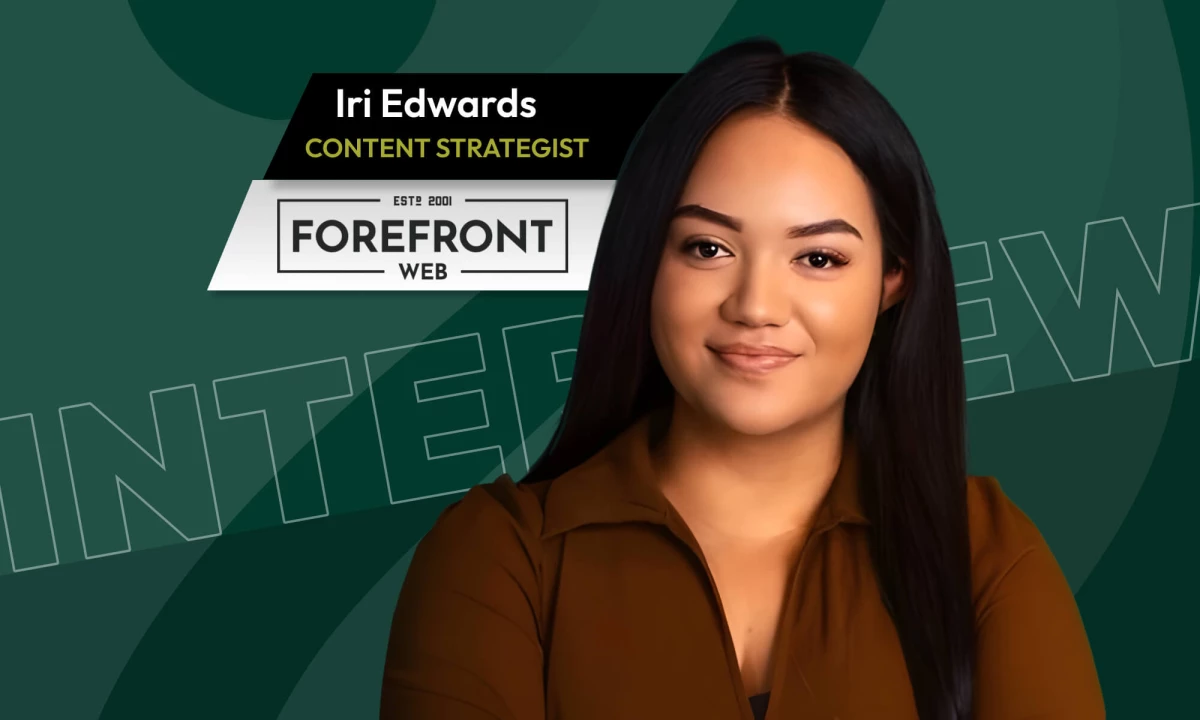
"Getting a draft used to take a lot longer, but with the advent of AI, you can have something on the page almost immediately," says Iri Edwards, Content Strategist at ForeFront Web.
"The problem is that the writer still has to work out whether it’s right, whether it fits the client, and whether it should be there at all."
In this DesignRush interview, Edwards discusses why she spends much of her time working out what needs to be said before writing starts, then checking what survives once there is a draft to review.

Who Is Iri Edwards?
Iri Edwards is a content writer and marketing strategist at ForeFront Web, an award-winning digital agency in Dublin, Ohio, specializing in web design, development, and digital marketing.
Originally from Whangārei, New Zealand, she began her career at Deloitte New Zealand before working in international relations in Medellín, Colombia, experiences that shaped how she approaches business, audience needs, and cross-cultural communication.
What Content Briefs Miss About Customer Context
Edwards starts by talking through how the business actually works.
She asks what customers tend to bring up on calls and whether there are claims or phrases the company has learned to be careful with.
Sometimes the detail that changes the assignment comes up almost casually.
A client might mention a group they have struggled to reach or wording that caused a compliance problem before.
"A brief can tell you what someone thought the project needed when they sat down to write it," Edwards adds.
"But you typically learn more once you start talking to people, with some of the most useful things coming up almost in passing."
She also wants to know what brought the reader to the page, especially since someone comparing providers is in a very different position from someone dealing with a denied claim or a new diagnosis.
"A client usually knows what they want to say," Edwards says.
"The writer has to look at it from the reader’s side too. What does this person actually need to understand? Can the business stand behind what we’re saying, and does it sound like them?"
Technical writer Federico Marafin explains why audience context and direct feedback need to shape written content:
Where AI Content Loses Critical Context
In regulated industries, even a small edit can change what a sentence says. Drop a qualifier and “may help” becomes “helps.”
Legal and insurance copy can depend on the jurisdiction or the wording of a policy.
Likewise, financial content needs to avoid slipping from general information into personal advice, while healthcare writing can’t sound more certain or alarming than the facts allow.
"AI can give you a sentence that sounds completely confident even when the wording isn’t quite right or the claim doesn’t hold up," Edwards says.
"That’s the part you have to watch closely, as something can sound completely fine and still not be right for that situation."
Edwards reads the draft against what she heard from the client and what the reader came to the page for.
Sometimes the problem is obvious, but other times, a useful detail has disappeared or the wording has drifted further than the business can support.
Complicated material gets the same treatment, where she takes out what makes it harder to understand and leaves only the parts the reader needs to know.
Her earlier work in international relations in Colombia made that familiar.
A direct translation could be technically correct and still miss what someone meant, especially when the people involved came from different languages and cultural backgrounds.
Her Māori heritage and work around representation and financial inclusion also affect how she thinks about the person reading.
This as the reader may be new to the subject, worried, using a phone, or sitting in a doctor’s waiting room trying to understand something difficult.
"If someone says a sentence sounds too simple, I usually ask who they have in mind when they say that," Edwards adds.
"A lot of the time, they’re imagining someone who already knows what they know."
Humanitarians AI shows why polished AI-generated writing can still contain unsupported or incorrect claims:
How Content Teams Can Scale AI Without Losing Quality
Edwards points to three decisions teams need to make as they produce more content with AI:
1. What needs another set of eyes
Some claims may only need a source check. Others may need someone with legal, compliance, or subject-matter expertise to review them.
2. Who makes the final call
Teams need to know who can approve the work and who can stop it from being published.
3. Where AI stops
Decide which parts of the work AI can help with and where someone needs to step in and make the judgment.
That gives the team something more reliable than hoping the right writer or editor happens to catch a problem before publication.
"One writer can catch a problem on one page, but if you’re doing this over and over, you need everyone to know what they’re checking and why," Edwards says.
"AI can get you to a draft faster, but someone still has to look at the work, understand what’s at stake, and decide whether it actually holds up."