
McDonald's Netherlands 'Shortcuts' Campaign: Key Findings
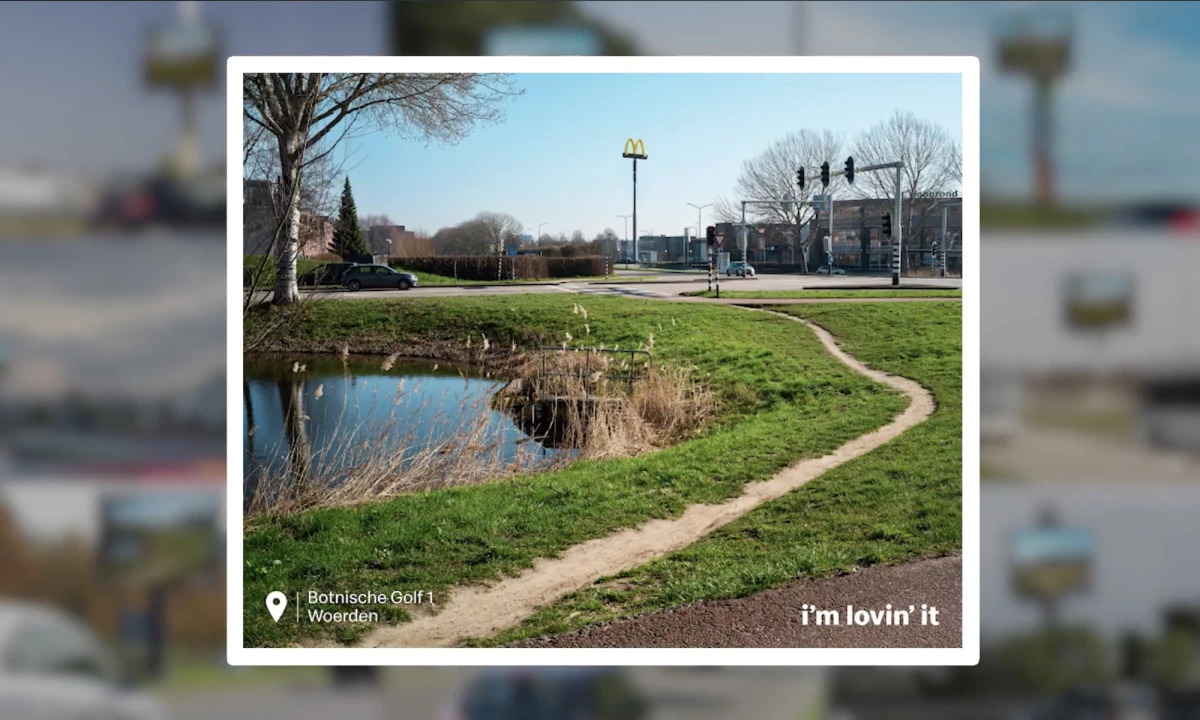
- The chain mapped real, unofficial shortcuts to its restaurants using open map data, then photographed them for print and OOH.
- The initiative is running across five Dutch cities, including Eindhoven, Almelo, and Lemmer.
- Every shortcut was documented as it exists in real life, with no invented imagery, constructed scenarios, or added design.
McDonald's Netherlands has launched a print and outdoor campaign built on how people have already carved shortcuts to its restaurants.
Working with TBWA\NEBOKO and OMD Netherlands, the chain used open map data combined with its restaurant locations.
They identified unofficial footpaths formed over time as people chose the quickest way to the restaurant.
These formed walkways were then turned into billboards across Dutch cities, including Almelo, Eindhoven, Venray, Woerden, and Lemmer.
Each execution features a single photographed shortcut leading directly to a nearby restaurant, with no additional design or construction.
The campaign arrives months after McDonald's Netherlands pulled its fully AI-generated Christmas ad due to backlash over uncanny visuals.
This time, the fast-food giant avoids synthetic imagery entirely, focusing instead on work rooted in real-world execution.
Open Data and Existing Paths
The creative logic behind the campaign is interesting in its own right. The team didn't build a concept and then find a way to execute it.
Instead, the brand identified existing, unofficial routes that people had worn into the ground through repeated journeys to McDonald's.
This is the core concept behind the work, with McDonald's Netherlands CMO Els Dijkhuizen saying in a statement that shortcuts reveal where people genuinely want to go.
Meanwhile, TBWA\NEBOKO Executive Creative Director Erik Falke describes the approach as almost the opposite of the agency's usual process.
He notes that these shortcuts already existed across the country, and the team's job was simply to find and document them.
The data-led approach used here is a practical example of consumer behavior doing the creative work.
A Sharp Contrast to the AI Christmas Mishap
The campaign lands roughly three months after McDonald's Netherlands pulled its fully AI-generated holiday spot.
The decision comes after the intense criticism it received for its unsettling visuals.
Also produced by TBWA\NEBOKO, in collaboration with AI specialists The Gardening.club, was delisted from YouTube within days of going live.
This latest campaign, on the other hand, uses no AI, no constructed scenarios, and no invented visuals.
Instead, it's built entirely from photography of existing paths in real locations.
Whether this is a direct response to the Christmas ad backlash or simply a different creative brief is not confirmed.
But the contrast is obvious, and it reflects how brands are recalibrating creative choices as scrutiny around AI-generated work grows.
The campaign offers a few principles worth applying across OOH and print:
- Use data to find the story: Open map data revealed a consumer behavior that fieldwork alone could not have surfaced as efficiently.
- Hyper-local executions build credibility: Running city-specific shortcuts means each execution is verifiable to the people who live there.
- Restraint is a creative decision: The imagery and execution carry the message on their own.
When the behavior already exists, the job is to make it visible, and this campaign does exactly this without adding anything the data didn't already tell them.
Our Take: Does Found Creative Actually Work at Scale?
We think it works well here, and the simplicity is the point.
McDonald's Netherlands has spent the past year experimenting at the edges of what a fast-food brand can do creatively, from AI production to cybersecurity awareness campaigns.
We think that the "Shortcuts" campaign is the most quietly confident of the three.
It asks the audience to do very little interpretation, which is exactly what good outdoor advertising should do.
Brands using data-led outdoor and print campaigns need agencies that understand how to translate consumer behaviour into creative strategy.
Check out the top creative agencies in our directory.