
McDonald's ‘Happy Doggy’ Pet Campaign: Key Findings
- McDonald’s France launches Happy Doggy, a four-piece dog toy collection inspired by its most iconic products, as pet parenting rises among younger consumers.
- DDB Paris grounds the campaign in real pet-owner behaviors, positioning McDonald’s within the daily routines of Gen Z pet-inclusive households.
- The drop functions as a low-risk cultural and product test, reflecting how QSRs are adapting to shifting definitions of family and expanding pet economies.

Campaign Snapshot
Globally, 45% of Gen Z say their pet is the "most important thing in their life," according to Mars’ Global Pet Parent Study.
To attract passionate pet owners, McDonald’s France is trying something new: selling dog toys.
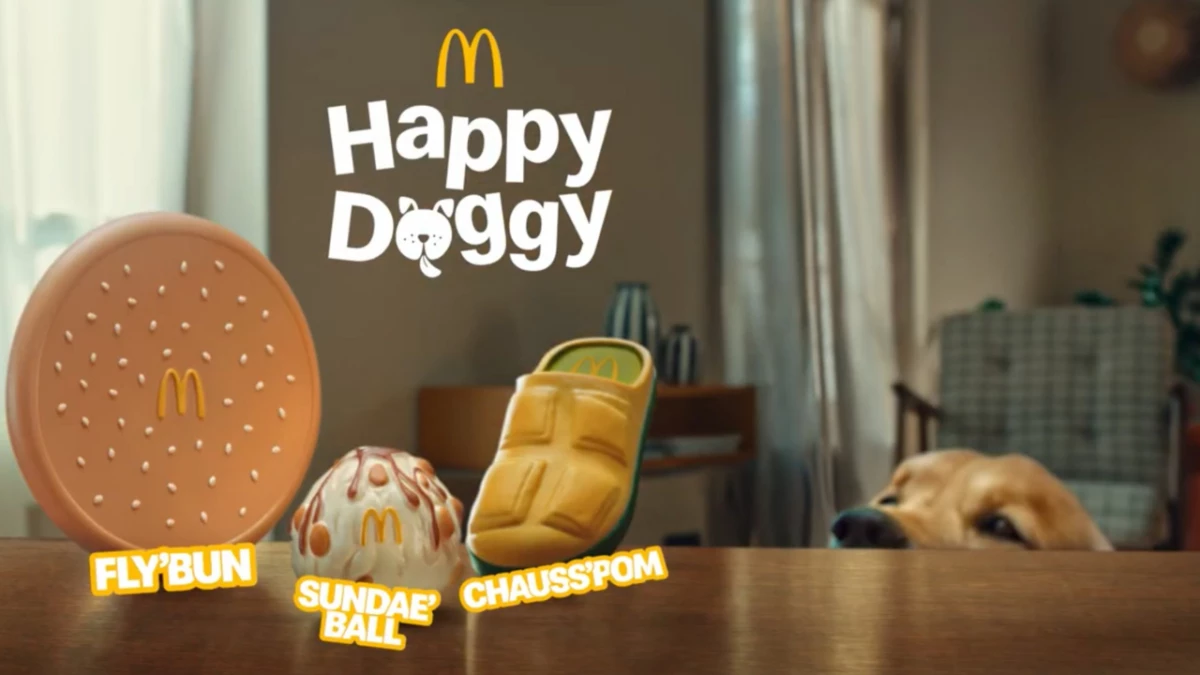
Launched in France on Nov. 27, 2025, the Happy Doggy collection features four chew toys, each inspired by popular menu items:
- Fun’Fries, echoing the classic French fries
- Chauss’Pom, a nod to McDonald’s apple pie
- Fly’Bun, shaped like the bun of its signature burgers
- Sundae’Ball, a ball inspired by the brand’s well-known sundae
-content-large-webp.webp)
With the purchase of a meal upgrade, patrons get to take home a novelty pet toy (while supplies last).
Created in partnership with DDB Paris, a long-time partner of McDonald's, this toy collection campaign is more than just a product drop.
For McDonald’s, it's a clever way to connect emotionally with a new subset of consumers (pet-loving Gen Z).
At the same time, it reinforces the fast food chain's role in family life.
As for brands and marketers? This approach teaches a creative lesson on staying relevant by aligning with your audience's evolving values, identities, and lifestyles.
How McDonald’s Brought ‘Happy Doggy’ to Market
McDonald’s spent nearly a century mastering fast food.
Tossing in a surprise with a meal? That’s nothing new; just ask anyone who’s had a Happy Meal.
But Happy Doggy is something new. It’s the brand’s first venture into pet products.
The toys are available for an extra €3.50 with a Maxi Best Of menu.
McDonald's France just launched one of my dream campaigns: the first ever collection of McDonald's toys for dogs available in restaurants.
— Guillaume Huin (@HuinGuillaume) November 27, 2025
The campaign is called "Happy Doggy". You can get a dog toy by buying a meal and adding roughly 3 euros. pic.twitter.com/a7OdGu0W6b
To make the new offer land, McDonald’s France had to build early buzz and drum up awareness.
After all, if someone’s asked, “Would you like a pet toy with that?”, they shouldn’t be caught off guard.
Here’s how the brand got the word out before launch.
1. Create Urgency
Before launch, McDonald's launched just one toy Fun’Fries (from Nov. 27 to Dec. 1) as an exclusive offer through the McDo+ app to drive mobile engagement.
After that, three of the toys (Chauss’Pom, Fly’Bun, and Sundae’Ball) were available in restaurants as part of the meal upgrade.
2. Distribute Everywhere That Matters
When the campaign debuted in France, distribution spanned multiple touchpoints.
To build awareness beforehand, the launch was supported across TV, digital, out-of-home, and social media.
Overall, it was a straightforward rollout, but smart in how it used an omnichannel approach to capture consumers across both digital and in-store touchpoints.
3. Make It Familiar and Fun
Inspired by McDonald’s menu items, the Happy Doggy pet toys are designed to trigger instant brand recall.
That way, they'd feel like a natural extension of the brand, while also providing a take-home treat for consumers to use daily.
The importance of achieving visual familiarity may seem obvious, but it can be make or break.
Nike did it well when it shifted into wearables and gear.
Why? The design stayed true to its identity, making the shift feel seamless.
4. Designing for Behavior, Not Just Branding
DDB Paris centered its approach on visible, routine interactions between owners and dogs, waiting outside restaurants, and accompanying drive-through visits.
These behaviors informed the design and the distribution strategy: compact items that work for real play, and that also serve as recognizable brand signals in social feeds.
In the company’s announcement, Jean-Guillaume Bertola, CMO of McDonald’s France, explained the intent behind the launch:
"'Happy Doggy' is our way of celebrating those unique bonds and turning each moment into a happy memory.
We are proud that France is the first country to offer this collection, which fits fully within the brand’s DNA while answering our consumers’ expectations."
The marketing campaign aligns with McDonald’s longstanding identity as a family brand.
As France’s definition of “family” expands to include pets as full members, the brand’s presence adapts accordingly without altering its core promise.
A Creative Strategy Built from Real-World Behavior
The Happy Doggy press release underscores how quickly France’s relationship with pets is evolving:
- One in three residents now lives with a dog.
- 69% view pets as full family members.
- Among younger adults, nearly one in two considers their dog the most important living being in their life.
As Europe’s pet-care market continues its steady rise, “pet-first” purchasing is becoming a default behavior for younger households.
For McDonald’s, the Happy Doggy marketing initiative allows the brand to:
- Test demand for pet-focused, non-food items without committing to long-term product lines.
- Expand presence in Gen Z’s daily routines, from errands and meals to social sharing.
- Modernize family positioning to reflect today’s households while keeping the core menu intact.
It’s a light lift for the brand, but one that says a lot about where culture (and customer loyalty) is heading.
McDonald’s isn’t the only legacy brand refining its relevance.
Lay’s has also sharpened its focus on audience behavior to guide its marketing decisions.
Our Take: Does a Small Drop Like This Truly Matter?
It does, and here’s why.
Happy Doggy shows McDonald’s responding directly to the emotional and practical habits shaping its next generation of customers.
The brand isn’t expanding into pet products as a new category.
Instead, it’s extending its universe into moments that already exist between Gen Z pet owners and their dogs.
Understanding how pets influence routines, purchasing, and brand affinity is causing lots of brands to shift and expand.
And from my perspective, McDonald's appears to have nailed it.
See which creative agencies are driving culturally relevant work with the Top Creative Agency at DesignRush.