
Protected endpoints, validated inputs, patched vulnerabilities, and monitored traffic are still the most preferred cybersecurity guardrails.
This approach still holds significance, but it no longer caters to the full picture. Now, applications thrive in connected systems.
They work in more dynamic and AI-powered environments. This changes the way they behave and how they can be attacked.
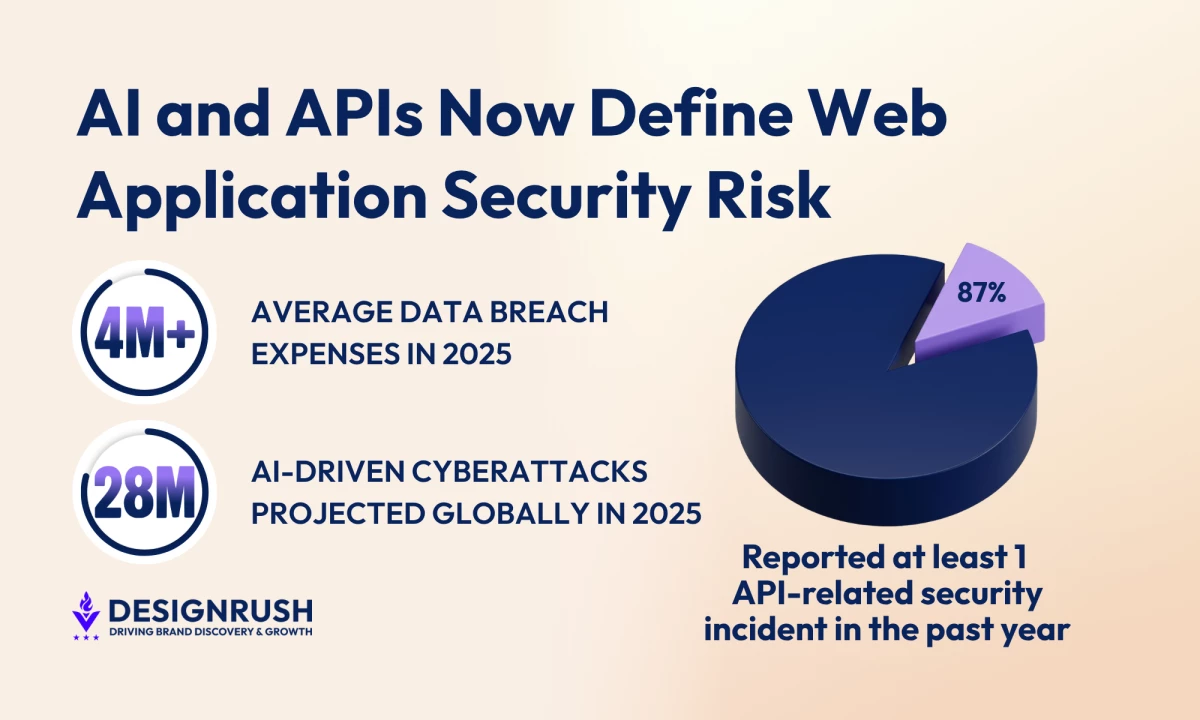
In a 2025 IBM report, it was revealed that data breach expenses crossed the mark of $4 million.
Web applications face a security reality that has changed more in the past two years than in the previous decade.
A total of 28 million AI-driven cyberattacks were projected globally in 2025, according to research by The Network Installers.
Why Does The Old Security Playbook Not Work Anymore
For a long time, security meant keeping systems threat-proof. Secure networks, firewalls, and perimeter defenses sufficed miraculously.
But that model doesn’t hold up anymore because modern web apps rely too much on APIs, cloud services, third-party integrations, and AI-driven features.
Each of these adds a new entry point for security threats. Rather than a single perimeter, you now deal with a distributed environment having multiple layers of exposure.
What’s more concerning is that attackers, too, are using AI to automate and scale their efforts.
Now, they can identify vulnerabilities faster, create more convincing phishing attacks, and adapt their methods in real time.
So, what does this mean? Your security strategies need to evolve hand in hand with your system, not before, and not after.
APIs Have Become the Primary Attack Surface
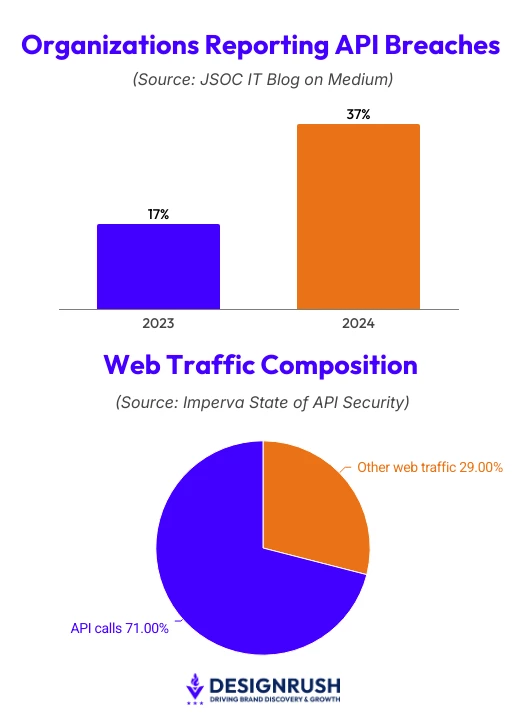
API security problems are still hitting most companies, according to Akamai’s 2026 API Security Impact Study. About 87% of organizations reported at least one API-related security incident over the past year.
API calls account for 71% of all web traffic, as per Imperva's State of API Security Report. This increases the attack surface substantially.
It also reflects a broader architectural change.
Modern web applications are built as distributed systems in which front-end interfaces communicate with back-end services through APIs. Each API endpoint represents a potential entry point.
When those endpoints lack proper authentication, authorization, or input validation, they become exploitable at scale.
AI Introduces New Vulnerability Patterns in Code
AI-generated code has 2.7 times higher vulnerability density compared to human-written code, according to research compiled by SQ Magazine.
The same analysis found that around 40% of AI-generated code snippets contain critical security gaps.
This indicates that AI tools reproduce known vulnerability classes, including:
- SQL injection
- Cross-site scripting
- Insecure deserialization
And all at higher rates than human developers working without assistance.
The reason appears structural.
AI coding assistants are trained on large code repositories, many of which contain security flaws.
When developers use AI-generated code without a security review, those flaws propagate.
SQL injection and cross-site scripting remain among the most frequent flaws in AI code, with AI tools failing to prevent XSS in 86% of test cases, according to the same SQ Magazine research.
The Architectural Question for Custom Applications
There’s a difference between building custom web applications and relying solely on off-the-shelf platforms.
For organizations focused on the former, the security model takes the shape of a design decision, not an operational overhead.
From the choice of the auth mechanism to the structure of API authorization logic or the session management approach, every decision carries long-term implications.
If not addressed from day one of the build cycle, later retrofits won’t just be difficult; they will be expensive.
When a web app isn’t designed on a threat model, tech leaders will be forced to implement security controls reactively.
They get busy with patching vulnerabilities on the go, just because they didn’t architect systems that could resist diverse classes of attacks.
The distinction is between security as remediation and security as architecture.
Security is a design conversation, not a QA checklist.
On every custom application we build at Quixta, the auth model, API authorization logic, and session management approach are defined during architecture and not bolted on before launch.
This is the case whether it’s a property portal with authenticated listings, an eCommerce backend with Stripe payment flows, or an internal ops tool.
When you retrofit security, you're essentially working against your own system's assumptions. It's expensive, and it never quite closes all the gaps
While the former addresses specific flaws after they exist, the latter eliminates vulnerability classes by design. It’s done through parameterized database queries, potent enough to prevent injection.
What’s more, these capitalize on content security policies that block cross-site scripting and zero-trust authorization models to verify permissions on every request.
What This Means for Digital Leaders
Even though AI itself is fundamentally a new technology principle, the vulnerability risks it introduced aren’t.
What it did instead was accelerate the discovery and exploitation of these loopholes.
That’s one of the primary reasons why generating codes with no security and authentication layers is so easy in today’s time.
Every organization aiming to launch highly secure web applications treats security as a core component of the architectural requirements.
What’s more, they capitalize on automated tooling in CI/CD pipelines and conduct regular audits to verify if the controls placed are performing as expected or not.
For technical leaders and CTOs, the question is whether applications already deployed to production were designed after accounting for threat models and risk mitigation or not.
Only then can they assess the damage attacks can cause, now that these products are exposed to vulnerabilities.