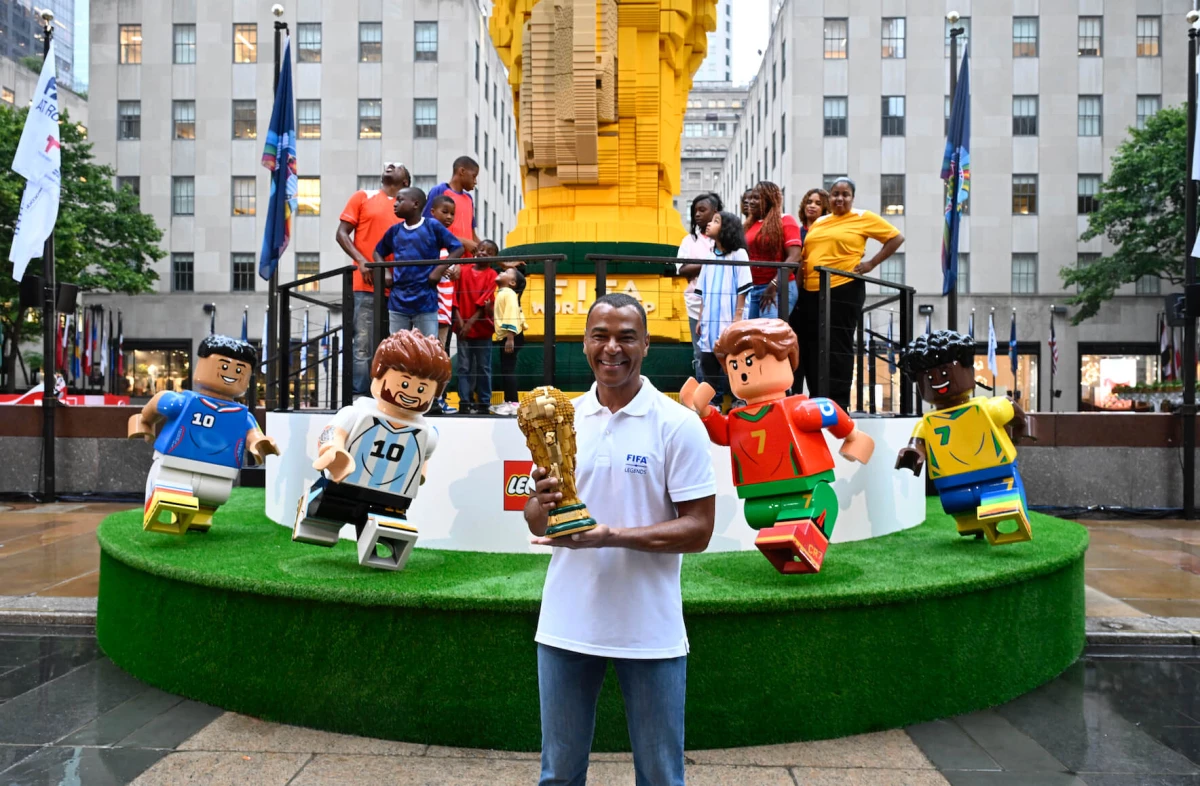

Lego just built a trophy too big to lift.
The toy giant partnered with FIFA to unveil a nearly 27-foot-tall World Cup trophy at Rockefeller Plaza in New York City on July 6, built from more than 1.36 million bricks.
Fifty-nine designers, engineers, model builders and technicians spent eight months and over 7,000 hours assembling the piece at Lego's Kladno Factory in the Czech Republic.
In fact, it was so big and labor-intensive that it had to be shipped to the site in sections.
Lego Senior Designer Christophe Vietti called it the brand's largest mobile build ever to give the FIFA Fan Fest a landmark moment as the tournament heads into its final stretch.
"The goal of the Lego World Cup Trophy is to unite people through the love of football and play," Vietti said.
He added that replicating the trophy's curved, organic shape was the hardest part of the build, forcing the team to get creative with how bricks stacked to mimic its texture.
Notably, the monument was unveiled by football legend Cafu, who was accompanied by a group of fans representing the nations currently competing.
A Trophy You Can Take Home
The giant World Cup trophy activation sits inside Lego's FIFA World Cup Fan Zone at the NYNJ World Cup and Telemundo Fan Village, free and open through July 19.
Visitors can hit interactive building stations, add to a FIFA-themed brick mural, snap photos, and pick up giveaways at the Lego Store on Fifth Avenue.
"We hope the Fan Zone gives fans a place to connect, create and celebrate together," Federico Begher, Lego SVP for Product, Marketing and Development said in a press release.
The giant build and accompanying fan centers aren't a standalone stunt.
It serves as an oversized version of a commercially available 1:1 scale Lego World Cup trophy the brand already sells.
The smaller version is a 2,842-piece World Cup trophy replica that retails for $200.
It stands 14.5 inches tall with two figures holding up the globe and a hidden compartment for a FIFA minifigure.
The lineup also includes a $25 tournament emblem set, a $130 soccer ball, and player-specific builds featuring football stars that also starred in a Lego spot, namely:
- Lionel Messi
- Cristiano Ronaldo
- Kylian Mbappé
- Vinícius Júnior
Make no mistake, this kind of creative rollout is a familiar move for Lego, which tends to show up where culture takes place.
Whether it's a World Cup fan zone or an Olivia Rodrigo album collection, the brand rarely creates its own moment from scratch.
Instead, it opts to attach itself to something with a highly established fanbase, giving their respective communities a playful way to practice their fandom.
Lego's Scale-First Marketing Play
The campaign shows Lego isn't afraid to treat scale as the marketing message, using an oversized public build to generate coverage that a store shelf release never could.
FIFA's licensing and merchandise revenue is projected to hit roughly $397 million in brand value for the 2026 cycle, according to Brand Finance.
Lego's giant trophy establishes the brand squarely inside that spending.
Marketers eyeing similar plays around major sporting events can take a few lessons from this one:
- Create an event out of the product: Lego released a set, but it also built a landmark people have to see in person.
- Give fans a souvenir, not just a photo: Tying the installation directly to a purchasable set allows Lego to convert foot traffic at Rockefeller Center into retail intent.
- Let the free activation do the selling: The Fan Zone's build stations and giveaways cost nothing to attend but keep people in the Lego ecosystem long enough to consider the paid sets.
Lego isn't inventing new territory here; it's applying a formula that's worked for it before.
And that's to find the world's biggest live event and build something too large to ignore.
Our Take: Does Big Mean Grand?
In Lego's case, most definitely.
A trophy nobody can lift is standing right next to one every kid can build at home, and that's precisely what makes the brand's efforts feel magical.
It's selling proximity to the World Cup by giving fans who never got near a match something real to walk up to.
The giant build isn't even the product; it's the billboard for the product.
Most brands cut through these tournaments with flashy content and athlete team-ups.
Lego does that, but doesn't stop with just that.
It built something too big to ignore and let people come to it.
The small trophy will likely outsell the big one, but the big one is why anyone's talking about either.
Looking to turn cultural IP and fandom into product ecosystems?
Find top experiential marketing agencies specializing in experiential and product storytelling to compare execution models across industries.