-details-webp.webp)

AI-Driven Design: Key Findings
- 71% of organizations now use generative AI, earning an average ROI of $3.70 for every $1 invested.
- Digital Silk reinforces that speed and scale should never come at the expense of thoughtful design and user trust.
- The agency helps brands use AI to streamline creative workflows while protecting consistency and human judgment.
The future of creative work isn’t coming, because it’s already here.
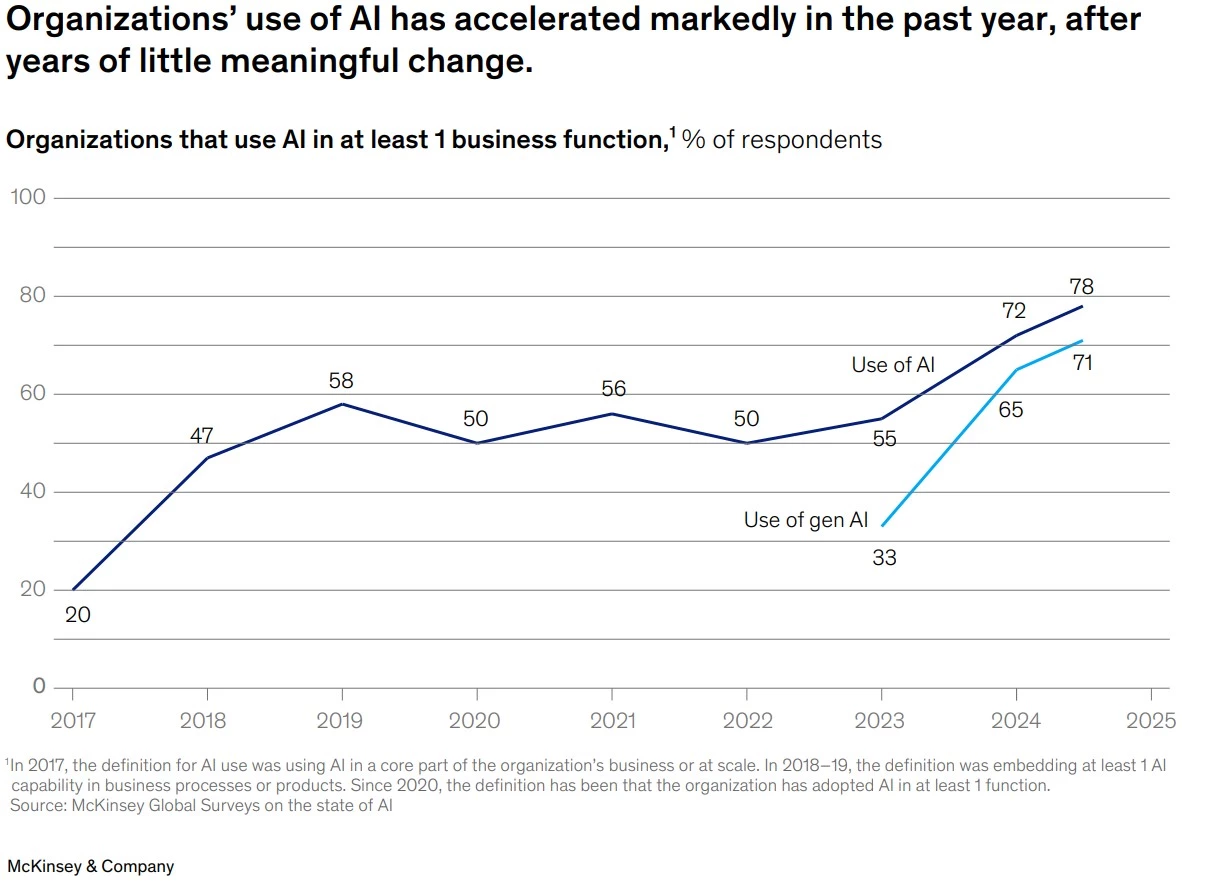
According to McKinsey’s 2025 The State of AI Report, 71% of organizations are now using generative AI. This has led to an estimated average return of $3.70 for every $1 invested.
But as automation takes over routine production tasks, many brands are learning that speed alone isn’t enough to guarantee better outcomes.
Digital Silk argues that design success in the AI era depends on one thing: keeping human creativity in control of machine efficiency.
“AI can generate content faster than ever, but it cannot replace the intuition and emotional depth that define great creative work. The key is to let technology handle the repetitive and mechanical aspects so human talent can focus on the conceptual and emotional core of design,” said Digital Silk CEO Gabriel Shaoolian.
The report also supports this call for balance.
While 78% of enterprises have embedded AI in at least one function and 92% of executives plan new AI investments by 2028, the research also notes that results vary widely depending on how companies implement the technology.
Editor's Note: This is a sponsored article created in partnership with Digital Silk.
Those that pair automation with structure, oversight, and governance see measurable ROI, while others risk inconsistency and creative drift.
Where the Next Phase of AI Maturity Begins
1. Automation That Drives Measurable Impact
A report from Harvard and the University of Pennsylvania shows that productivity gains of up to 40% are now achievable through AI automation in marketing, HR, and customer service.
Offloading repetitive execution can help teams focus on strategy, creativity, and innovation.
Yet automation alone isn’t the differentiator.
Companies that tie these gains to defined KPIs and ROI metrics see the strongest business impact.
Take, for example, AI integration in Google Ads Management.
Shaoolian believes AI is more than just an add-on and is now a core component of campaign execution.
"The data shows that while AI tools can enhance efficiency, human oversight remains critical to ensure accuracy, alignment, and brand safety,” he explains.
2. Human Oversight That Builds Trust
Even as AI adoption accelerates, human review remains essential.
With 70% of new applications now built on no-code and low-code AI platforms, teams that combine AI output with expert oversight maintain accuracy, preserve brand tone, and ensure responsible deployment.
This balance helps prevent errors, bias, and misalignment in customer-facing content.
3. Governance That Sustains Consistency
According to a CIO Dive report, more than 3 in 5 enterprises lack key AI governance policies or are still in the process of implementing said policies.
Without clear documentation for brand tone, data practices, and approval processes, organizations risk inconsistency and reputational damage.
Experts emphasize that building these governance frameworks is key to scaling responsibly.
Structure Turns AI into a Creative Advantage
AI is here to stay, with 72% of companies worldwide using the technology.
Which is why it’s time to learn how to use it with efficiency and integrity.
A new creative process is taking shape, and it’s one that runs on AI tools but is led by people.
The data is clear: automation can transform production, but it’s structure and oversight that turn technology into a long-term advantage.
This is why Digital Silkreinforces structured workflows and human review when implementing AI, ensuring every piece of content aligns with brand tone and operational standards.
When a solid system is in place, AI stops feeling like a disruption and starts functioning as quiet infrastructure by keeping data, design, and decision-making in sync so marketing teams can focus on staying creative.
That’s how organizations turn experimentation into reliable, repeatable performance.