
Generative AI Customer Service Strategies: Key Findings
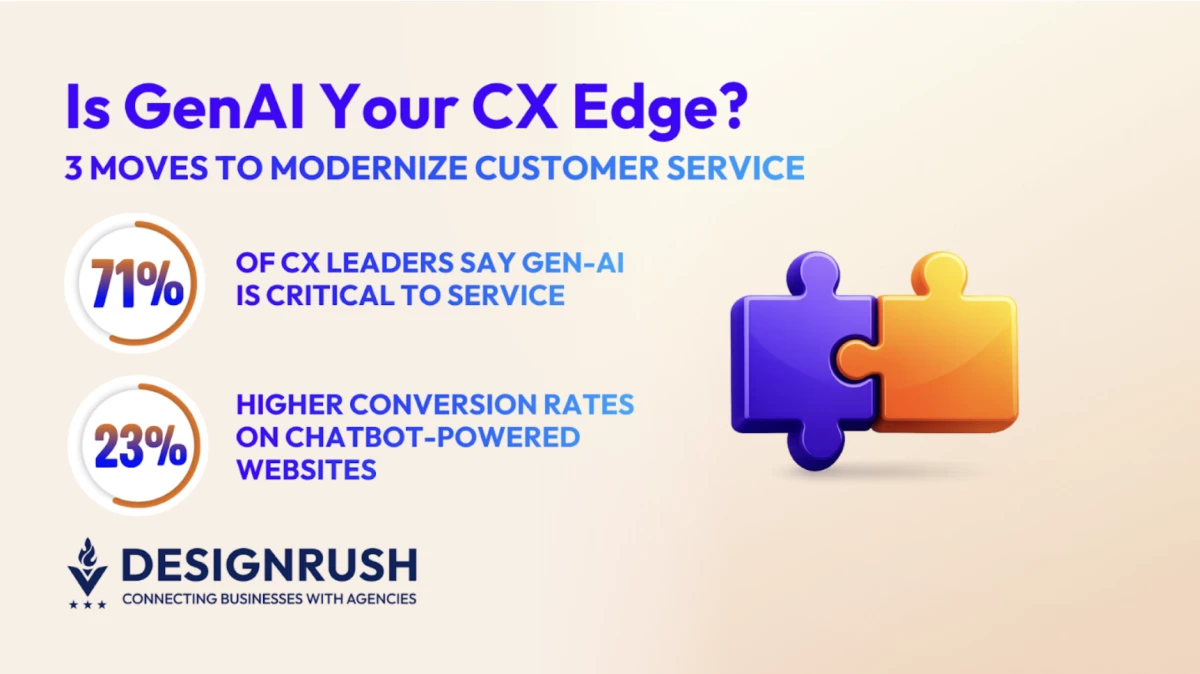
- 71% of CX leaders view generative AI as critical for customer service, signaling that brands should prioritize AI adoption to stay competitive.
- AI-powered voice agents can automatically resolve up to 90% of inquiries, reduce support costs by around 35%, and increase customer satisfaction by 150%, demonstrating high ROI potential.
- Only 10% of organizations have fully integrated solutions. It highlights the importance of structured, scalable deployment strategies for measurable impact.
Data shows that 71% of CX leaders consider generative AI (GenAI) critical for improving customer service delivery.
That’s according to a 2025 survey by TELUS Digital and Statista, which found that CX leaders rely on GenAI to streamline routine tasks and reduce operational costs.
It also helps deliver faster, more personalized support that improves overall customer satisfaction.
Why?
Because these capabilities drive measurable gains in both efficiency and customer satisfaction.
Infinum is a global digital consultancy specializing in enterprise technology and product design.
The company helps clients identify high-impact use cases and deploy AI-powered voice and chat solutions.
Such tools can resolve up to 90% of inquiries automatically and boost customer satisfaction scores by as much as 150%.
The takeaway?
When applied strategically, AI does more than just fix operations. Instead, it’s got the power to totally transform the customer experience at scale.
To make that transformation real, brands need a structured roadmap that aligns AI capabilities with customer expectations and business goals.
Turning AI into a Customer Experience Powerhouse
Getting real value from GenAI depends less on the tools themselves and more on how they’re used.
The following three strategies can help organizations shift from trial efforts to meaningful results.
Strategy #1: Start with business-aligned AI use cases
Many organizations experiment with AI without clear objectives, which can lead to wasted time and resources.
Focusing on business-aligned use cases ensures AI addresses the most pressing priorities, such as improving service quality, reducing response times, and lowering operational costs.
“The most successful AI implementations are those that start with the business problem,” says Nina Jelić, lead product strategist at Infinum.
Defining objectives first ensures every AI initiative drives measurable impact rather than becoming an experiment with unclear value.”
How to apply it:
- Map customer journeys to identify high-impact touchpoints.
- Prioritize interactions where AI can deliver measurable improvements.
- Define success metrics upfront to evaluate effectiveness.
Start with clearly defined goals so organizations can focus their efforts on AI solutions that deliver tangible business outcomes.
Strategy #2: Align AI with Customer Intent
AI is only effective if it addresses real customer needs.
Infinum says leaders must ensure that AI solutions automate repetitive tasks while complementing human agents for more complex inquiries.
“AI works best when it’s designed around the customer. Understanding what customers actually need allows organizations to deploy AI in ways that enhance experiences,” says Georgios Athanassiadis, MD of Your Majesty – Part of Infinum.
How to apply it:
- Analyze support data to identify frequent inquiries and customer pain points.
- Deploy AI where it can enhance efficiency without compromising service quality.
- Continuously measure impact on metrics such as resolution time, customer satisfaction, and cost per interaction.
Aligning AI with customer intent ensures that technology adoption leads to better experiences, rather than just automating processes for efficiency’s sake.
Strategy #3: Scale with Voice-First and Multimodal AI
While chatbots are common, voice technology and multimodal solutions remain underutilized.
Voice-first AI can handle high volumes of inquiries, integrate across channels, and deliver faster, more consistent support.
“Scaling AI effectively requires moving beyond isolated chatbots. Voice-first and multimodal omnichannel solutions create seamless experiences, allowing organizations to serve customers efficiently while maintaining consistency and quality,” says Branimir Akmadža, AI & data engineering team director at Infinum.
How to apply it:
- Implement voice-enabled AI agents to automate routine interactions.
- Integrate AI across chat, mobile, and digital channels for seamless experiences.
- Measure performance using resolution rates, customer satisfaction scores, and operational cost reductions.
TELUS research supports this voice-first approach, highlighting a growing shift toward AI solutions that improve efficiency, reduce support costs, and elevate customer satisfaction at scale.
Overcoming Barriers to Adoption
Even with growing interest, CX leaders face common obstacles:
- High costs:Flexible, cloud-based solutions allow phased implementation without large upfront investments.
- Data compliance: Ensuring regulatory adherence while handling sensitive information.
- Infrastructure limitations: Scalable platforms and governance frameworks are essential for smooth AI integration.
Addressing these barriers strategically ensures AI adoption is both scalable and sustainable.
Practical Takeaways
Survey insights and industry trends highlight three practical ways to maximize AI value in CX:
- Focus on high-impact, business-aligned AI use cases.
- Deploy AI where it meets real customer needs to improve outcomes.
- Scale AI with voice-first and multimodal solutions for seamless experiences.
Structured adoption ensures AI delivers measurable benefits rather than remaining experimental.
Generative AI, particularly voice-first and multimodal solutions, is becoming central to customer experience.
Focusing on strategic use cases, aligning AI with customer intent, and scaling thoughtfully lets organizations bridge the gap between ambition and execution.
Leaders who adopt a structured approach are best positioned to improve efficiency, reduce costs, and enhance customer satisfaction in 2025 and beyond.