
Freshpet is in 36,000 in-store fridges, sits in more than 13 million households, and does about $1 billion in net sales a year. It’s not a brand that struggles to be known.
So when its digital marketing team started asking ChatGPT and Google AI Overviews basic questions about fresh pet food and got answers that barely mentioned Freshpet, that was the moment it became clear that reputation and AI visibility aren’t the same.
I recently sat down with Freshpet’s senior director of digital marketing, Steve Elwell, for a session with Search Engine Journal to walk through what it took to close that gap.
What follows is a breakdown of what the underlying data showed once we stopped assuming a strong brand would carry over into how AI systems talk about it.
Why Brand Reputation Doesn’t Guarantee AI Citations
You might think that decades of content, third-party coverage, and category leadership should be enough.
Freshpet had all three, yet it was still largely absent from AI-generated answers to questions it should have owned.
The reason behind this is that large language models (LLMs) aren’t ranking brands the way search engines rank pages.
LLMs are building a contextual understanding of an entire category (the questions people ask, the concerns that come up repeatedly, and the language used to describe a problem) and then deciding which sources answer that question in a form that they can cleanly extract.
A brand can have real authority in the market and still lose to a smaller competitor whose content happens to be structured in a way that’s easier to lift a direct answer from.
This is where I’ve found it useful to divide the citation factors into categories so they can be better understood.
At Intero Digital, we call this the RASE framework, which delves into relevance, authority, structure, and engagement.
Freshpet’s audit is a good illustration of why all four matter independently.
The brand had authority and engagement in spades, but the gaps that were keeping it out of AI answers lived almost entirely in relevance and structure.
Years of blog content had been written the way most SEO content still gets written, with long-form, narrative-driven copy built to keep a human reading past the first paragraph.
That structure can be close to invisible to an LLM that’s trying to extract one clean, quotable answer to a specific question.
As Elwell put it, the shift required going from writing to be read to writing to be quoted.
That involved restructuring existing expertise into direct question-and-answer passages, short digestible sections, and content that can stand on its own as a single citable unit, without losing brand voice and human connection in the process.
What to Do When AI Cites Outdated Brand Information
Part of our audit process involved identifying where AI models were repeating outdated or incorrect information about Freshpet.
If you run a consistent set of prompts within a brand’s category regularly enough, the gaps and errors will surface on their own.
The playbook to address these gaps was multi-part, and it reflects the way we approach GEO as an agency. To address this, we:
- Identified which specific prompts were returning weak or inaccurate answers.
- Built content that directly and specifically addressed those exact questions.
- Attributed it to a credentialed expert (in Freshpet’s case, one of roughly 90 credentialed pet food nutritionists in the country who are on staff).
- Got it distributed through channels that were likely to be picked up and recrawled, including smaller, category-specific trade publications.
It’s less “correcting the record” and more “out-publishing the bad information” with something more current, more specific, and more attributable.
How to Measure AI Search Visibility
There’s no established benchmark for AI citation performance the way there is for search rankings, so we built one from scratch.
This included a set of 475 prompts, grouped into 13-14 topic categories that a real pet parent would plausibly ask, tracked daily across the major LLMs.
Looking at this level of volume allowed us to isolate performance at a granular level (for example, “are we showing up correctly on questions three, four, and seven within the ingredients category?”) and prioritize fixes based on the proximity to purchase decisions.
That mattered more than any single content fix.
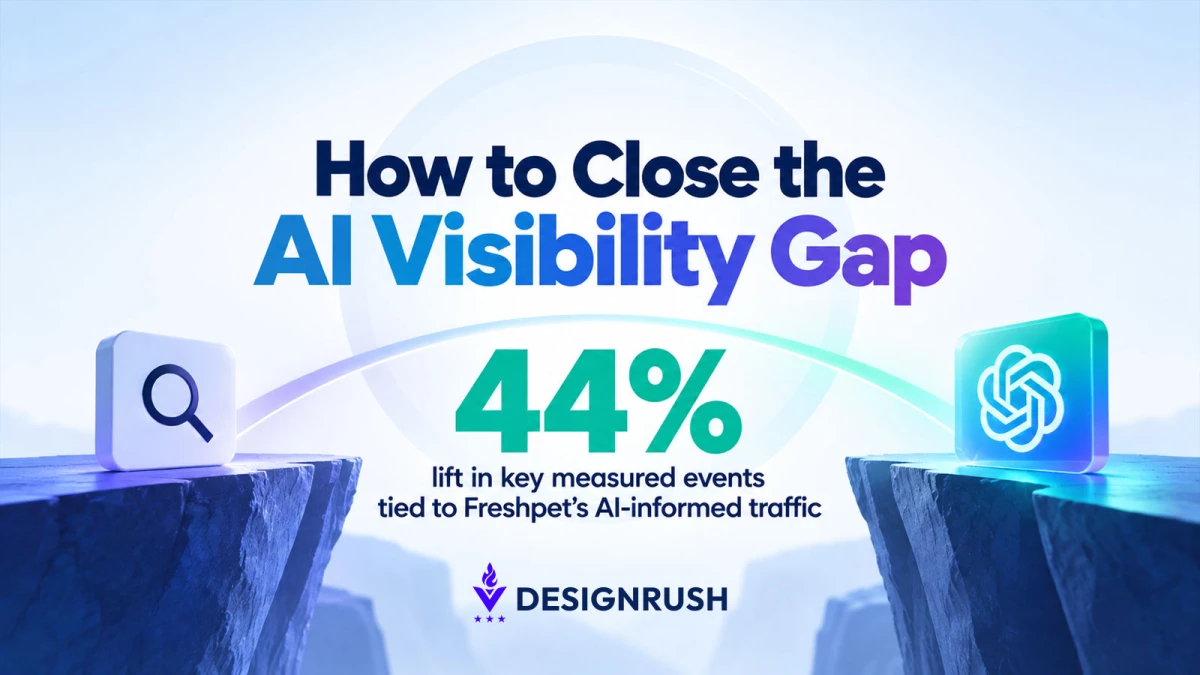
Addressing the topics closest to conversion first, rather than the broadest visibility gaps, is what produced a 44% lift in key measured events tied to the AI-informed traffic Freshpet could track through its direct-to-consumer subscription business.
The distance between “our brand is well-known” and “AI systems represent our brand accurately” is often wider than you might think because AI systems evaluate something closer to structural extractability and topical relevance than brand equity.
Closing that gap starts with measuring it consistently enough and granularly enough to see which questions go unanswered, then treating the fix as a content and structure problem rather than a PR problem.