
Tech Debt Limits eCommerce Growth: Key Findings
- eCommerce tech debt inflates project costs by 10–20%, quietly draining budgets before growth initiatives even begin.
- Nearly 40% of IT spend now goes toward bridging tech debt, diverting investment away from innovation and customer experience.
- Modernization restores the link between effort and outcomes, allowing architecture to absorb complexity instead of pushing it onto people.
eCommerce brands often chase growth by running more ads and promotions.
Yet, what happens inside an organization is often overlooked.
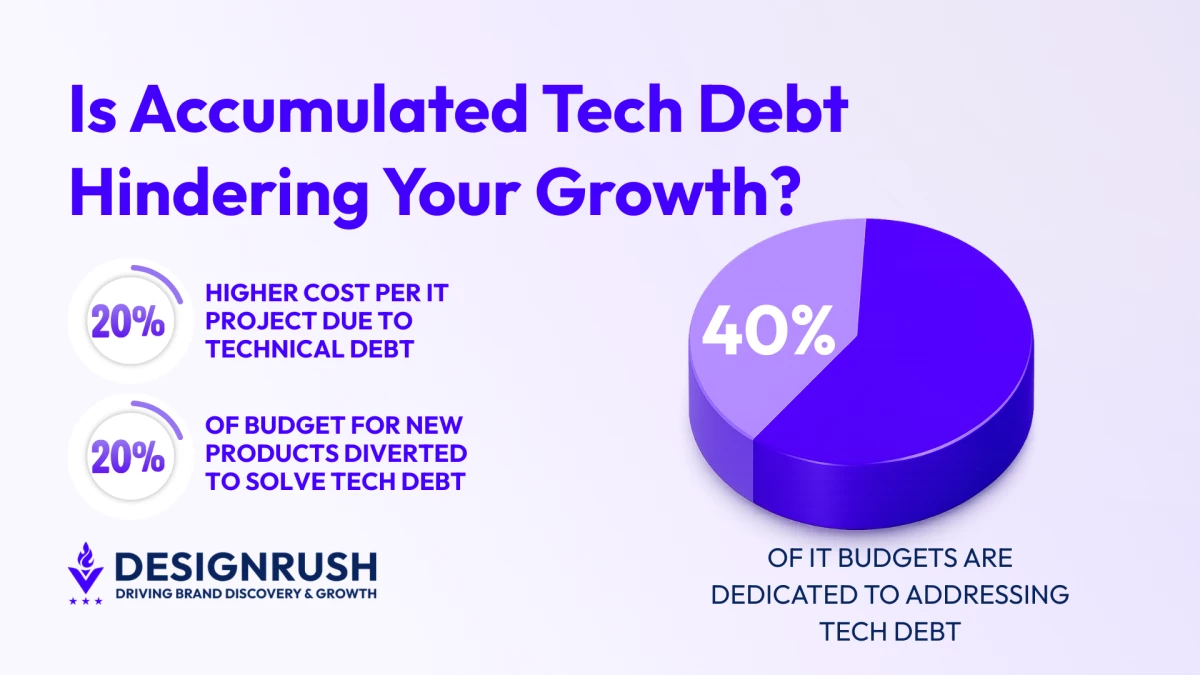
According to a McKinsey report, companies pay an additional 10% to 20% per project just to work around existing tech debt.
To make matters worse, the same study showed that roughly 40% of a company’s IT balance sheet is dedicated to bridging technical debt.
As eCommerce tech stacks grow more complex and customer expectations evolve, legacy platforms and fragmented systems will continue to create friction that even well-funded teams struggle to absorb.
This means that eCommerce growth is becoming increasingly tied to operational readiness rather than pure acquisition alone.
To understand why costs keep rising even as teams invest more, eCommerce experts like Codal encourage brand leadership to look closer at tech debt and where it hides.
Where eCommerce Tech Debt Actually Accumulates
Enterprise eCommerce tech debt can’t be traced back to just one poor decision.
More often than not, it’s something built gradually through years of quick fixes and short-term workarounds that solved immediate problems.
The main issue is that these “solutions” actually complicate everything else, without most people noticing.
“Clients of a certain age and scale have been purchasing software extensions and new modules of legacy tools for years,” said Joe Comins, Director of eCommerce Strategy at Codal.
“That creates a sprawl of technical debt in how systems communicate and how data flows.”
In his experience, Comins says that this sprawl tends to show up in predictable places:
Platform and extension sprawl
Core CMS and commerce platforms accumulate years of add-ons.
Point solutions are introduced faster than they are retired. Each extension solves a narrow need while adding dependencies that make future changes harder.
Fragmented product data
Product information lives in too many places at once. SKUs are duplicated across systems. Spreadsheets fill gaps that should live in a PIM.
Manual delta feeds shuttle updates between tools, increasing the chance of drift.
Broken sources of truth
Attribute mismatches and variant conflicts emerge across regions and channels.
Localization efforts fork product records without aligning pricing, compliance, or regulatory requirements such as SDS (safety data sheet) documentation.
Disconnected system communication
Systems may be technically integrated but operationally brittle. Data moves, but not reliably. Errors surface late, often during launches or peak traffic periods.
Outdated Infrastructure Suppresses Scale and Performance
When it comes to enterprise eCommerce, outdated infrastructure often manifests as patterns executives misdiagnose as execution problems.
“Slow feature development throttles growth,” Comins explained.
“A legacy system with technical debt prevents a business from scaling, leaving manual processes, legacy deployments, environment drift, and a dependency on a small team of very niche experts that put it together.”
Each of these issues constrains growth in a specific and compounding way.
For example, manual processes suppress scale by tying growth directly to headcount.
When humans are required to reconcile data, move updates between systems, or correct errors after the fact, volume becomes expensive.
Every increase in traffic, catalog size, or channel count demands more intervention, slowing execution and raising operational costs at the same time.
On the other hand, legacy deployments limit performance by locking businesses into rigid capacity models.
As a result, teams avoid ambitious initiatives because the system cannot absorb the risks associated with innovation.
This is often most obvious during peak periods like the holiday season.
When it reaches that point, growth is governed solely by what the existing stack can tolerate, rather than customer demand.
And when infrastructure begins to define those limits, modernization becomes a question of how much growth the organization is willing to leave on the table.
Recognize the Signals That Modernization Is No Longer Optional
One of the biggest reasons why tech debt compounds is that teams have become so accustomed to its symptoms to the point that the friction feels normal.
When leadership fails to recognize these patterns for what they are, these symptoms become habits that become harder and harder to correct later on.
And since tech debt rarely causes an immediate collapse in operations and growth, spotting red flags early becomes even more important.
Fortunately, experts at Codal say these red flags are easy to spot early on:
- New features demand disproportionate effort. What should be routine development expands into cross-team coordination and extended testing. When effort scales faster than output, it means the system is resisting change rather than supporting it.
- Minor updates trigger cascading issues. Small changes expose conflicts in pricing logic, fulfillment rules, or product data. This unpredictability slows decision-making and trains teams to avoid change instead of pursuing it.
- Data reconciliation overtakes optimization. Teams spend more time aligning inconsistent records than improving performance or customer experience. When cleanup replaces progress, growth loses momentum.
- Release velocity declines despite larger teams. Headcount increases without a matching rise in throughput. Infrastructure, not talent, becomes the bottleneck, revealing limits that hiring alone cannot solve.
Individually, these issues appear manageable. But taken together, they signal that growth is being constrained by architecture rather than team strategy or capability.
Rebuild for Readiness, Not Just to Get By
For eCommerce brands, modernization goes beyond upgrading to the latest platform.
From a system standpoint, modernization is about restoring the relationship between efforts and outcomes.
When systems are designed to scale cleanly, progress accelerates because complexity is absorbed by architecture, not by people.
And that matters, especially in industries where demand fluctuates and competition gets fiercer every year.