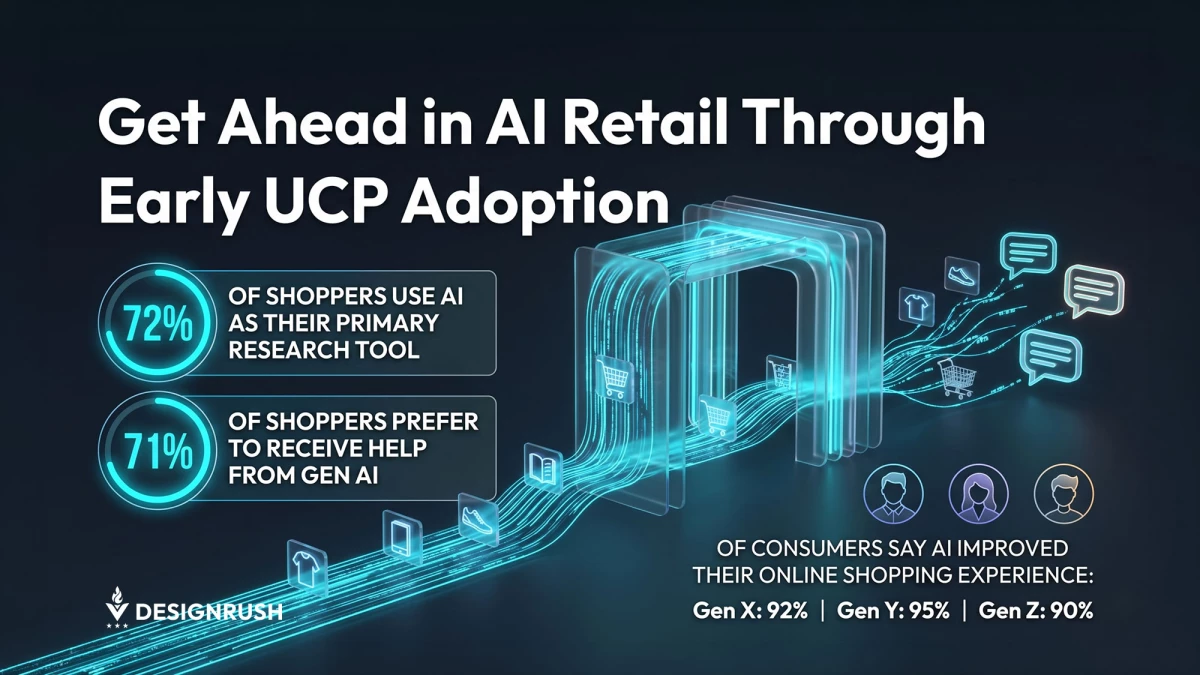

Adopting UCP Early: Key Findings
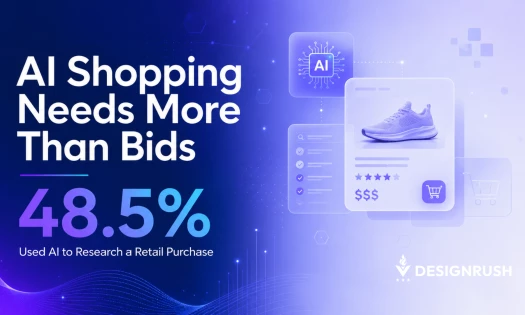
- Nearly 60% already use AI tools to research purchases, accelerating the shift toward AI-assisted commerce.
- Universal Commerce Protocol allows AI agents to read catalogs and transact directly with merchants, moving product discovery into conversational AI environments.
- Early UCP adoption could give brands a long-term visibility advantage, similar to how early SEO adopters dominated search rankings before competitors caught up.
For decades, eCommerce strategy revolved around building a website, ranking in search results, and guiding customers through the checkout funnel.
Though this approach still works, to a degree, it relies almost entirely on people doing the browsing.
This isn’t the case anymore, thanks to AI shopping. And the scales are set to tip further in favor of AI.
Shopify and Google recently introduced the Universal Commerce Protocol (UCP), an open standard designed to help AI systems interact directly with merchant commerce platforms.
In practical terms, UCP creates a shared, machine-readable structure for product data, pricing, availability, and checkout interactions.
So instead of scraping pages or relying on scattered feeds, AI agents can read and transact with commerce platforms in a consistent format.
The announcement couldn’t have been more timely.
According to data from Capital One Shopping Research, 71% of consumers want help from genAI while shopping. Meanwhile, nearly 60% of consumers have already used AI tools to research purchases.
And among those who do use AI, 72% of them now rely on it as their primary research tool for products and brands.
Caleb Bradley, Founder and CEO of Bighorn Web Solutions, a premier enterprise eCommerce development agency, believes the protocol could reshape how brands appear in AI-driven shopping experiences.
“For the last two decades, brands competed for visibility inside search engines and marketplaces. With UCP, the competition moves one layer upstream,” he said.
“Given how we’re all moving towards AI-driven eCommerce at an accelerated pace, brands that don’t act fast and make their catalogs readable by AI simply won’t be recommended at all.”
In fact, Bradley said that brands are already feeling some of these shifts, despite UCP still being in its early days:
- The shopping journey is becoming conversational. AI agents guide users from discovery to comparison and purchase in a single interaction. Navigation gives way to real-time recommendations.
- AI agents can now transact directly with merchants. UCP lets AI assistants interact directly with merchant catalogs and checkout systems. Purchases now move from discovery to transaction inside the conversation.
- Commerce infrastructure becomes interoperable across platforms. Previously, each AI platform required custom integrations with merchants. UCP’s shared protocol allows AI agents to operate across platforms.
The benefits of UCP are easy to see and understand. But now, eCommerce teams are left to answer an important question:
Should they wait for this new ecosystem to mature or should they participate early?
Why Early Adoption Can Create Competitive Advantage
History suggests that being an early adopter of new technology often leads to significant competitive advantages.
In the early days of search engines, companies that invested in SEO before it became mainstream accumulated years of visibility before competitors understood what was happening.
UCP could create a similar moment for AI-driven commerce.
Since UCP introduces a shared language between merchant platforms and AI agents, it allows AI systems to interpret product catalogs, pricing, and availability in a consistent format across platforms all at once.
As such, merchants that choose to support UCP early on are easier for AI assistants to recommend more often and for far longer.
That frequency and longevity allow eCommerce brands to establish advantages that compound online visibility:
1. Greater AI Visibility
AI shopping assistants rely on structured data to retrieve and compare products. The clearer and more accessible that data becomes, the easier it is for AI systems to surface a merchant during a shopping conversation.
Early adopters of UCP may benefit from:
- Faster retrieval of product attributes during AI queries
- Higher likelihood of appearing in AI-generated product comparisons
- Stronger alignment between catalog data and AI recommendation systems
2. Faster Integration With Emerging AI Platforms
Before protocols like UCP, every new commerce surface required custom integrations.
Unfortunately, that approach rarely scales the way brands want it to.
But a shared protocol changes everything.
When AI platforms adopt a common standard, merchants who already support it can appear across new shopping interfaces without rebuilding infrastructure each time.
This allows brands to benefit from reduced technical overhead and faster participation in new AI shopping environments.
3. Control Over Brand Representation
In AI-powered commerce, product information is synthesized by an assistant responding to a prompt.
That makes structured product data far more important.
Protocols like UCP allow merchants to define how AI systems access key information like:
- Product specifications and attributes
- Pricing and promotional details
- Availability and fulfillment options
- Return and policy information
The clearer this structure becomes, the less likely AI systems are to misinterpret or misrepresent the product.
Build The Internal Capabilities UCP Needs
Although activating UCP is as simple as activating “Agentic Commerce” in Shopify’s sales channel settings, setting up everything it needs to run properly requires brands to rethink and restrategize product data, systems, and integrations.
According to Bighorn Web Solutions, brands that want to adopt UCP early should focus on these steps:
1. Audit and Clean Your Product Data
The foundation of UCP is structured, machine-readable product information. AI agents rely on consistent attributes, pricing details, and availability signals to interpret catalogs accurately.
Brands should begin by evaluating whether their product data is reliable enough for machine consumption.
Key areas to review include:
- Product attributes and specifications
- Pricing consistency across channels
- Inventory availability signals
- Shipping, returns, and policy data
2. Make Commerce Systems API-Ready
UCP operates through structured interfaces that AI systems can query in real time. This means commerce platforms must be able to expose product and inventory data through flexible APIs.
To do this, brands should ensure their infrastructure can support:
- Real-time product availability queries
- Dynamic pricing retrieval
- Checkout initiation through standardized endpoints
3. Launch Small UCP Pilots
Early adoption rarely begins with a full platform overhaul. Most organizations benefit from running controlled pilots that expose real-world integration challenges.
Testing small UCP integrations allows teams to observe how AI agents interpret product data and how customers interact with AI-driven shopping experiences.
These experiments provide early insight without requiring a full operational commitment.
4. Rethink Product UX for Conversational Shopping
eCommerce UX assumes customers browse pages and filters, but that’s not how AI agents operate.
As such, it’s important to rethink UX design in a way that makes life easier for both humans and AI agents.
This is why it’s advised to create clear product differentiation and positioning, structured specifications that AI can interpret, and descriptions that highlight real use cases.
5. Prepare Teams for Agent-Mediated Commerce
UCP adoption will also affect internal teams.
Product managers, marketers, and commerce leaders will need to understand how AI systems interpret product information and how conversational discovery differs from traditional search.
To ensure teams are prepared for this new reality, brands should invest in:
- Training marketing teams to structure product content for AI interpretation
- Aligning engineering teams around API-first commerce infrastructure
- Developing internal processes for maintaining clean product data
Set Up a Storefront That Attracts AI Agents
As agentic AI settles into its new role as personal shopper, more and more consumers will rely on it to compare products, filter options, and recommend purchases.
That means brands must focus less on attracting clicks and more on being interpretable by the systems doing the recommending.
Because in an AI shopping environment, the decisive moment may occur long before a shopper ever arrives on the site.
And when that moment happens, brands that prepare early are more likely to be surfaced by AI systems.