
DitchIt App’s Twitter Bird Destruction Takeaways:
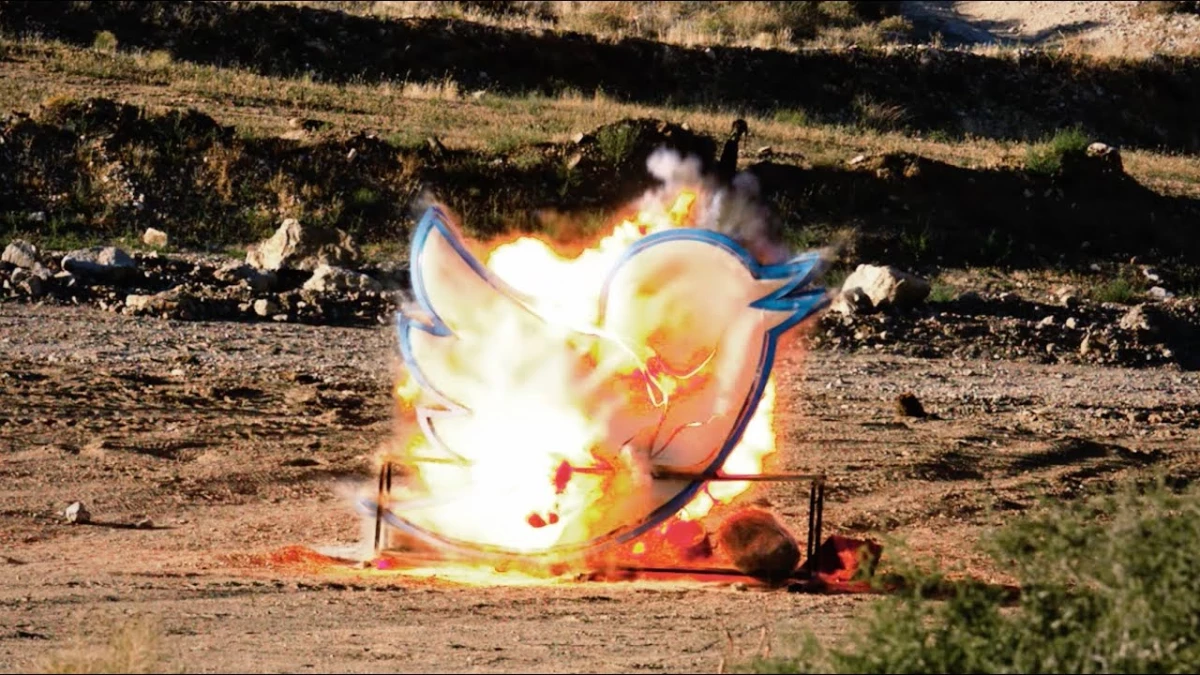
- DitchIt bought Twitter’s 560-pound “Larry” bird sign for $34,000 and blew it up in the Nevada desert to mark its product launch.
- The app is ad-free, fee-free, and focused on individual sellers rather than businesses or sponsored content.
- Fragments of the sculpture were auctioned on the app, with all proceeds donated to the Center for American Entrepreneurship.
DitchIt didn't just buy ad space. It completely blew up a legacy.
The community-first marketplace, founded in 2024, made its debut with a cinematic stunt that caught national attention.
The company acquired Twitter’s original blue bird sculpture, “Larry,” and destroyed it in the Nevada desert.
All it took was four Tesla Cybertrucks, a full film crew, and a Hollywood-grade pyrotechnician.
Spokesman James Deluca framed the act as more than shock value.
“Elon Musk rebranded Twitter to X to support free expression. At DitchIt, we’re doing the same for local marketplaces.
Today’s platforms are filled with ads, fees, and algorithms that prioritize businesses over people.
DitchIt is different — free to use, ad-free, and designed to support real communities and real sellers.”
The app focuses on individual users who feel sidelined on platforms dominated by business accounts and paid listings.
One Act, Strong Signals
Shot just outside Las Vegas, the video was produced by a 15-person crew and distributed across YouTube, TikTok, and other social channels.
Within a week, the campaign had reached nearly 900,000 views.
DitchIt followed up by listing pieces of the destroyed sign for sealed-bid auctions within its app.
Proceeds were donated to the Center for American Entrepreneurship, a nonprofit backed by leaders from Meta, Google, and Amazon.
The campaign aimed to contrast DitchIt’s model with fee-heavy platforms, positioning the company as a seller-first alternative that removes ads, fees, and algorithmic interference.
The entire stunt-style launch was executed at an estimated cost of $104,000 to $154,000, including:
- $34,000 for the Twitter bird sculpture
- $30,000–$50,000 for the film crew (based on industry rates)
- $10,000–$20,000 for a licensed pyrotechnician and explosives permits
- $5,000–$10,000 in post-production
- Additional logistics, equipment, and possible promotion
This yielded ~900,000 views in the first week, translating to a cost per view of around $0.12 to $0.17, which is far below traditional paid ad benchmarks.
B2C companies often dedicate 5–10% of revenue to marketing.
Higher-growth brands, especially mid-sized or early-stage startups, might spend 10–30% during launch phases.
For example, Google Pixel’s ad budget exceeded $100 million in digital, print, and national TV.
For startups evaluating how to scale without enterprise budgets, this approach highlights the efficiency of earned media and audience-first storytelling.
Instead of renting reach, DitchIt created a product-aligned moment that delivered both visibility and credibility.
Where Bold Brands Win
- Create launch moments with cultural impact. DitchIt proved that one timely event can rival paid media, and agencies can help clients craft moments that capture attention through relevance.
- Serve users tired of overcommercialization. As consumers look for simpler, ad-free experiences, brands that reduce friction and speak honestly can build trust faster.
- Leverage public sentiment against tech giants. Messaging that challenges platform dominance appeals to disillusioned users, and agencies can help brands claim that position credibly.
- Develop authentic, creative risk strategies. DitchIt’s success proves unconventional ideas can work when they align with brand values, and agencies should help clients make those calls strategically.
- Strengthen product-to-brand alignment. Marketing that reflects the actual product builds credibility, and integrated strategies between creative and product teams can drive long-term equity.
The campaign sparked a mix of reactions, from praise for its originality to skepticism over its theatrics.
Wait the Twitter logo blew up same night as Space X ?? https://t.co/7IPk3LxzrD
— Sissy (@SISSY_DP3) June 19, 2025
But it introduced DitchIt with a strong visual identity and a philosophy rooted in transparency and user empowerment.
Where Risks Turn Into Losses
- Audience burnout from performative campaigns. As stunts become more common, consumers grow skeptical, and brands risk backlash if messaging feels disconnected from the product.
- Heightened expectations for launch creativity. With standout campaigns setting the pace, brands that rely on safe rollouts may lose attention and relevance.
- Loss of trust from legacy associations. Ties to dominant platforms can make brands appear outdated or compromised, and agencies must manage that perception carefully.
- Short-term attention without long-term strategy. One big moment won’t sustain growth unless brands follow it with consistent product value and user engagement.
- Falling behind on user-centric business models. Startups offering no-fee, ad-free platforms are raising expectations, and brands that delay simplification risk losing ground.
I think DitchIt’s launch hits at a moment when users are growing tired of platforms that put profits ahead of people.
The explosion wasn’t just for attention. It set the tone for what the brand stands for.
By removing ads, fees, and biased listing systems, DitchIt is making a strong case for a simpler, seller-first alternative.
If user experience delivers, this campaign could build lasting trust and long-term value.
Much like DitchIt’s explosive debut, KFC Canada found its visual spark by turning chicken buckets into racetrack icons for a cheeky F1 campaign.
Want to grow your brand’s social presence? Check out top-rated social media marketing agencies: