
Key Takeaways:
- Nvidia, Google DeepMind, and Disney Research collaborate on Newton, a next-gen physics engine for robotics.
- Disney plans to use Newton to power advanced entertainment robots, including Star Wars-inspired BDX droids.
- Nvidia said it will release an open-source version of Newton later in 2025.
What if AI could truly bring robots to life? Well, it looks like we're about to find out.
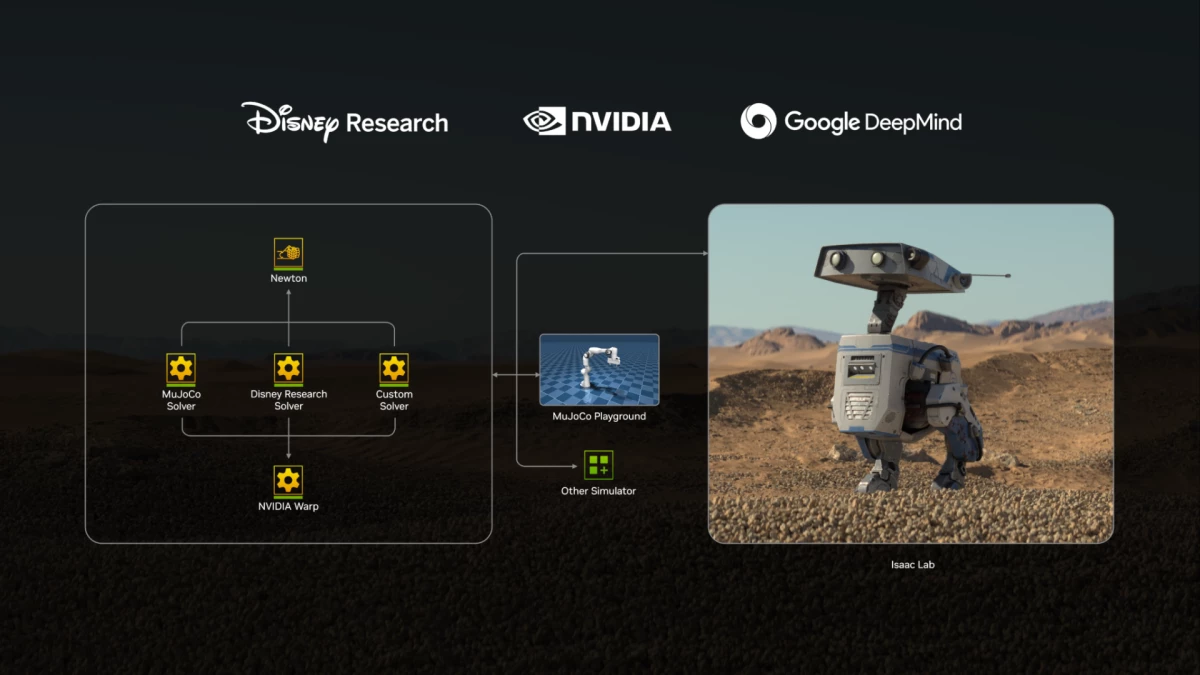
Nvidia made a splash at GTC 2025 with its announcement of Newton, a new physics engine designed to simulate real-world robotic movement.
Created in collaboration with Google DeepMind and Disney Research, the engine is set to power Disney's next generation of entertainment robots.
This will bring beloved Disney characters to life with more fluid motion.
During his keynote presentation, Nvidia CEO Jensen Huang was joined onstage by a waddling BDX droid, a Star Wars-inspired robot set to make its way into Disney theme parks.
According to Nvidia, Newton will enable robots to become more expressive and handle complex tasks with greater precision.
By simulating interactions with real-world materials like cloth, sand, and food, developers can create robots that move and react more naturally.
In a news release, Disney Imagineering SVP Kyle Laughlin emphasized the impact of this partnership:
"The BDX droids are just the beginning. We're committed to bringing more characters to life in ways the world hasn’t seen before, and this collaboration with Disney Research, Nvidia and Google DeepMind is a key part of that vision.
This collaboration will allow us to create a new generation of robotic characters that are more expressive and engaging than ever before — and connect with our guests in ways that only Disney can."
🚨Introduced at #GTC25: Newton is an open-source extensible physics engine being developed by NVIDIA, @GoogleDeepMind, and Disney Research to advance robot learning and development. ⚡️
— NVIDIA Robotics (@NVIDIARobotics) March 19, 2025
Learn how physics engines and #physicalAI models are driving the future of #humanoidrobots.… pic.twitter.com/nAfyLSIDsp
Newton will integrate with Google DeepMind's MuJoCo, a leading physics engine for multi-joint robotic movement.
This will provide developers with a comprehensive toolkit for robotic simulation.
Disney bringing AI-powered robotics to life with two tech giants proves that brand partnerships can turn sci-fi dreams into reality.
It also shows how the most advanced technologies can be combined to create immersive brand experiences.
Next-Gen Robotics at Disney Parks
Disney has been refining its robotic technology for years, with controlled demos of the BDX droids appearing at events like SXSW 2025.
Now, with the power of Newton, Disney is preparing to showcase these advanced robots in select theme parks next year.
Nvidia also announced a lineup of innovations at GTC 2025, including Groot N1, an AI model designed to enhance humanoid robots' perception and reasoning skills.
🤖 Experience the #NVIDIAIsaac GR00T blueprint for synthetic manipulation motion generation➡️https://t.co/WcusMC5jnL
— NVIDIA Robotics (@NVIDIARobotics) March 21, 2025
Dive into the pipeline for #robotic imitation learning and see how it can transform training for single-arm manipulators. 🦾 #GTC25pic.twitter.com/x9pV5Ciijw
Additionally, the company provided updates on its upcoming AI chips, Blackwell Ultra and Rubin, as well as a new wave of personal AI computers.
As AI-powered robotics become more advanced, companies can integrate these innovations early to gain a competitive edge in automation and interactive experiences.
Businesses should also explore how AI-driven perception and motion learning can enhance customer engagement and operational efficiency.
Earlier in January, Disney appeared at CES 2025 for its fifth annual Global Tech and Data Showcase, revealing AI advancements for smarter advertising.