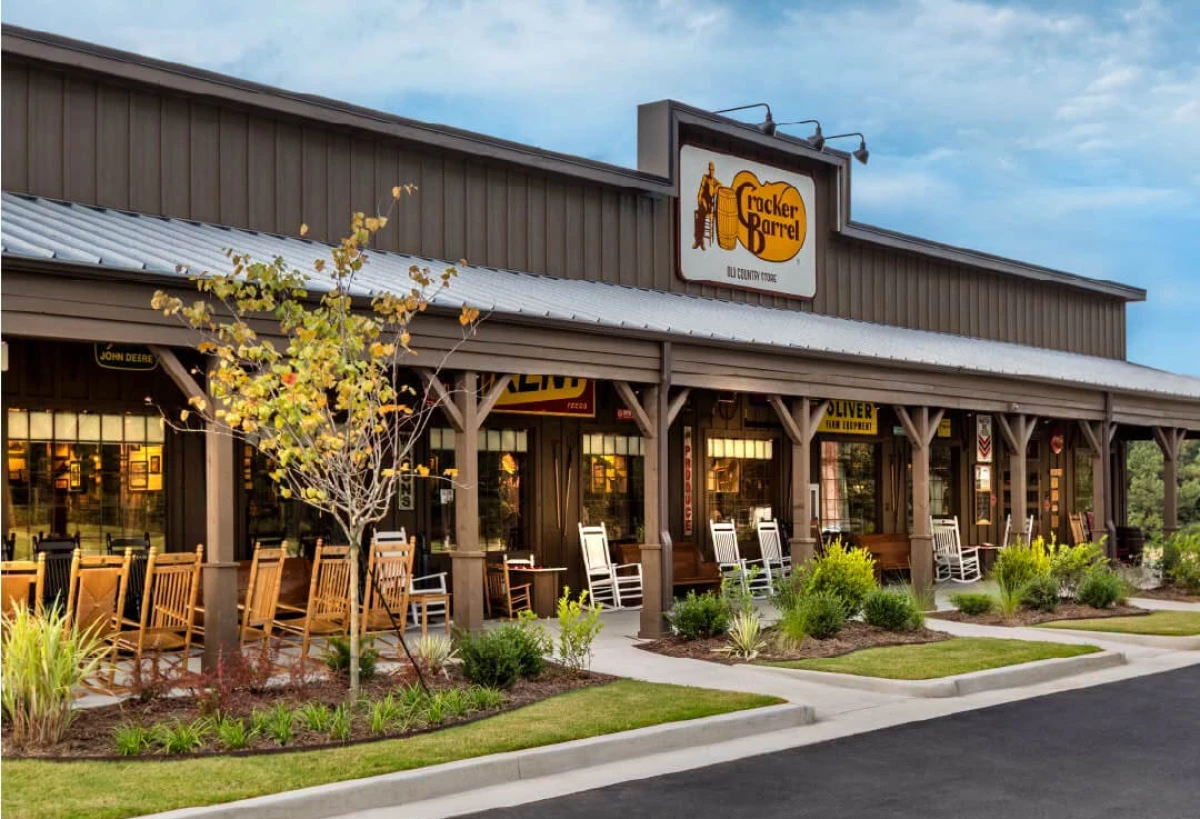

Cracker Barrel is putting a new face at the top of the org chart 11 months after a failed logo redesign became a national controversy.
The chain announced Monday that Chief Executive Julie Masino will leave the role effective August 10.
Former Bloomin' Brands CEO David Deno is stepping in as a successor.
Masino will stay on through October 9 in an advisory capacity to help with the handoff. She gives up her board seat on August 10 as well.
She leaves with an exit package worth roughly $4.6 million, paid in equal installments over two years, according to Cracker Barrel's SEC filing.
View this post on Instagram
Independent Board Chairman Carl Berquist described the process as a robust and thoughtful search, pointing to Deno's decades of experience in restaurants and retail.
Deno, in his own statement, indicated Cracker Barrel's "deep connection with guests across generations" as something he plans to build on.
"Together, we will stay focused on delivering delicious food and exceptional experiences for our guests, while driving profitable growth," he said in a press release.
Deno takes a $1 million base salary, and Cracker Barrel is covering $465,000 in relocation costs.
The package also includes a corporate apartment and two monthly flights home to St. Petersburg for six months.

The leadership swap follows one of the more chaotic stretches in the chain's history.
Deno starts four days before Cracker Barrel closes its fiscal year, which leaves him owning a branding strategy he had no hand in choosing.
The Cost of a Bad Redesign
The failed rebrand that set all of this off lasted only seven days.
Cracker Barrel unveiled a simplified "Old Timer" logo on August 19, 2025, alongside a fall menu campaign called "All The More."
Backlash arrived within hours from loyal diners and investors.
President Donald Trump even joined in on Truth Social, telling the chain to restore the original mark.
Cracker Barrel reversed course on August 26 and put the Old Timer back on its signs, but the damage outlasted the reversal.
View this post on Instagram
Traffic fell roughly 8% in the weeks after the launch, according to chief financial officer Craig Pemmelis on the September 2025 earnings call.
Cracker Barrel scrapped its plan to remodel all 660 restaurants, and the reported $700 million transformation program remains on hold.
The billboard attack was the moment the fight stopped being about logo design.
Steak 'n Shake CEO Sardar Biglari, a Cracker Barrel shareholder, used the moment to stir the pot further.
The activist investor framed the logo as evidence of a board that had lost its grip on the brand.
The argument then moved from customer sentiment to shareholder value.
Cracker Barrel had spent weeks defending a logo, and it suddenly found itself defending its governance.
View this post on Instagram
Shares closed on Monday at $52.43, roughly 110% above the $25 low Cracker Barrel hit in December, when adjusted EBITDA had collapsed to $7.19 million.
Comparable restaurant sales narrowed to a 2.6% decline in the quarter ending May 1, up from a 7.1% trough three months earlier.
Management raised full-year adjusted EBITDA guidance to between $120 million and $125 million, from a previous range of $85 million to $100 million.
Strip out a $47 million litigation settlement, and third-quarter adjusted net income was about $7 million, against $487 million in total debt.
Cracker Barrel restored its old logo on the eighth day and spent 11 months rebuilding everything attached to it.
A logo redesign spends customer trust, which is the one line item that a turnaround plan can't accurately refinance.
Cracker Barrel now faces this transition while fending off competitors like Denny's and IHOP for budget-conscious diners.
Meanwhile, the paused rebrand stays a live piece of crisis management that Deno inherits on day one.
The Sausage Backlash That Set the Template
Cracker Barrel had been here before, and the 2025 redesign followed a script the company already knew.
A 2022 decision to add plant-based sausage to the breakfast menu drew the same criticism from the same core audience.
Both times, the audience read the change as a signal about who Cracker Barrel wanted to serve.
The logo went further because the complaint reached the people who own the stock, and Biglari turned it into a proxy campaign to remove Masino.
Shareholders rejected him on November 20 and voted to keep her in place, though the board removed her eight months later anyway.
Cracker Barrel's past year is worth studying for how one design decision escalated into a governance fight that outlasted the redesign itself.
- Isolate the backlash before it reaches the board: What started as a design complaint escalated into an activist investor's billboard campaign, showing how fast a brand misstep can become a shareholder issue.
- Repeat backlash builds a longer memory: The 2022 menu controversy and the 2025 logo fail point to the same core audience reacting to change, raising the stakes on each new incident.
- A CEO exit doesn't close the chapter: Swapping leadership a year after tells investors and diners that the issue was never fully resolved; it just changed hands.
Nostalgia is an asset that doesn't show up on the balance sheet, and Cracker Barrel's logo redesign proved how fast it converts into a governance problem.
Our Take: Can Deno Fix What He Didn't Build?
We keep hearing "stability" attached to this hire, but we're not convinced that it means the same thing as trust.
Deno's résumé is heavy on retail and restaurant operations, with a strong background that keeps supply chains humming and margins intact.
However, nothing in it says he knows why a family drives past three other chains to sit in a rocking chair at Cracker Barrel.
That's not a skill you put on a search committee's checklist, and it's the one thing this brand actually runs on.
If the next year just means a quiet earnings call and no fresh controversy, the board will chalk that up as a win.
But the diners who stuck around through all of this weren't looking for a smoother operator.
They were looking for someone who understands what they show up for, and that's a much harder thing to hire for than a CEO.
In short, Deno has some tough shoes to fill.
Brands navigating major identity resets need agencies that understand how to align visual changes with operational ones so the rebrand holds up over time.
Explore these top branding agencies in our directory.