
When Copa Design was commissioned to create the official logo of NFL veteran and Super Bowl champion Vernon Davis, expectations were high.
The Silicon Valley-based full-service creative agency had to create something unique and personal to Vernon, comprising an official logo, typeface, and style guide.
But Copa understands people, cultures, and their differences — and when Vernon saw what they had come up with, they sealed the deal.
In our interview, Copa’s President and CEO Jason Saldana discusses the agency’s approach to creating impactful, tailored brand identities through close collaboration and innovative design to help clients like Vernon build lasting brand recognition.

Who Is Jason Saldana?
Jason is the president and CEO of Copa Design, a creative agency specializing in luxury brand identity and subscription-based graphic design services through its signature offering, Breeze. While not a designer by trade, Jason excels at managing and driving the business forward, ensuring Copa delivers top-tier design solutions to its clients. Jason credits much of Copa’s creative success to the vision and talent of his cofounders, Leo Bandeira and Daniel Morais, who bring their expertise in design to help shape the company's innovative services.
Copa Design’s name can be traced back to Copacabana, one of the most famous neighborhoods in Rio de Janeiro, Brazil. The concept behind the name represents a socio-democratic function, which plays a large part in the agency’s ideology.
Copa welcomes every customer — big and small — because Jason believes that a balance between collaboration and efficiency results in success, irrespective of brand size.
This, combined with a meticulously structured process that keeps the client involved at key stages forms their unique framework when designing brands, one that has seen Copa receive multiple awards for their work.
“By setting clear milestones and maintaining open, strategic communication, we create an inclusive environment without sacrificing momentum.
This balance ensures that while the client’s vision is consistently integrated, the project stays on course to meet our high standards of quality and timely delivery,” Jason explains.
This approach is what led Copa to clinch the deal with Vernon. Jason says this collaboration was both a creative and strategic challenge — and yet this project highlights exactly how thoughtful design can bridge multiple aspects of a client’s identity.
“Vernon came to us with a need for a personal brand that reflected his dynamic career — spanning professional sports and business ventures.
We worked closely with him to develop a logo and visual identity that encapsulated his athletic achievements while speaking to his entrepreneurial future.
The result was a modern, powerful brand that resonated deeply with his diverse audience,” he shares.
A Structured and Collaborative Process
Copa’s approach delivered the same results during a recent collaboration with a client in the tech industry, who approached them with a very specific brand ethos deeply rooted in innovation.
According to Jason, the project involved multiple touchpoints, each built on client feedback, resulting in a visual identity that captured their essence and allowed them to scale:
“The result was a timeless logo and visual system that elevated their brand perception in the marketplace. This project is a testament to how collaboration, when structured effectively, enhances both creativity and outcome.”
While this approach has proved very successful over the years, not all clients have the bandwidth to be as hands-on during the process. To navigate this, Jason says they provide a more turnkey approach:
“We remain aligned with their vision by having clear, upfront conversations to understand their goals, and then we proceed with minimal check-ins.
Our goal is always to meet the client where they are in terms of involvement, ensuring a seamless and satisfying experience, whether they prefer close collaboration or a more hands-off approach.”
Brands can surely take a page from Copa’s handbook here, as this approach shows that adjusting the level of client involvement to fit their needs can still lead to successful and satisfying outcomes for both parties.
A Proven Formula for Innovation and Scalability
Copa’s creative process focuses on three cornerstones: strategy, artistry, and innovation.
According to Jason, this process begins with the client’s world — understanding their brand, audience, and market positioning. They achieve this understanding by conducting in-depth discovery sessions to gain insight into the client’s brand values, goals, and audience.
Doing so informs a strategy that is both personalized and aligned with their vision.
Furthermore, maintaining a close dialogue with the client ensures that each design reflects their objectives:
“From there, we move into conceptual development, where creativity flourishes as we explore a variety of design directions,” he says.
Then, a phase of refinement follows, in which the ideas are distilled into a cohesive and elegant solution. But throughout it all, innovation remains the one constant.
“To ensure innovation, we constantly challenge ourselves to think beyond the brief — bringing fresh, forward-thinking perspectives to every project. The result is a final product that not only meets but often exceeds expectations,” Jason says.
The same approach can be applied to graphic design trends, such as botanicals, which have become more prominent in fashion, home décor, and web design.
Using botanicals as an example, Jason believes combining the trend with clean lines and minimalist design ensures a timeless, refined aesthetic.
“Incorporating botanical design into a project requires a delicate balance of natural elegance and modern sophistication. At Copa Design, we recommend using organic shapes and textures as subtle yet powerful elements within a composition.
Whether through soft floral accents or intricate leaf patterns, botanical elements should enhance the design without overwhelming it,” he says.
This clearly demonstrates how once a full understanding of a brand is achieved, maintaining cohesion between the brand identity and for example, the natural motifs of botanical design, can become effortless, natural, and authentic.
The Art of Effective Communication Through Design
Effective design is more than just aesthetics — it’s a strategic tool for communication.
According to a Piktochart survey, 55% of businesses use it for this purpose, while 24% use it to drive social media engagement, and 19% to communicate internally.
In addition, A McKinsey study of 300 companies over five years revealed that those who employed effective design increased their revenues and total returns to shareholders much faster than their peers.
According to Jason, clarity and consistency are the cornerstones of effective graphic design communication, emphasizing the importance of keeping things simple and direct, yet conveying a sense of luxury and elegance, in marketing design.
“We advise focusing on a strong visual hierarchy — ensuring that the key message is immediately visible and supported by secondary elements. Typography, color, and imagery must all work in harmony to reinforce the brand’s voice and the message being conveyed.”
Watch our video for an overview of the four key elements needed to create a brand visual identity:
At the same time, he believes that functionality is crucial in graphic design. The trick is to find a balance between form and function.
“Beautiful design draws the audience in, while functional design ensures the message is effectively communicated. We view them as two sides of the same coin; neither can be sacrificed.
In our work, we strive to create visually striking designs yet always serve a clear purpose — whether that’s evoking emotion, building trust, or driving action,” he adds.
These methodologies were showcased at Graphic Design USA’s (GDUSA) 60th Anniversary Showcase, where Copa won the prestigious “Best Catalog Design” award.
For Twenty20 Cannabis Seed Catalog 2022, Copa blended narrative flow to guide readers seamlessly, visual hierarchy to highlight key information, and strategic use of white space to craft a clean sophisticated design.
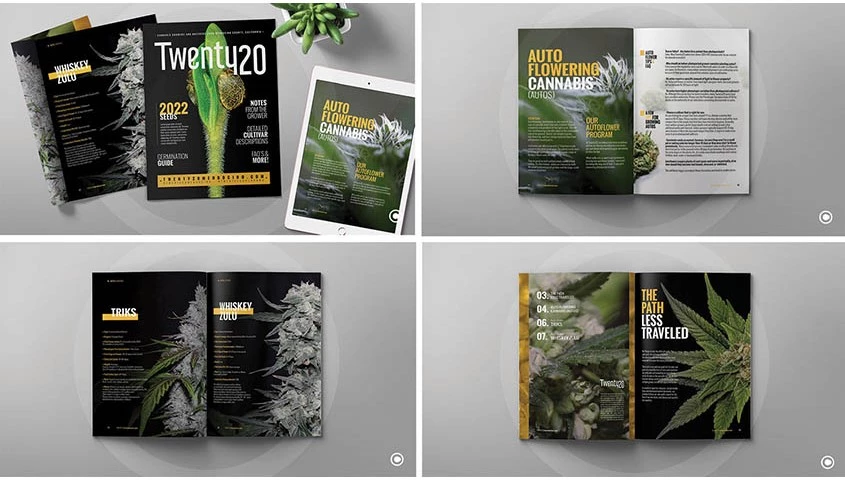
Great thought and care extended beyond the visuals. Jason noted that the team carefully selected materials to further elevate the catalog, reinforcing the brand’s story through every detail:
“We also used luxury materials to enhance the tactile experience, making the catalog a premium brand extension. The award was a testament to the power of thoughtful, strategic design that aligns form with function — an approach we bring to every project at Copa Design.”
Copa’s approach shows that the best design goes beyond trends or looks — it’s about capturing a brand’s story in a way that feels true to them, while also resonating with people everywhere.
The agency shows that the true strength of creativity is in staying grounded in a brand's core values, making sure each project feels both classic and current at the same time.