
Optimizing for AI Search: Key Findings
- Half of consumers now use AI search, pushing brands to shift from keyword tactics to entity- and identity-driven visibility.
- AI systems prioritize well-defined topical authority, so brands that lack clear concepts and signals lose discoverability fast.
- Consistent identity across SEO, content, and PR strengthens AI citations and improves visibility across both AI results and traditional search.
AI-driven search has rewritten the rules of online discovery for brands and marketers. In turn, consumers are also changing the way they search for brands online.
According to a recent McKinsey report, 50% of consumers now actively seek out and use AI-powered search engines.
Furthermore, 40 to 55% of consumers in sectors like consumer electronics, grocery, travel, beauty, and financial services use AI search to make purchasing decisions.
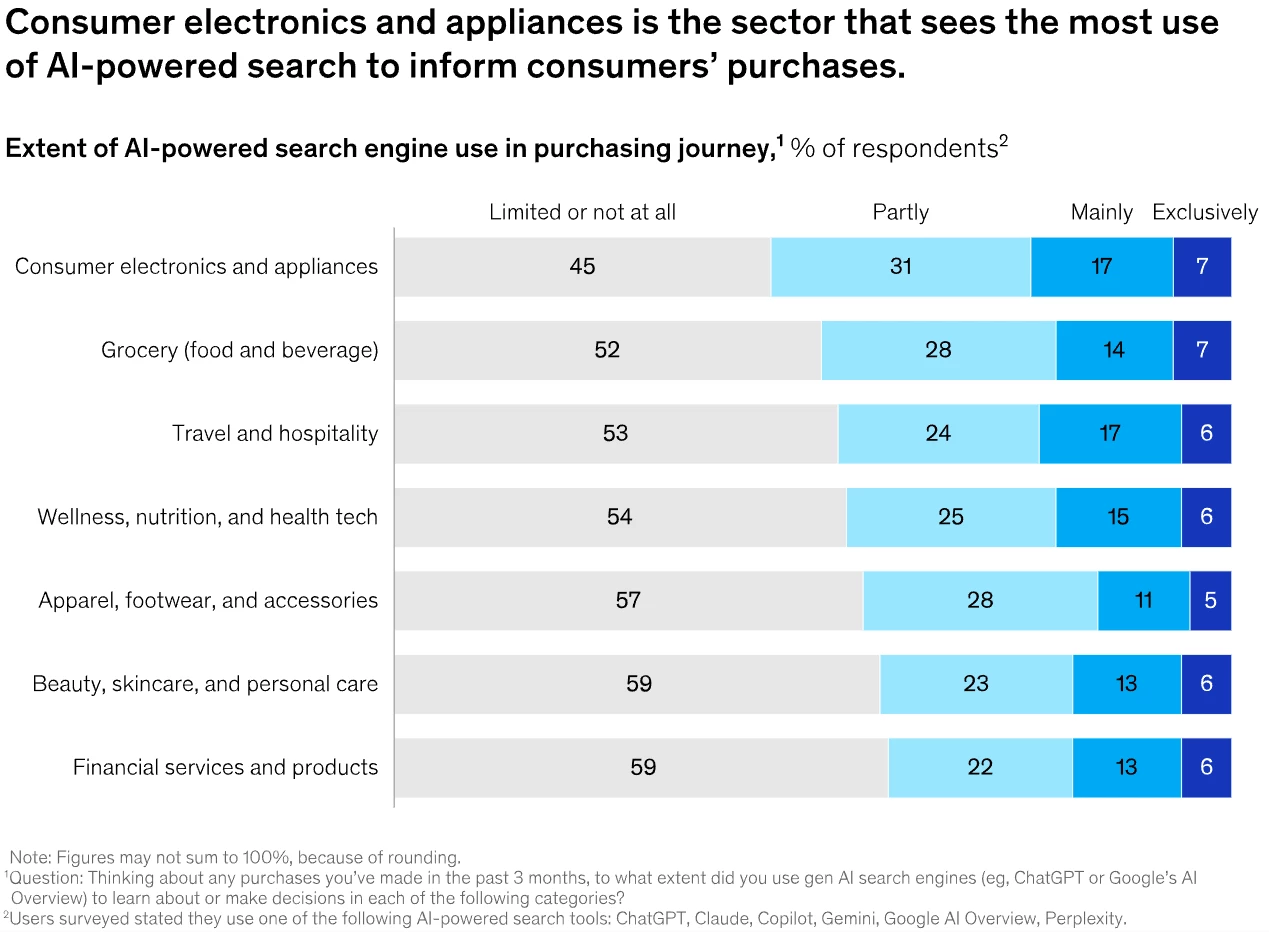
These numbers clearly illustrate how AI search has nudged brands away from chasing keywords and toward entity optimization, brand signals, and citation relevance.
As a result, visibility now depends on how clearly a brand defines what it stands for and how confidently AI systems can interpret those signals.
This new era of search is where Cody Jensen, Founder and CEO of award-winning digital agency Searchbloom, has started to specialize.
His agency works with brands navigating the ghost from traditional SEO to AI-informed optimization:
“A clear, consistent identity is now one of the most important ranking factors. AI systems need to know exactly who you are, not just what keywords you want to show up for,” he says.
In our interview, Jensen shares why brands should move from keyword-led execution to brand-first visibility that resonates with both search engines and generative AI models, and how executives can align internal stakeholders around this shift.

Who Is Cody Jensen?
Cody Jensen is the Founder and CEO of Searchbloom, an award-winning search marketing agency. Cody began his career at Google. He then advanced through leadership roles at some of the largest digital agencies in the country. Along the way, he saw a clear problem. Most firms chased vanity metrics, locked clients into long contracts, and hid behind jargon. He created Searchbloom to be the opposite of that. Cody specializes in building full-funnel strategies that align SEO, paid media, and CRO. His focus is on helping businesses turn marketing into profit.
Editor's Note: This is a sponsored article created in partnership with Searchbloom.
Online Visibility Is Changing
Many brands are learning that AI search does not simply rank pages.
It attempts to understand subjects, relationships, and authority. The model has moved from isolated keywords to a deeper interpretation of the topics a brand should own.
This shift includes broader thematic structures that act as the connective tissue of modern visibility.
- Concepts
- Keyword clusters
- Products
- Services
According to Jensen, both search engines and AI systems evaluate these factors to determine meaning, intent, and reputational weight.
“AI-driven search depends on well-defined topical coverage and strong identity signals. If a brand doesn’t establish those signals across the topics it needs to own, it loses visibility,” he says.
This is why marketing teams and agencies everywhere are rethinking their playbooks.
Even established agencies like Searchbloom have rebuilt their strategies to account for the way AI parses information.
“Generative AI and AI Overviews have pushed us to design strategies that focus on clarity, depth, and identity instead of chasing surface-level metrics like traffic,” Jensen says.
“AI models pull from concepts, relationships, and well-defined topics, so our work starts by defining exactly what a brand should be known for and building the coverage needed to support it.”
“That means stronger entity structure, complete topical coverage, and clear proof points of expertise.”
Searchbloom organizes its efforts across content, PR, and SEO so the brand signals remain coherent.
The goal is to build a presence recognizable to both AI-driven search and traditional search engines without leaning on vanity metrics.
This led to the birth of new frameworks for the agency, as they place more emphasis on the growing importance of optimizing for AI search.
“For example, our MERIT methodology was built with exactly this in mind,” Jensen says.
“It defines the concepts a brand should be known for, organizes them correctly, and structures the depth required for AI systems to recognize and surface them.”
How Brands Should Adapt
At its simplest, adapting to AI-based visibility requires foundational clarity.
But of course, things aren’t always as simple as they sound.
Brands must define the entities, topics, and signals they need to own and then use that structure as the shared blueprint for every team.
Once leadership understands the reasoning behind this model, it becomes far easier to support the approach and hold teams accountable to meaningful KPIs.
“When SEO, content, and PR all work from the same structure and leadership enforces it, the brand becomes much easier for AI systems to understand and surface,” Jensen says.
Jensen says other steps brands can take to future-proof their visibility include:
- Expanding topic ownership with intention. Map the brand’s ecosystem and identify gaps where AI systems may not have enough supporting context.
- Strengthening identity signals across channels. Align brand language, expert claims, and product relevance so AI recognizes the same story everywhere.
- Creating content with depth, over pure volume. Invest in content and proof points that reinforce expertise rather than inflate output.
“When a brand presents a stable and well-supported identity across all channels, generative models are far more likely to cite it and represent it correctly in both AI results and traditional search,” Jenson says.
“And in a nutshell, this is exactly like SEO, just with a different execution.”
Measure ROI Using Signals That Matter
Executives often want to know which metrics best reflect progress in an AI-driven environment. After all, these give insight into what’s working and how strategies and executions should adapt.
However, the answer to which metrics to use depends on understanding how AI interprets authority.
In this case, ROI becomes visible through several indicators:
- Visibility across the topics the brand wants to own. Broader and more consistent recognition shows AI has accepted the brand’s topical structure.
- Quality of AI citations. Frequent, accurate mentions in AI-generated answers reflect trust and clarity.
- Strength of presence in AI results. This shows whether AI systems can readily surface the brand when interpreting related concepts or queries.
Jensen notes that these shifts eventually show up across user behavior as well:
“The real ROI shows up when the brand is consistently understood, referenced, and selected as a trusted source across AI systems and traditional search,” he says.
“You’ll also see it in stronger engagement, better conversion paths, and shorter time to value because the right users find the right answers faster.”
Jensen also reminds us that measuring ROI is only one reason why performance should be monitored.
Another important reason is to catch signs of misalignment early.
“If teams operate with separate priorities or produce work that doesn’t ladder up to the same identity signals, the brand becomes harder for AI systems to understand,” Jensen says.
Rebuild Your Visibility Strategy with Purpose
AI systems reward coherence, depth, and identity just as much as traditional search rewarded keywords and backlinks.
This model works best when brands adopt the discipline to define their identity in full and apply it without contradiction.
As such, consistency becomes a strategic asset, not an aesthetic one.
After all, the easiest way to evaporate your online presence is to let AI decide who you are before you bother defining it yourself.