
Adopting AI in Design: Key Findings
- Logos that connect emotionally stick, yet most logo tools still miss that spark of real brand storytelling.
- Guided constraints reduce decision fatigue and help non-designers generate stronger ideas.
- With real feedback and iteration, AI stopped being a tool and started acting like a creative partner.
Companies that invest in strong design practices outperform their industry peers by as much as 32% in revenue growth, according to Forbes.
Clearly, design can be a growth driver, with the right creative partner in the driver's seat.
Whether that partner is an agency, an in-house brand team, or an AI-powered platform, collaboration and strategy now define design success.
If you’re using a tool to aid design, what should you look for?
Most online logo makers haven’t changed much since the Web 2.0 days.
They can't do much more than churn out predictable, clip-art-style graphics.
And who wants that? The result is generic, run-of-the-mill designs that rarely (if ever) get at the heart of your brand.
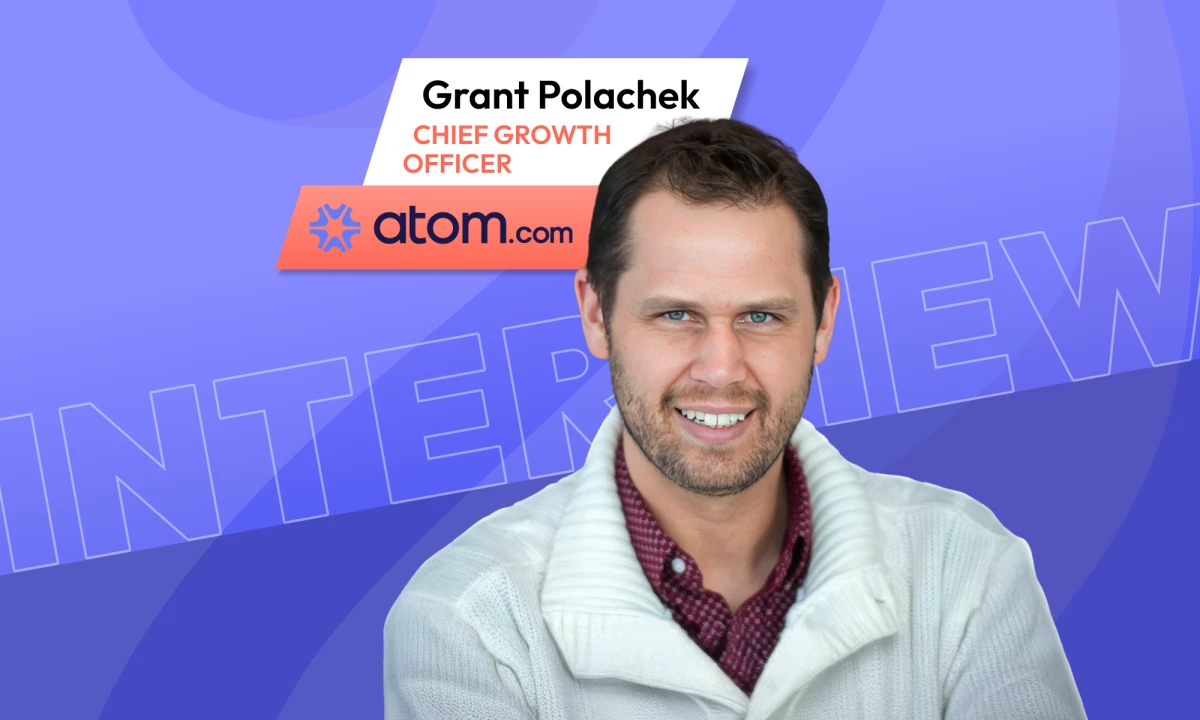
In an interview with DesignRush, Grant Polachek, chief growth officer at Atom, a global branding and domain marketplace platform, discussed how the team built its own AI logo maker.
The tool combines decades of branding expertise with advanced AI, helping startups and enterprises create logos that are strategic, emotionally resonant, and adaptable across contexts.

Who is Grant Polachek?
Grant Polachek is the Chief Growth Officer at Atom, a branding platform helping businesses create names, domains, and logos that stick. Atom has supported more than 50,000 companies worldwide and Polachek himself has led over 1,000 consultations with founders and brand leaders. His experience gives him a front-row view into how startups and enterprises alike balance brand imagination with day-to-day operations.
Build Logos That Communicate Emotion
Logos that connect capture the emotional essence of a brand. Polachek emphasized that most traditional tools miss this point, defaulting to generic icons that say little about the business they represent.
Atom’s AI logo maker was designed to close this gap. Founders can choose from brand styles like innovative, bold, luxurious, or peaceful and pair them with their own descriptions of brand identity.
This process ensures the final logo isn’t just visually polished, but aligned with the emotions the brand wants to spark in its audience.
“At Atom, we understand that what makes brands stand out is the key emotions they evoke in their audience,” Polachek said.
“Our logo maker allows brands to pair a style with a vision for the brand’s identity in the founder’s own words to create a truly impactful logo.”
For agencies and brand teams, that insight underscores how early emotional clarity sets the tone for effective creative partnerships.
Whether briefing a designer or experimenting with AI tools, defining the emotions a brand should evoke is the foundation of any strong logo collaboration.
Use Constraints to Unlock Creative Possibilities
Unlimited freedom in AI design tools can be overwhelming, especially for entrepreneurs without a creative background.
Atom’s team learned through years of branding experience that constraints often encourage stronger ideas.
Instead of presenting users with a blank canvas, the AI logo maker guides them with structured choices like logo type and style menus, paired with descriptive prompting.
This balance between direction and flexibility makes it easier for non-designers to generate options they feel confident in and reduces the risk of decision paralysis.
“One of the primary insights from our branding experts was that constraints can encourage creativity, which is why we added the drop-down Logo Type and Style menus alongside the ability for descriptive prompting,” Polachek explained.
Every good creative team gets this. When there’s just enough structure, clients stop second-guessing and start creating with you.
Test Relentlessly to Improve Real-World Quality
Atom tested the tool internally on hundreds of domain landing pages and actively incorporated community feedback.
Each iteration refined the prompts behind the AI, improving how well the logos aligned with real brand needs.
That cycle of testing and refining, Polachek noted, was what elevated the tool from a simple generator to a platform capable of producing logos that entrepreneurs could use with confidence.
“It gave us 100s of iterations on our backend prompts,” he said.
“Our community is very active and communicative, and they aren’t afraid to tell us when they don’t like something. This deep exercise in prompt engineering has had a huge impact on the quality of our logos.”
Treat AI as a Partner, Not a Replacement
Polachek is clear that Atom’s vision isn’t to replace human creativity, but to extend it.
The AI logo maker generates multiple formats to help founders brainstorm a range of possibilities.
From there, many choose to refine the results further with a designer, ensuring the final identity balances efficiency with originality.
“Our vision isn’t for AI to replace human creativity, but to become a valuable tool that enhances our creativity,” Polachek said.
This hybrid approach makes the tool versatile.
Budget-conscious startups can use it to launch quickly, while enterprise teams can leverage it for large-scale ideation before handing concepts over to design professionals.
Apply Enterprise Lessons to Improve Startup Tools
Working with global brands like Dell, Nestlé, and Hilton taught Atom that big companies value structured creative processes just as much as ideas.
Polachek explained that while these organizations understand brand strategy, they often lack consistent systems for naming, logo development, and decision-making.
Atom applied these lessons to its AI tool, embedding process-driven steps into the experience.
The process begins with vision and ends with emotion.
In between, structured prompts guide each step, bringing the focus and discipline of big-brand thinking to something founders can actually enjoy using.
“The main thing that big companies and branding experts understand is brand alignment: the connection between product, audience, and brand. Our AI is trained to work towards a powerful brand that prioritizes this connection,” Polachek says.
Make Design Accessible Without Losing Strategic Depth
Strong design has measurable business impact, but access has often been limited by budget and expertise.
Atom’s AI logo maker demonstrates how technology, guided by branding know-how, can democratize design without sacrificing strategy or emotional depth.
For founders, that means launching with confidence. For enterprises, it means scaling creative work with clarity and speed.
In the end, design that connects emotionally, and is built through real creative collaboration, is what builds trust, drives growth, and makes a brand unforgettable.
Atom’s AI Logo Maker FAQs
Designers, agencies, and founders are all asking how AI can fit into real creative work. Here’s what to know about Atom’s approach.
Why did Atom build its own AI logo maker?
Most tools produce generic clip-art logos; Atom built one that combines AI with branding expertise to create meaningful identities.
How does the tool capture brand emotion?
Founders choose from style options and describe their vision in their own words.
The AI uses that input to design visuals that reflect how a brand wants people to feel.
How was the tool tested before launch?
Atom iterated on hundreds of real domain pages and incorporated active community feedback to refine logo quality.
What makes Atom’s approach different from other AI design tools?
It blends structure with flexibility. The guided prompts keep users focused while helping them explore ideas that actually fit their brand.
Does this replace human designers?
Not at all. The tool jumpstarts ideas so designers and brand teams can focus on storytelling, detail, and craft, which AI tends to struggle with.
Is the tool useful for large brands as well as startups?
Yes. Startups can launch quickly, while enterprises use it to scale ideation with the discipline of brand strategy.