
As AI automates more of marketing, Noble Studios decided its next identity should come straight from its people's hands.
In September, the agency shortened its name to Noble and retired its single corporate logo.
The new identity uses more than 70 handwritten versions of the name, one from each person on the team, with every new hire adding another.
Noble also repositioned as a Business to People marketing agency, built on the idea that a person sits behind every B2B buyer, consumer, and traveler.
It made the call mid-growth, posting 13% year-over-year revenue growth and double-digit gains every year since 2022, the agency says.

Jarrod Lopiccolo, Noble's CEO and co-founder, sees AI flattening the work that agencies put out.
"As AI tools become more accessible, we're going to see a lot more work that looks and feels the same," he tells DesignRush.
"I think the ones that will stand out are the ones that use AI but with the lens of humanity."
Gartner expects plenty of brands to respond, predicting that over 80% of companies will significantly change their identity by 2028 to keep pace with AI.
Noble already has its answer on the table, handwritten by its own team.
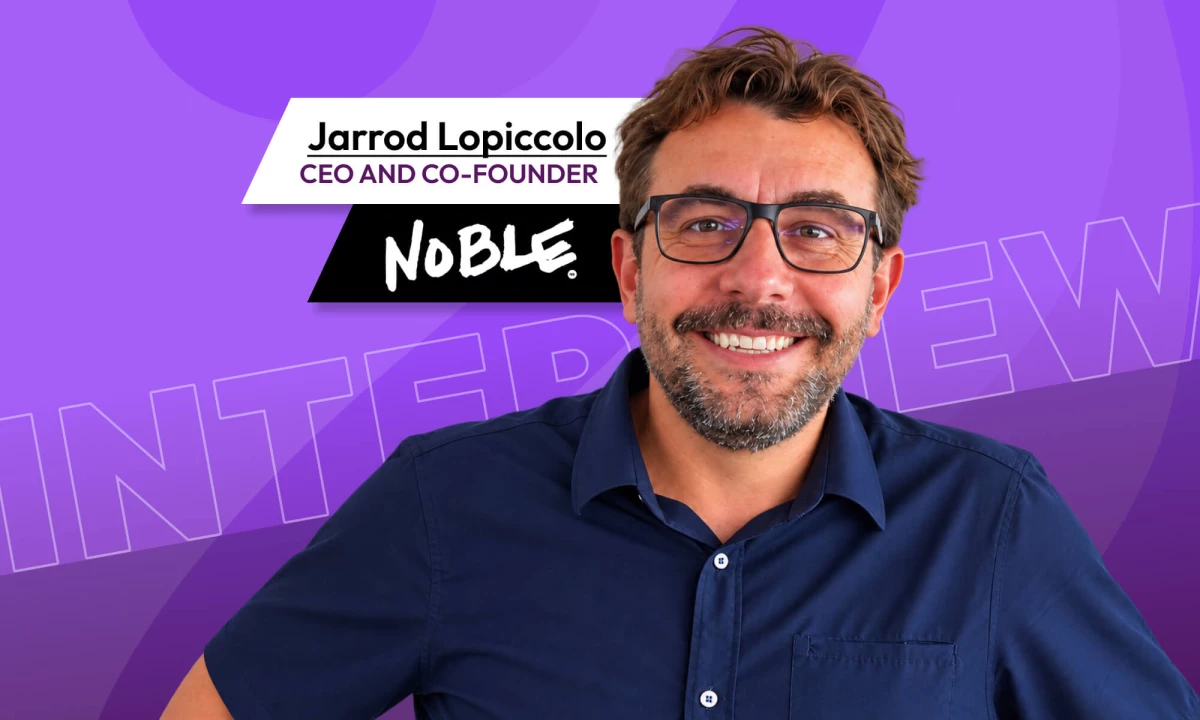
In this DesignRush interview, Lopiccolo explains why Noble put its people inside its logo and what this change cost.
He also lays out where AI sits in an agency that sells human judgment.

Who Is
Jarrod Lopiccolo
?
Jarrod co-founded Noble in 2003 with his wife, Season, and has grown it from a single-laptop business into an agency with offices in Reno, Las Vegas, and Bristol, U.K.
Noble has worked with big brands including Adobe, Disney, Visa, and Google.
Jarrod studied architecture at the University of Nevada, Las Vegas, a background he still brings to how Noble builds digital experiences.
He has spoken at Destinations International's Annual Convention, Social Media Week Bristol, and DMA West.
1. Drop the Labels Clients Have Outgrown
Lopiccolo is the first to admit that Noble could have left its agency name alone.
"Did we need to rebrand ourselves right now when we had all these amazing things happening? No," he says.
"But that's also the moment you should ask yourself, should we be rebranding right now?"
Noble leans on a question from author Rishad Tobaccowala, "Is your business designed for today, or is it designed for the future?"
"We knew that the desire for more human connection was going to be even greater in the future," he explains.
"We wanted to be ahead of the pack."
The name was the first thing Noble had outgrown, with "Studios" describing Noble accurately when it started as a web design studio.
As the agency grew, the word made it sound narrower than the work clients were buying, closer to a production or photography shop.
Lopiccolo compares the change to going by a first name. Nobody calls him Jarrod Lopiccolo, just Jarrod.
"With the industry recognition and the clients we have today, people just see us as Noble," he shares.
"So yes, legally we're still Noble Studios, but in our relationships with clients, team members, and partners, we're known as Noble.
It just felt right to start leading with that."
He also points back to where the agency's name came from in the first place.
"The fact that we named our company after this core value of being noble reinforces that decision."
Noble also dropped "digital" from its positioning, a word that once gave the agency an edge in pitches.
It used to lead client conversations with mobile-first experiences and responsive design, charging separately for ADA compliance and A/B testing.
"Now those things are just built into our work. They're expected," Lopiccolo says.
Lopiccolo already sees AI heading down the same road that digital took.
"Today, we're having those conversations about AI adoption.
But in five years, we're probably not going to be selling AI services. It'll just be standard," he points out.
"And I think what's funny is that one day we might start using the word 'physical' as a differentiator, just like we once used 'digital.'"
Noble sees part of its job as telling clients when a familiar practice has run its course, the same test it just ran on its own name.
2. Put the Team Inside the New Identity
Shortening the name was the easy part. The logo took a lot more nerve.
Lopiccolo and his team felt that Noble's previous logo was "very corporate, very technical and too polished."
The new brand identity drops the idea of one fixed mark.
Every employee writes "Noble" in their own handwriting, and new hires add theirs to the library.
Versions stay in the system after someone leaves unless the person asks for theirs to be removed.
"Our signature is really an extension of ourselves, an extension of our identity. And that's what our brand identity is made up of," Lopiccolo says.
The work, led by Chief Creative Officer B.C. LeDoux, broke one of the most basic logo conventions on purpose.
LeDoux even joked in the rebrand announcement that "Paul Rand and other amazing designers are eye-rolling us in their graves."
Lopiccolo also had his doubts when the team first walked him through the concept.
"Are people going to trust us with their brands if we're doing something so bold?" he remembers thinking.
But he reminded himself that "if you believe in the reason behind it, you're in a safe and defensible position."
"What if we actually embrace the imperfection, embrace the individuality that has become our strength?" Lopiccolo shares what was going through their heads at the time.
"People are always the variable. They're what makes every single company successful.
That's what gave me confidence in the decision to move forward," he adds.
A week after launch, Lopiccolo sat down at a boardroom table at the University of Nevada, Reno College of Business.
Before introductions, someone started praising a local company whose logo was made of every employee's handwriting.
"You know that's Noble, right?" he joked. "Yeah, that's the company name," came the reply. "No, that's us," Lopiccolo said.
"It was this amazing moment where someone was using us as an example of humanity without knowing we were even in the room. That filled up my cup," he shares.
A logo made from employee signatures depends on the employees sticking around.
The agency says it averages 95% quarterly team retention, and 42% of employees have earned an internal promotion or reached long tenure.
"We've always believed in promoting people earlier than they're ready because they'll fill the shoes," Lopiccolo says.
"We've given people bigger challenges than they're fully ready for because we know they'll rise to the occasion."
Noble borrows Jim Collins' idea of getting the right people on the bus, then working out which seat fits each one.
When someone who fits the culture ends up in the wrong role, the agency works with them to create a better one.
Monthly recognition and 360-degree peer reviews reward employees for how they live Noble's core values.
"We've always had this people-first belief. The difference is that we're now expressing it through the brand itself," Lopiccolo says.
"Our people aren't just representing Noble. They're literally part of our identity."
Culture claims are easy to make and hard to show.
Building every employee's mark into the design system puts the evidence on every deck, site, and shirt clients see.
3. Keep AI in the 'Messy Middle'
Lopiccolo hears the same request in almost every pitch.
"Everyone wants things faster, cheaper, and better," he says.
"And I always joke that you can have one of those things. You can't have all three, right?"
He sees AI's effect most in new business, where a pitch that once went to five agencies can now draw hundreds of applicants.
"Everybody has access to the same tools, and when you see the responses afterward, there's this sea of sameness," he reveals.
The winning pitch, he concludes, is the one that "didn't let those tools dictate the outcome."
"That's how we think about AI at Noble. Our process starts with a human understanding the problem and getting context," Lopiccolo explains.
"We use AI for the messy middle, and then at the end, it's all human again."
Six weeks of research have little value on their own anymore, he says. The value is in finding the white space.
"We have a pretty hard line. If it smells like AI, we're immediately going to lose trust," Lopiccolo shares.
"We have to maintain our individuality because that's what clients come to us for."
In a 2026 Canva and Harris Poll survey, 69% of consumers expect future ads to feel like generic AI output, and 74% are more likely to buy from all-human ads.
"Technology is a great tool, and it's needed," Lopiccolo says.
"But we can never lose sight of human connection. That's what drives progress, commerce and relationships. It's the human part."
Faster execution raises the price of judgment.
Once the tools clear the blank canvas for everyone, the client's context and the call on what to do with it are what's left to compete on.
4. Earn a Seat at the Client's Table
Noble's longtime clients see the human side up close, which made them the toughest audience for the change.
The company says it retained 77% of clients in 2025, and 94% of its revenue came from returning clients.
Lopiccolo credits a habit that his team shares with its clients for these numbers.
"I think what keeps clients coming back, and I truly mean this, is that we actually go to sleep worrying about the same things our clients worry about," he says.
"When you become empathetic, not just sympathetic, you feel their challenges as your own.
When they have a bad quarter, you feel it. When they succeed, you feel that too. You're not disconnected from the realities of their business."
Lopiccolo also draws a line between two kinds of agency relationships.
"Our clients have always referred to us as a partner rather than a vendor. And there's a big difference," he explains.
"If you're a partner, you're listed on the balance sheet as an investment. If you're a vendor, you're listed as an expense.
"So when sh*t hits the fan, you better hope you're listed as a partner."
Clients who know Noble this well judge a new identity against years of customer experience with the agency.
"I remember one client describing it as 'spot-on' and very inspiring," Lopiccolo shares.
"When clients know you really well, your brand is almost like an outfit you put on.
You can tell when it doesn't match the personality. Our clients see this as the true version of us."
Lopiccolo measures the rebrand's return by how it makes clients feel.
"We joke that ROI can also mean return on inspiration," he says.
"If we can give people goosebumps, that's one of the best returns you could ask for."
Gartner puts a number on the business side, finding that companies with a strong brand strategy are twice as likely to exceed their growth goals.
Lopiccolo's advice starts with a three-to-five-year test.
"I'd encourage any company to ask whether they're showing up as the business they want to be in the next three to five years," he shares.
"And don't wait for everything to be perfect. If you wait for the perfect moment or the biggest budget, you're oftentimes waiting too long."
As AI makes execution easier to buy anywhere, agencies grow by showing clients the people behind the creative work.
A brand strategy that puts these people in the logo itself shows clients exactly what kind of agency they're hiring.
Brands and agencies weighing a rebrand of their own can start here:
- Audit your name for words every competitor can claim. Any word in your name or tagline describing a standard capability is due for retirement.
- Test the identity on strangers. Feedback from people outside the company shows whether the identity reads clearly, with no one in the room to explain it.
- Plan the system past launch day. A flexible identity needs rules for palette, type, and illustration that keep growing after the first rollout.
Lopiccolo sums up the case for rebranding while the business is still growing, before the market forces the decision.
"Ultimately, a successful brand should clarify who you've become and who you want to be.
The world is moving, and you've got to move with it."
And that's why Noble's logo is designed to keep moving, growing right along with the team behind it.