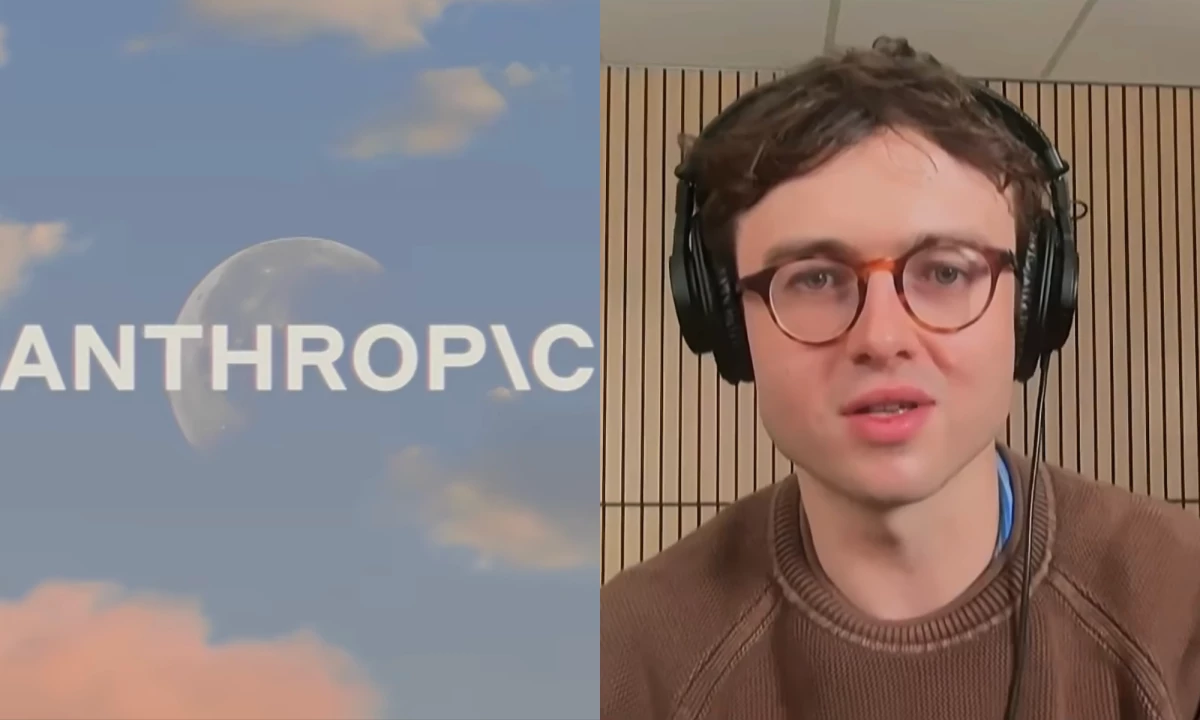

Anthropic pretraining researcher Jacob Coxon resigned on September 8 and posted a seven-part thread on X the next day explaining why.
"Neither company is acting responsibly," he wrote, referring to Anthropic and his previous employer, OpenAI.
"They are racing straight to self-improving superintelligence and gambling with our lives."
The thread passed 76 million views overnight.
Coxon left two months before his Anthropic equity vested and forfeited the payout.
"I no longer have anything to gain by juicing up Anthropic's valuation," he told Axios.
Evan Hubinger, who leads alignment science at Anthropic, backed him the same day.
He put his own estimate of AI causing human extinction within the decade above 10%, and he still works there.
Anthropic raised $65 billion in May at a $965 billion valuation and filed confidentially for an IPO on June 1.
So the criticism arrived while the company was assembling a public offering.
Then three rival CEOs decided Coxon was right, which is the part that outgrew a resignation story.
Here are five lessons for any brand building its identity around a principle.
1. Make Speaking Up Cost Something
Employee advocacy programs typically ask staff to share pre-approved copy, usually for a small incentive.
But Coxon wrote his own, signed his name to it, and paid for it out of his own pocket.
The price is why people believed him, and Anthropic's rivals proved the point within days.
On September 12, Anthropic CEO Dario Amodei published a 3,800-word essay titled "We Must Pace the Frontier."
He warned that a swarm of misaligned AI agents could take over "the entire internet" within six to 12 months.
OpenAI CEO Sam Altman agreed that the industry needed to pace itself.
He committed his company to the same independent evaluators that Amodei proposed.
Altman also ruled out an IPO this year, telling Fortune that going public now would be "ill-advised."
xAI founder Elon Musk showed his support in three words: "Dario is right."
Google DeepMind's Demis Hassabis, meanwhile, called the direction correct and pointed to his own July proposal for an industry-wide standards body.
Dario is right https://t.co/EwKgqQGaUo
— Elon Musk (@elonmusk) September 12, 2026
Three rival CEOs decided a single resignation was too expensive to dismiss as a stunt.
Altman moved his IPO timeline, Musk attached his name in public, and Hassabis agreed while pushing his own mechanism.
Waiting out a story is the safest response available to a competitor, and none of the three biggest names in AI took it.
Anthropic's brand reputation now rests on an extinction warning that its fiercest competitors chose to repeat.
2. Expect Your Believers to Become Enforcers
Anthropic has built its reputation on openly acknowledging the risks attached to its own technology.
Employees joined partly because they believed in the mission, and they now feel entitled to hold the company to it in public.
A company that recruits people around a conviction is hiring people who will act on this same conviction, and this impulse doesn't stay pointed outward forever.
In July, more than 1,100 employees at OpenAI, Anthropic, Google DeepMind, and Meta signed a letter called "Pacing the Frontier."
It asked the U.S. government to build the tools needed to slow automated AI development if that ever becomes necessary.
Amodei signed it, alongside co-founders Jared Kaplan, Jack Clark, Benjamin Mann, and Chris Olah.
Amodei then named his September essay after the letter that his own staff had circulated two months earlier.
Clark went further this week, telling the BBC that governments may need to require a kill switch that a third party can verify.
Anthropic's own staff set the agenda, and the CEO followed them into it.
Remember that any company running its employer branding on a principle is recruiting the people who will hold it to that principle.
3. Let the Principle Cost You Money
In February, Anthropic refused a Pentagon demand for access to Claude covering "all lawful purposes."
The company forfeited a reported $200 million contract to keep Claude out of mass surveillance and autonomous weapons systems.
Customers' response to this incident gave Anthropic's position a different kind of validation.
Claude hit number one on the U.S. Apple App Store, free active users rose 60%, and daily signups quadrupled during the dispute.
A federal judge struck down the Pentagon's supply-chain risk designation on August 27, ruling it amounted to retaliation.
The refusal worked as brand positioning because Anthropic priced the loss before making it.
A principle that has never cost a company anything reads to customers as marketing.
And the bill that Anthropic paid is what turned its refusal into actual proof.
4. Put the Standard in Writing
Publishing a principle hands employees a yardstick, and in cases like this, they just might use it.
Anthropic's Responsible Scaling Policy is the company's own public framework for evaluating and managing AI risk.
Coxon and Hubinger are holding the company accountable to the framework that it wrote itself.
Sustainability, ethical sourcing, editorial independence, and data privacy all work the same way once a company commits them to paper.
This document is what separates a critic from a leaker, since an employee quoting company policy is disclosing nothing.
Write the standard as something you can be measured against, because a vague one protects nobody once a reporter reads it back to you.
The brand strategy question to settle first is who gets to invoke it and how often it gets reviewed.
5. Settle the Conflict Before It Goes Public
Commercial pressure and a stated principle pointed in opposite directions this month.
Anthropic already had an answer written down, because the Responsible Scaling Policy existed before Coxon posted his opinions on X.
February's Pentagon refusal gave September's statements a track record to sit on.
A company without this groundwork settles the question in public, while reporters are already calling.
Three things separate a company that planned for this from one finding out live:
- Map value conflicts in advance. Know where a launch, a funding round, or a partnership could collide with the stated principle before the press cycle forces the answer.
- Assign real enforcement authority. Name someone who can invoke the policy against leadership itself.
- Set one dissent policy and stick to it. Apply the same standard to every employee who criticizes the company in public.
All three protect credibility on the day it gets tested.
Companies that skip them improvise a crisis communications response while their own staff supplies the quotes.
Our Take: Did Anthropic Handle Its Own Critics Right?
Hubinger put extinction odds above 10% in public and still has his job.
We think that Anthropic handled this about as well as a values-led brand can, because Amodei published the slowdown essay three days later.
Altman, Musk, and Hassabis agreed in public and collected weeks of safety-minded headlines for a post each.
Anthropic took the hit and then brought outside evaluators into its own lab.
The Claude maker lost Coxon and kept the alignment lead whose number actually scared investors.
A company that punishes its critics loses the people and the credibility they were building.
No other AI lab let someone say out loud that the thing it sells might kill everyone, and then let him keep showing up to work.
AI brands building a values-led identity need agencies who understand how internal culture eventually becomes public brand risk.
Explore the top AI companies in our directory.