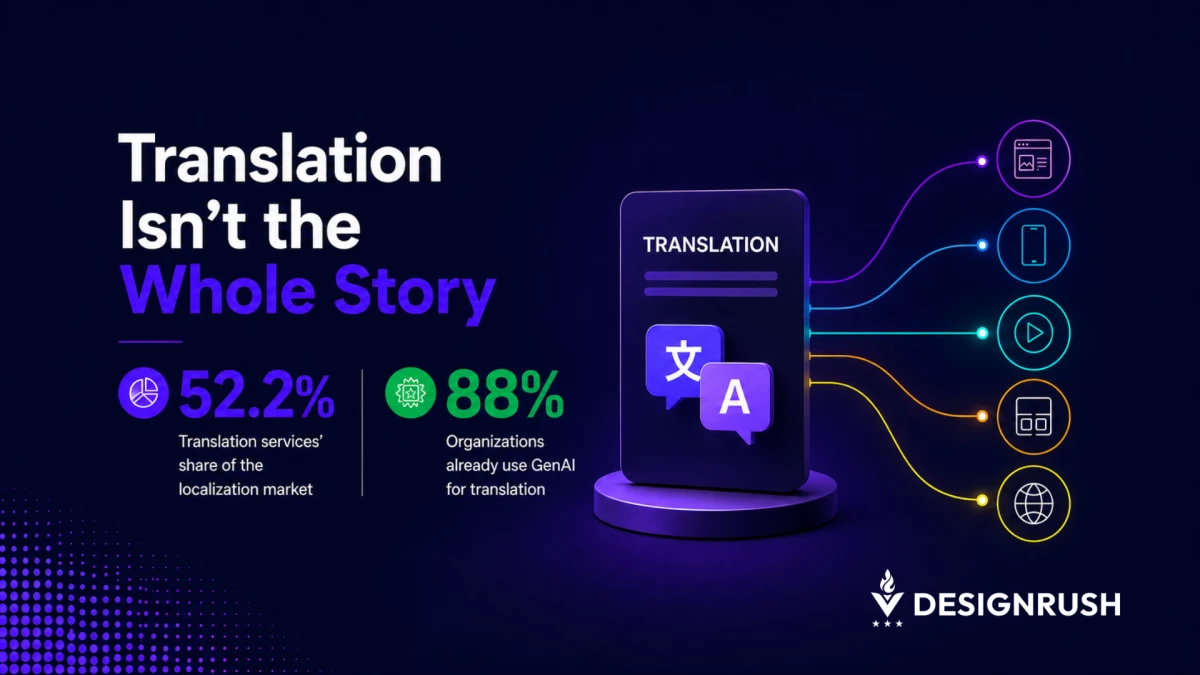

Translation services are expected to account for more than 52% of the global localization strategies market by service type this year, according to Coherent Market Insights, making them the industry's largest service category.
That leaves 48% of the spend going to everything else.
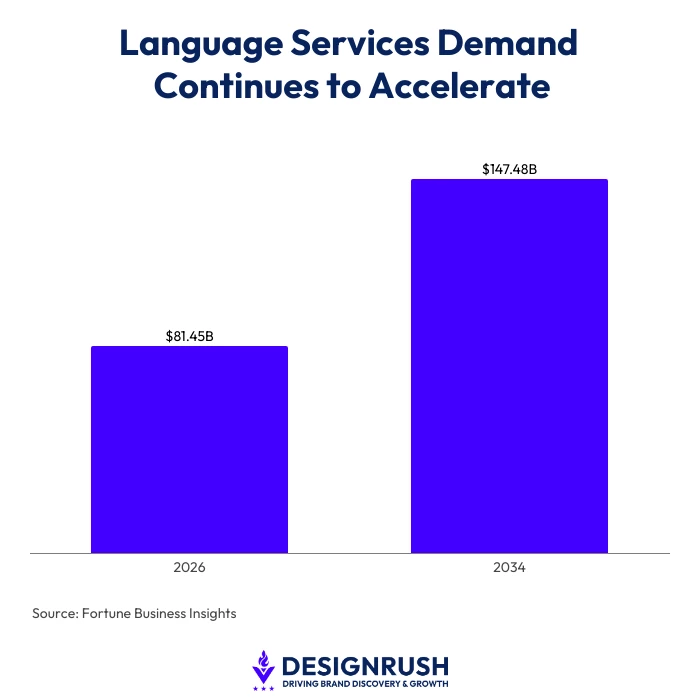
Demand is growing across the wider language services industry, too. Fortune Business Insights projects the global language services market will increase from $81.5 billion this year to $147.5 billion by 2034, a compound annual growth rate of nearly 8%.
But Steven Gurevitz, CEO of 2002 Studios Media, a leading content production and localization agency, says the larger share of that spend buys the least valuable part of the job.
"A lot of the spend on localization, which is translation, is what I call churn spend. In fact, no one's making money out of it. It's being fed into AI credits, and nowadays it's a commoditized item. The bit where the value is in the 48%," Gurevitz says.
AI can now translate huge volumes of content in seconds.
In fact, 88% of content decision-makers say their organizations already use generative AI for translation in some form, and 70% of translations are now machine-assisted, according to Forrester's Rethinking Localization in the Age of AI.
But customers experience much more than text. They move through websites, apps, videos, and support material, all of which need to work naturally in their language and culture.
The team at 2002 Studios Media believes that's where many localization projects begin to fall apart, because businesses often underestimate the engineering, production, and testing that follow translation.
Gurevitz adds that even with the translation speed offered by AI, the amount of work needed to localize digital products hasn't gone down.
"Customers aren't reading isolated blocks of text. They're using websites, apps, videos, and software. Every part of that experience has to work naturally in their language."
Why Businesses Keep Putting the Translation Process First
The misconception that localization means translation isn't new.
Much of the localization industry grew around translation services, so linguistics naturally became the starting point for many projects.
"The industry was set up by translation companies. They're often who people are going to. They've got the most money, they do the customer acquisition. But you're essentially getting into a food chain where we're at the back end," Gurevitz says.
Unfortunately, this resulted in production planning, engineering, multimedia, and quality assurance being treated as separate stages that come later.
Problems often begin before translation starts. Websites, videos, and e-learning courses are sometimes sent for translation before the source material has been properly prepared.
As layouts or technical requirements change, translators, designers, developers, and editors can find themselves revisiting work that could have been done correctly the first time around.
This is also seen when it comes to video localization.
A 30-second television commercial usually needs every translated voiceover to match the original runtime. A two-minute training or promotional video often doesn't because viewers won't compare different language versions side by side.
Yet many organizations still request tightly synchronized audio for every project because those selling and managing these solutions often don't understand the variables and options available to them, given that their core expertise is linguistics.
This often adds production time without necessarily improving the final experience.
"Many localization problems are created long before anyone starts translating," Gurevitz says.
"If nobody questions the project scope or workflow at the beginning, every team that follows spends time fixing problems that didn't need to exist."
Why Translation Is Only One Part of Localization
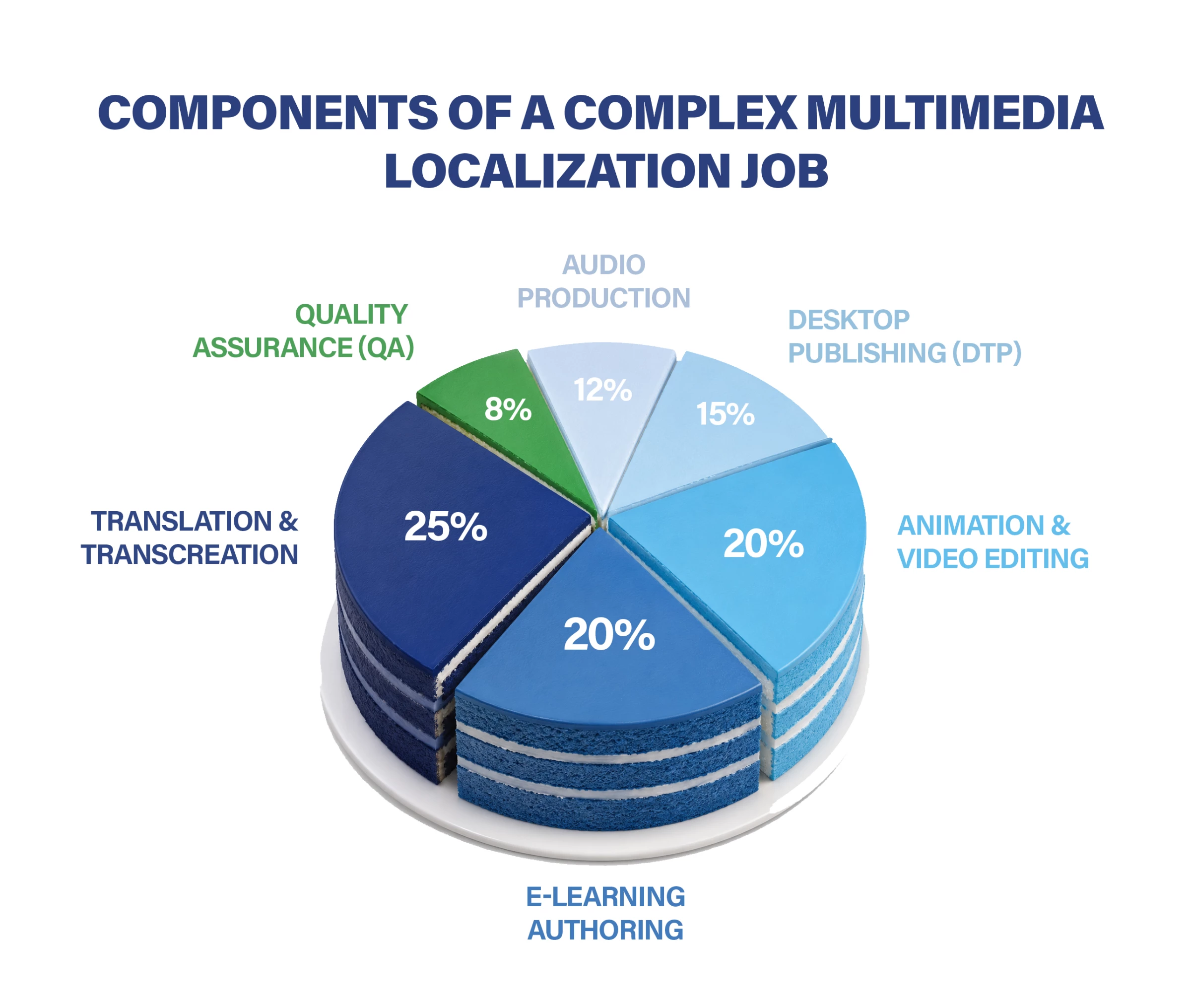
2002 Studios Media compares localization to baking a cake.
Translation is one ingredient. Engineers, designers, editors, and voice artists are the ones who turn it into something you can serve.
They rebuild layouts, adapt software, edit video, record voiceovers, and test the experience before it reaches customers.
2002 Studios Media's production framework illustrates the point, with translation and transcreation accounting for about 25% of the production effort.
The rest is spread across e-learning engineering, multimedia production, desktop publishing, audio production, and quality assurance.
And even though AI may speed up translation, those stages still require specialist expertise.
"Translation gives us the raw materials. The real work starts once those materials have to function in another language, on another platform, and in another culture," Gurevitz says.
"That's where localization either succeeds or fails."
Where AI Translation Works Best
AI works best on content where speed matters more than creative judgment.
Internal documentation, support articles, knowledge bases, and product specifications are good examples.
AI can produce a strong first draft, while leaving linguists to review terminology, refine the language, and adapt content where local context matters most.
"AI has changed the way translation teams work," Gurevitz says.
"When it works well, it gives linguists a much stronger starting point. That's where it delivers real value."
Where Human Expertise Still Matters
The same approach doesn't work everywhere, especially given that customer-facing content brings a different set of challenges.
These include marketing campaigns, legal disclosures, healthcare information, financial communications, and websites, all of which depend on context that extends beyond language.
Here, a translation can be technically accurate while still sounding unnatural, missing cultural references, or failing to meet local regulations.
Digital experiences also create another layer of complexity. To mitigate this, websites need layouts that are adjusted to accommodate longer languages, while videos require graphics, subtitles, and voiceovers to be rebuilt.
E-learning courses may need interactive elements rewritten, retimed, and tested before they're ready for another market.
"Translation is one deliverable, but everything around it still has to work for the audience using it," Gurevitz says.
"That's where people continue to make the biggest difference."
When Poor Translation Becomes Costly
History offers many examples of what can happen when organizations treat translation as the finish line.
HSBC Private Bank hired WPP for a $10 million rebranding exercise, replacing an "Assume Nothing" campaign that had been mistranslated as "Do Nothing" in some countries, according to WealthBriefing.
Likewise, KFC's early expansion into China became widely known for translating "Finger-Lickin' Good" as "Eat Your Fingers Off."
And while those examples are memorable because they're easy to laugh about, others have carried much greater consequences.
An example of this was when medical device instructions were mistranslated, contributing to incorrect procedures
Meanwhile, inaccurate legal disclosures and consent forms have created compliance risks in regulated industries.
In cases like these, the words themselves weren't the only problem. The review process failed to catch how the content would be understood and used in another market.
"Most localization failures aren't caused by a lack of technology," Gurevitz says. "They're caused by treating translation as the end of the process instead of the beginning."
Why Translation Is Only the Beginning
For 2002 Studios Media, successful localization begins well before the first sentence is translated.
Gurevitz recommends preparing source material before translation starts so production teams can extract content correctly, define technical requirements, and avoid unnecessary revisions later.
He also suggests matching AI to the level of business risk, using automation where speed matters most while reserving human reviews for customer-facing, regulated, and brand-critical content.
"Keeping engineering, multimedia production, and quality assurance connected throughout the project also reduces delays caused by repeated handoffs between vendors," Gurevitz says.
"If the client wants an e-learning course back or a bunch of videos back, then the team that understands such deliverables should be the ones driving the client relationship and managing the overall project."
Gurevitz adds that production and design companies should keep content and localization with an agency that provides these services in-house where possible, rather than relying on a long, fragmented and never-ending supply chain.
"Businesses often think localization starts with translating content. In reality, translation is where one part of the work ends and the rest of the work begins," he says.
And even though AI is making translation cheaper every year, the bigger question is whether businesses have mistaken the easiest part of localization for the most important one.