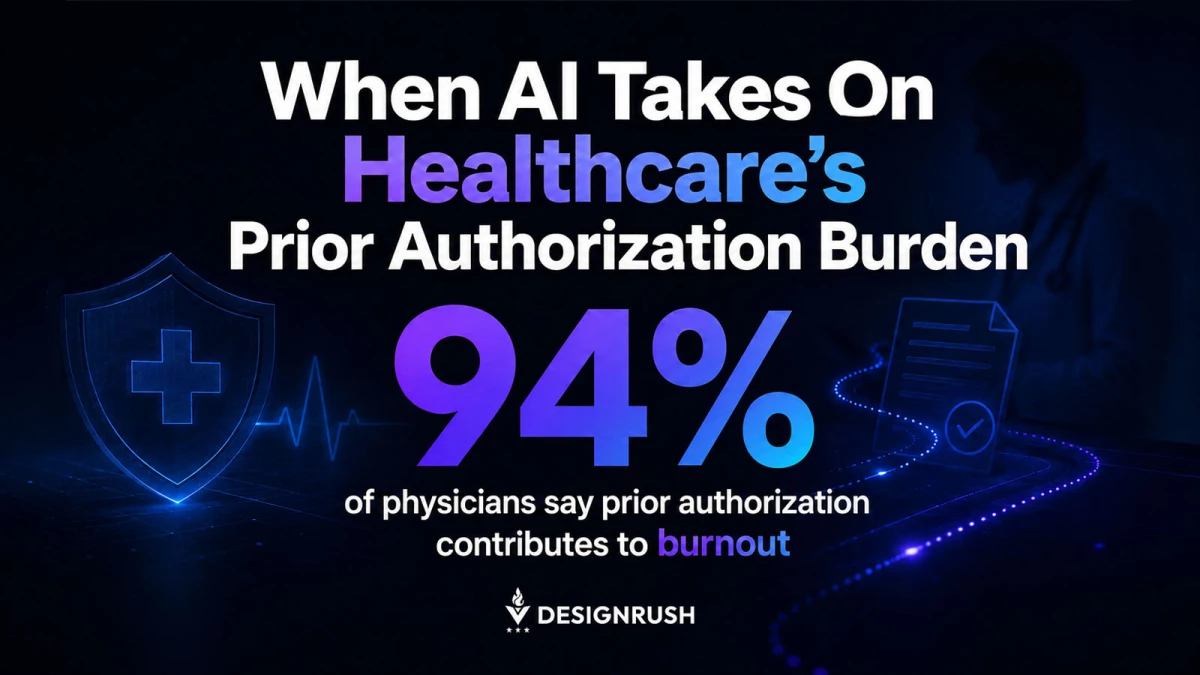

Prior authorization is a time-consuming healthcare process, with the AMA's 2025 survey, released in May 2026, stating that 94% of physicians say it causes burnout.
Practices complete around 40 prior authorizations weekly, which take approximately 13 hours of staff time. The survey also shows that 40% of practices have dedicated staff for this task.
The burden goes beyond just paperwork.
The staff would need to identify the need for authorizations, collect medical documents, fill out forms, send documentation, wait for the reply, and provide additional information when needed.
This presents a real chance for AI agents working at the provider’s side.
These agents won’t be making any clinical decisions but rather will perform the same routine tasks in connection with the prior authorization, from gathering evidence and preparing requests to tracking submissions and identifying cases that need human attention.
Why Prior Authorization Is a Strong Use Case for AI Agents
A typical authorization request can involve multiple systems and several administrative steps.
Staff may need to:
- Determine whether authorization is required
- Identify payer-specific requirements
- Retrieve relevant patient records
- Gather supporting clinical evidence
- Complete authorization forms
- Submit documentation
- Track the request
- Respond to additional-information requests
- Prepare an appeal when a request is denied
Most of these activities surround the clinical decision rather than constitute the decision itself.
That distinction makes prior authorization well suited to AI-agent automation.
An agent can coordinate information across systems, perform repetitive tasks, and prepare work for staff while leaving medical necessity, clinical interpretation, approval, and final decisions to qualified professionals.
Where AI Agents Can Handle Prior-Authorization Work
AI agents can coordinate several stages of the authorization workflow rather than automating only one task.
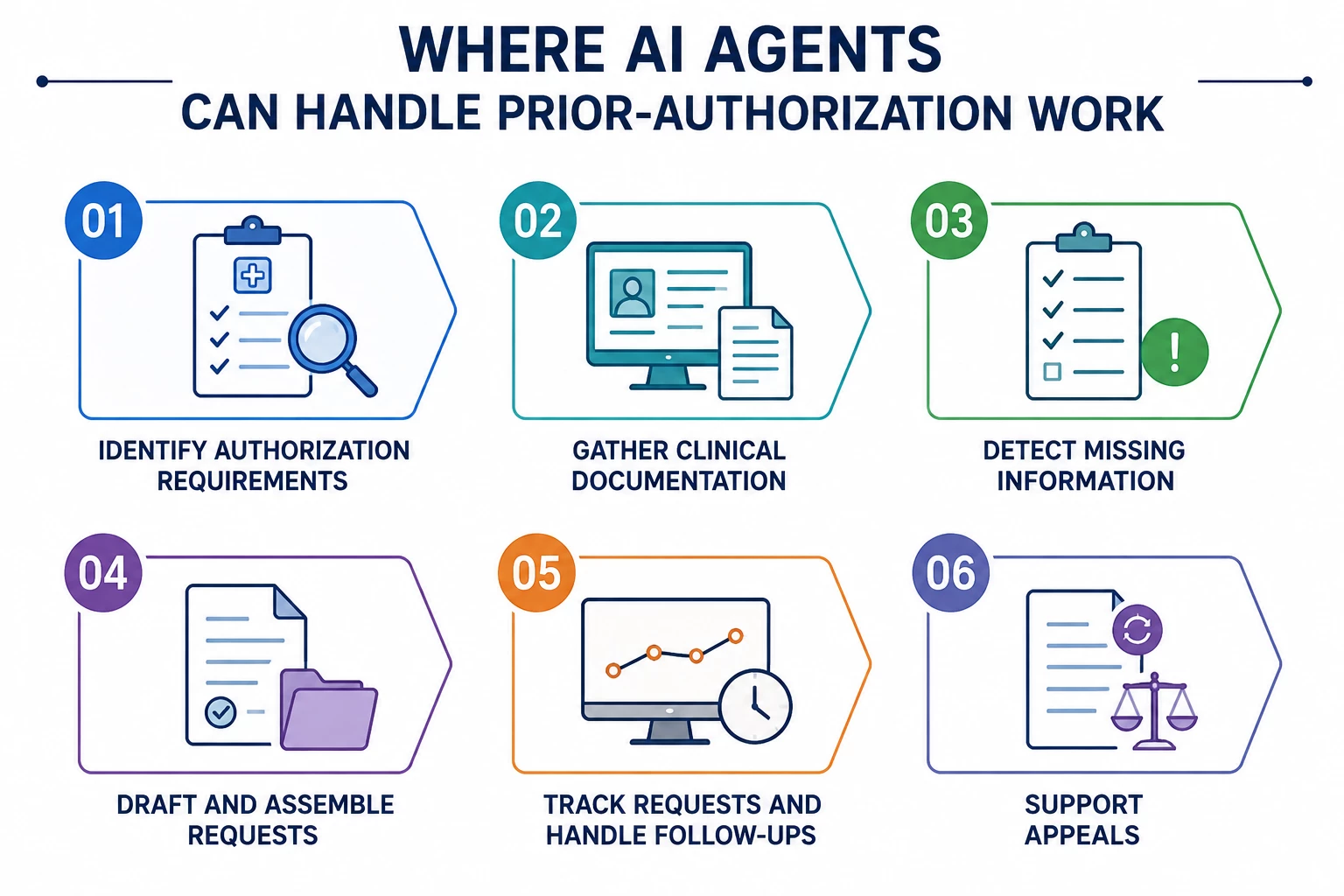
Identify Authorization Requirements
An AI agent can analyze an order, identify the patient's payer, and determine whether prior authorization may be required.
It can then retrieve the relevant payer requirements and identify the documentation needed for submission.
Gather Clinical Documentation
Rather than manually looking through several records, an agent can pull up pertinent information on the diagnosis, laboratory tests, medications, physician’s notes, and all other documents from the associated healthcare IT systems.
Information can be extracted from unstructured clinical notes using natural language processing.
Detect Missing Information
Incomplete submissions can create additional delays.
The agent may compare the documentation that is readily available to the needs of the payer to identify what is missing before the request is made.
For instance, in case the payer needs documentation of attempts at treatment, the agent may be able to tell whether such records are available and notify staff when additional information is needed.
Draft and Assemble Requests
The agent can populate forms, organize supporting documents, summarize relevant clinical evidence, and prepare the authorization package for human review.
This is where provider-side AI can reduce repetitive administrative work without making the underlying clinical decision.
Track Requests and Handle Follow-Ups
After submission, an agent can monitor connected payer systems, identify status changes, and notify staff when action is required.
Medicare Advantage insurers alone made nearly 53 million prior authorization determinations in 2024, illustrating the scale of the administrative workflow involved.
Support Appeals
When an authorization is denied, an AI agent can help assemble the relevant documentation, identify the reason for denial, organize supporting evidence, and draft an appeal for review.
The appeal should still be reviewed and approved by the appropriate healthcare professional before submission.
The Administrative Burden Is Already Significant
Given that the AMA survey found that prior authorization contributes to burnout, it’s fair to assume that the technology opportunity is therefore not simply about making paperwork faster.
It is about reducing the amount of time clinical staff spend navigating administrative processes that do not require their full clinical expertise.
At the same time, there is growing concern about the use of AI on the payer side, with the AMA reporting that 61% of physicians are concerned that health insurers are using AI to deny or reduce access to care.
The stronger case for AI on the provider side would be using AI technology to enable clinicians and their teams to build better-justified requests, not to use AI to make decisions on whether to provide care for patients.
Traditional Automation vs. AI Agents
Typically, RPA-driven automation is limited to repetitive actions such as data transfers between systems, pre-defined field inputting, or file transfers.
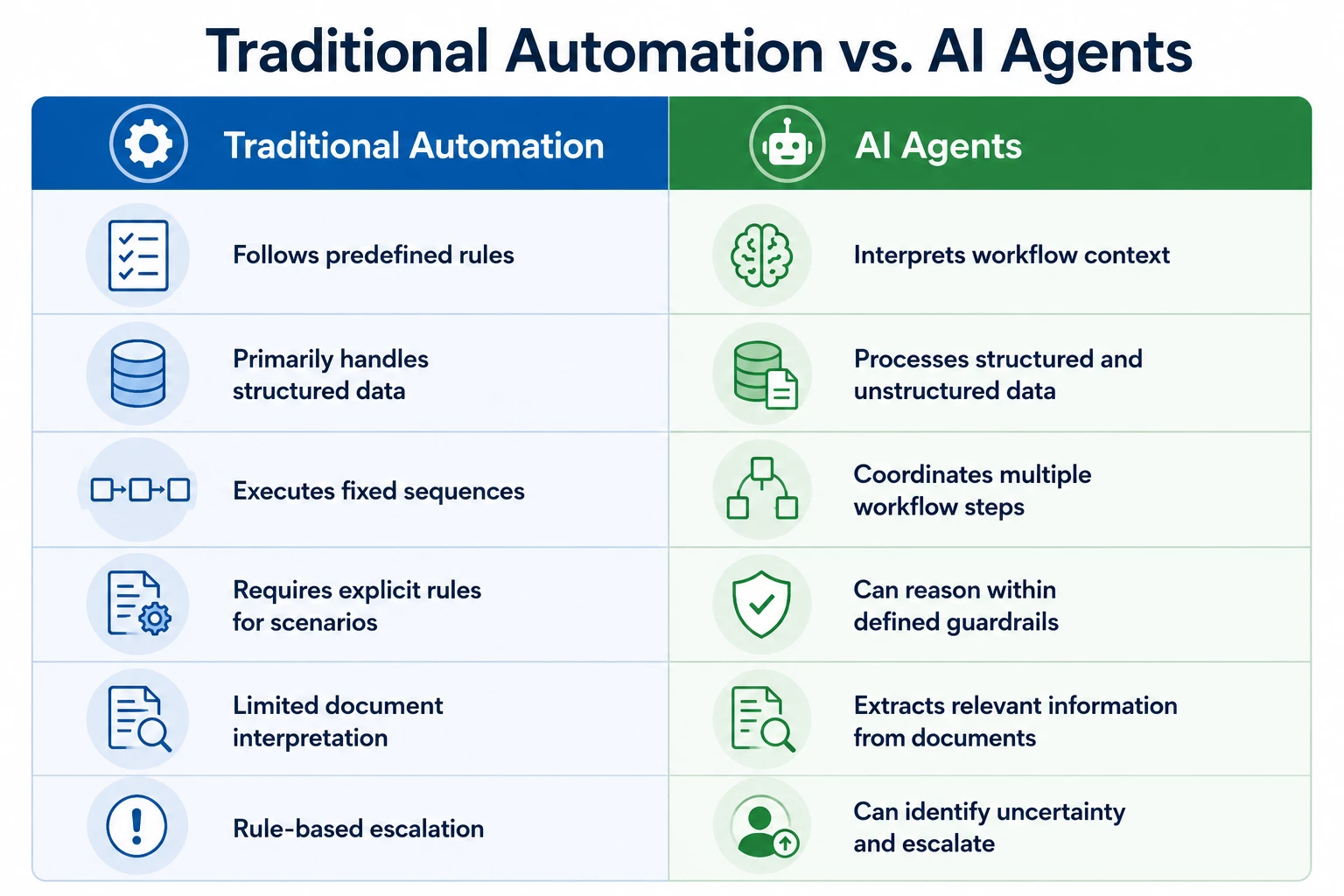
AI-powered agents can accomplish more complicated actions, including information analysis, finding related documents, orchestrating the process's several steps, and handling exceptions.
There is no need for these two automation methods to be competitive against each other.
For example, a healthcare organization may leverage LLMs, RPA, APIs, NLP, a rules engine, and agentic workflow orchestration to design an advanced prior-authorization workflow.
What an AI-Enabled Prior-Authorization Workflow Would Be Like
Let's suppose a doctor prescribes a treatment that needs prior authorization. This is how the workflow might look:
- Order detection: The agent detects that prior authorization is needed.
- Payer verification: It identifies the payer and retrieves applicable requirements.
- Record retrieval: Relevant clinical documentation is collected from connected systems.
- Evidence mapping: Available information is mapped against payer criteria.
- Gap detection: Missing documentation is identified.
- Request preparation: The authorization package is assembled.
- Human review: Authorized staff validates the information and approves the submission.
- Submission and tracking: The submission is made and tracked.
- Exception handling: Requests for more information, denials, and special cases are referred to employees.
- Appeal assistance: In appropriate cases, the representative gathers information to prepare an appeals letter for human review.
The objective is not to allow AI to decide whether a patient needs treatment but to reduce the administrative workload surrounding that decision.
Why Human Oversight Still Matters
Prior authorization affects access to healthcare, so provider-side AI should operate within clear boundaries.
Human oversight remains important for:
- Clinical judgment: The AI cannot independently perform any medical necessity or treatment determinations.
- Exception handling: Exception cases should be escalated.
- Appeals: The clinician or other authorized personnel should evaluate the appeals before submission.
- Auditability: Actions performed by the agent, information obtained, and documents produced should be auditable.
- Security: The agents should use proper access controls and least-privilege principles.
- Compliance: The healthcare providers must also take into account the necessary legal aspects of privacy, security, and compliance.
This means that there is human intervention in the process, not purely autonomous decision-making.
How Healthcare Organizations Can Start
The best starting point is not full autonomy.
Organizations can begin with high-volume, repetitive activities such as authorization verification, documentation retrieval, form population, status tracking, missing-information detection, and appeal preparation.
Performance can then be measured using metrics such as:
- Authorization processing time
- Staff hours per request
- First-pass submission rate
- Additional information requests
- Human escalation rate
- Denial rate
- Appeal preparation time
- Treatment delays
These measurements help determine whether AI is actually reducing administrative workload and improving workflow efficiency.
Building Provider-Side AI Agents for Prior Authorization
Prior authorization is a practical example of where agentic AI can augment healthcare workflows without replacing clinical expertise.
The most valuable implementation would not be one where the AI itself makes decisions.
Rather, it would be an automated process of using the AI to collect information, make sense of the guidelines and regulations, gather the documentation, and take action appropriately.
For organizations exploring healthcare solutions, this approach provides a way to reduce administrative workload while keeping clinical judgment and final decisions with healthcare professionals.
The goal is simple. Let AI handle more of the administrative work so clinical staff can spend more of their time on patient care.