
AI in the Media: Key Findings
- Agencies that scale AI successfully build process first. AI accelerates what’s already structured and repeatable.
- Visibility in tools like ChatGPT and Gemini is about delivering real product value that earns credible digital signals.
- Prompts are strategy. Without context and clarity, LLMs return generic outputs that flatten brand differentiation.
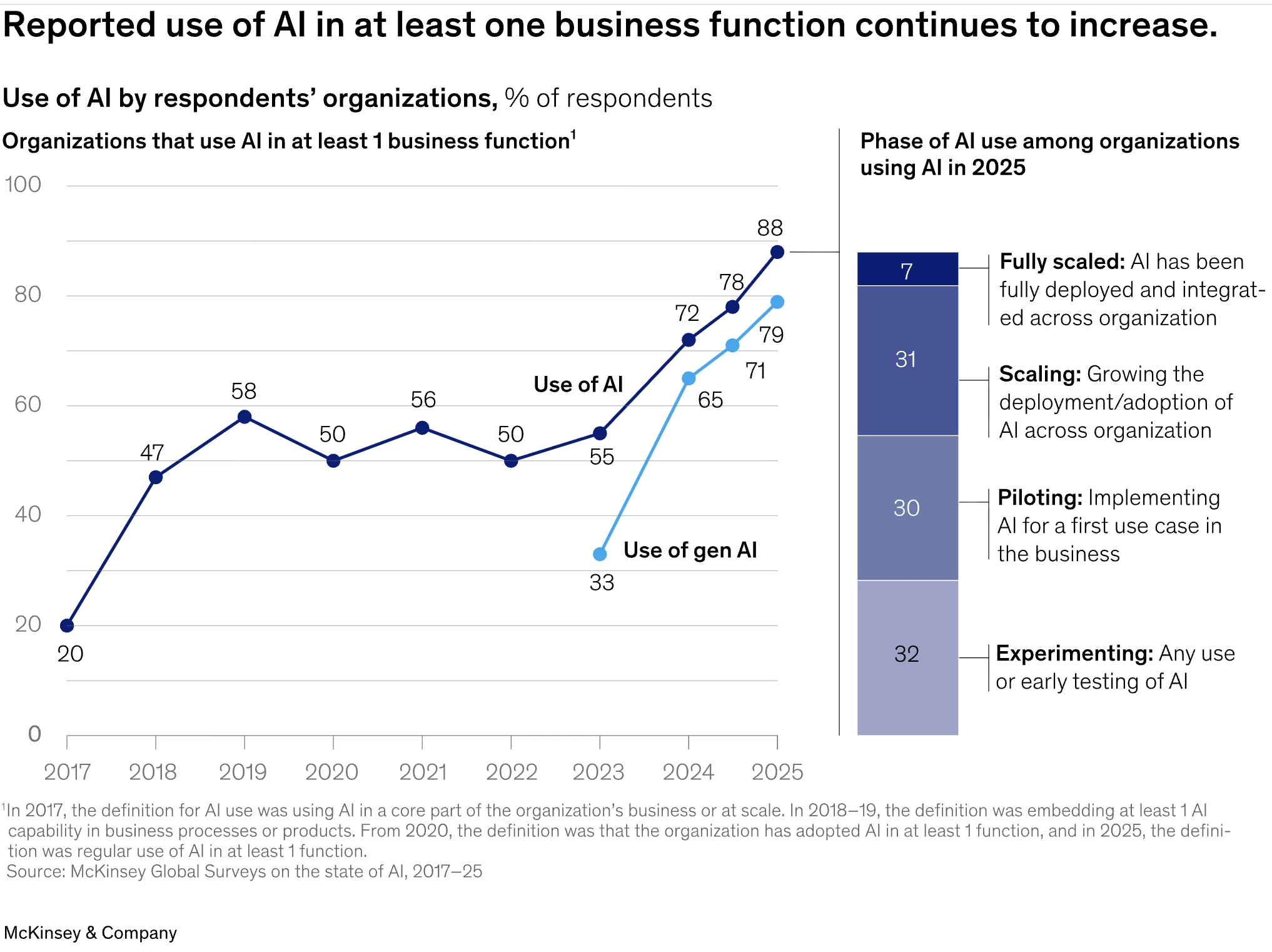
In 2025, 88% of companies report using AI in at least one business function, according to a report by McKinsey, up from 78% the year prior.
Yet most haven’t scaled it beyond isolated use cases.
Most are treating AI as an add-on, and not a foundation.
But that’s where agencies like Brainlabs stand apart.
In episode 115 of the DesignRush Podcast, Daniel Gilbert, Global CEO of Brainlabs, breaks down why scientific process, relentless iteration, and deep AI integration are now essential for agency performance.
Founded in 2012, Brainlabs began as a one-person consultancy.
And it scaled into a 1,000+ person global agency by applying a data-driven, systems-first approach to marketing.
Today, it partners with leading brands like Adidas, Estée Lauder, and Capital One.
In this episode, you’ll learn:
- Why agencies fail when they treat AI as a feature instead of infrastructure
- How “AI visibility” reframes SEO around product quality and brand reputation
- Why prompting is a strategic skill, and how average prompts lead to average results
Watch the full episode now on YouTube or listen on Spotify.
3 Ways AI Is Redefining Agency Execution
1. Mistake: Using AI Without Process
Agencies fail when they treat AI as a magic trick instead of a system. Tools don’t fix inefficiencies, but structure does.
Brainlabs embeds AI across every workflow, but only after documenting those workflows for continuous improvement. This ensures AI is used to scale repeatable precision.
"If you can't describe what you're doing as a process, you don't know what you're doing,” Gilbert says.
This results in very campaign improving because every input is structured, tested, and iterated. AI acts as an accelerant for operational excellence.
2. Warning: Visibility in AI Requires Product Excellence
Many brands think AI visibility is about tricking algorithms. It’s not. It’s about aligning digital presence with product truth.
What LLMs like ChatGPT and Gemini surface depends on the sum total of what users and the internet say.
"You can't outmarket a poor product. What LLMs surface is based on real-world sentiment,” Gilbert says.
This is a return to fundamentals: SEO, content, UX, customer reviews, even podcast guesting. These build credible signals across channels.
AI scrapes the ecosystem for proof. Agencies must treat marketing as a system that begins with product quality.
3. Rule: Average Prompts = Average Results
Most users treat LLMs like search bars and get average answers. That’s a flaw in approach.
"Ask for 'how to market' and you'll get generic advice. Ask through a lens... say, the principles of Daniel Gilbert, and you'll get differentiated, high-value output,” Gilbert says.
LLMs are probability engines, and to extract value, agency leaders must teach teams to prompt with precision, context, and intent.
Otherwise, the tool reinforces the status quo. Why does this matter? Because differentiation lives in execution, and AI, when used lazily, erases that edge.
Why Brainlabs Doesn’t Build More Tech (And What It Builds Instead)
Many agencies confuse having engineers with needing to become SaaS companies, but Gilbert rejects this path.
Brainlabs licenses 95% of its stack and only builds tools when no off-the-shelf option exists. When the market catches up? It kills its custom tech.
"Build fast. Sunset fast."
This lets the agency stay ahead without drifting into non-core ventures.
Culture Is the Real AI Moat
The most advanced AI agencies connect product teams with delivery teams.
How? They share internal builds, log experiments, and showcase wins across their organizations.
"We celebrate tools in town halls, all-hands, Slack. Our culture logs everything we're playing with,” Gilbert says.
Agencies without this connective tissue stay reactive. Those with it build lasting advantage.

About Daniel Gilbert
Founder and CEO, Brainlabs
Daniel Gilbert is the global CEO of Brainlabs, the media agency known for turning marketing into a science. He grew the company from a one-person startup into a 1,000-strong global team, earning recognition from Deloitte and Adweek along the way. With a background in systems thinking and a degree from Oxford, Gilbert brings a clear focus to everything from team culture to AI integration, making sure every part of the agency runs with purpose and precision.
Why Strategic AI Execution Will Define the Winners
The real promise of AI is leverage, not automation.
Why?
The best agencies working with AI will be the ones that apply the following at scale:
- Better judgment
- Faster decisions
- Sharper differentiation
So, if you thought success came from being the quickest to adapt or boasting the most tools, you'd be sorely mistaken.
As AI levels execution across the industry, your edge comes from how well you frame problems, direct machines, and embed continuous learning into your systems.
Brainlabs shows what that looks like:
- Build fast, sunset faster
- Use AI to systematize excellence, not to mask inconsistency
- Treat prompting and process as strategic leadership tools
Moral of the story?
Those getting ahead with AI operationalize it, turning clarity into speed and execution into a compounding advantage.