
Where does AI save time, and where does it flatten the work?
Ashay Kshirsagar, founder of full-service visual production studio Tonic, says the answer is obvious once teams stop pretending speed is the same as judgment.
Kshirsagar notes that AI is useful in production, admin, and early research, but it becomes risky when brands hand over the work that depends on taste, context, and cultural awareness.
About 80% of marketers use AI for content creation, and 75% use it for media production, according to HubSpot’s 2026 State of Marketing report.
And this creates a standard part of marketing workflows where the real question is whether it strengthens output or replaces judgment with speed.
In this DesignRush interview, Kshirsagar discusses where AI adds value, why human creativity still sets the standard, and how leaders can avoid building lazy habits that weaken ideas.

Who Is Ashay Kshirsagar?
Ashay Kshirsagar is the founder of Tonic, a visual production studio focused on CGI, photoreal imagery, and animation for commercial and automotive brands. After starting out in photography, he launched the agency in 2012 to help brands manage CGI, animation, and visual production work through one team instead of multiple vendors.
Since then, he has produced campaign visuals, automotive renders, branded content, and commercial imagery for brands including BMW, Maserati, Volkswagen, Tata Motors, Royal Enfield, Nike, and Griffin.
Kshirsagar regularly speaks about AI’s role in creative production, particularly where it helps with research, preparation, and repetitive production tasks while human judgment still guides the creative direction and decision-making.
AI Belongs in the Repetitive Work
The strongest use case for AI today is the work most teams would happily hand off tomorrow.
Resizing assets, pulling rough drafts together, organizing mood boards, and summarizing briefs. Basically, handling the parts of production that clog up a week without adding much strategic value.
“The real value of AI is in doing the boring, repetitive work,” Kshirsagar says.
Many teams already use AI to get through the early grind of a project faster. The problem starts when a polished output gets confused with a strong idea.
“A lot of business leaders assume that if AI makes something look finished, it has done the hard creative work,” Kshirsagar adds.
“It has only handled the final drawing or rendering, which is not the same as having a good idea.”
That distinction is where a lot of brand work gets sloppy, because a finished-looking concept can still be weak, and a visually tidy campaign can still be forgettable.
Kshirsagar is blunt about what AI can’t do well.
“The biggest mistake is thinking AI understands human feelings or culture.”
And that’s the part many teams miss. A machine can produce, but it can’t live in a market, read a room, or understand why one message lands in one city and falls flat in another.
Projects like Tonic’s launch visuals for BMW India’s X5 campaign, developed with Rediffusion using a combination of CGI vehicle rendering and stock-image backplates, are a case in point.
View this post on Instagram
For example, AI-supported production helps teams execute faster and produce high-quality visual assets at scale, while the creative direction, positioning, and campaign thinking still depend on human decisions.
A lot of teams are still unsure where AI belongs because they haven’t been forced to answer a sharper question.
What do humans here do that software can’t?
It’s also a hard question, and plenty of groups would rather stay busy than answer it honestly.
Some of this confusion stems from how agencies and internal teams have historically sold their value.
Process has often been billed like insight; meetings, revisions, and endless polishing can eat up time without improving the actual idea.
AI exposes that fast.
“AI is showing everyone how much time is wasted on these things, which makes people uncomfortable,” Kshirsagar says.
It should. Waste has a way of sounding respectable until a machine gets there first.
About 88% of employees with enterprise AI access also use personal AI tools for business tasks, often to save time, according to Gartner.
The same research found that hybrid AI users are 1.7 times more likely to report significant time savings than those using only enterprise solutions.
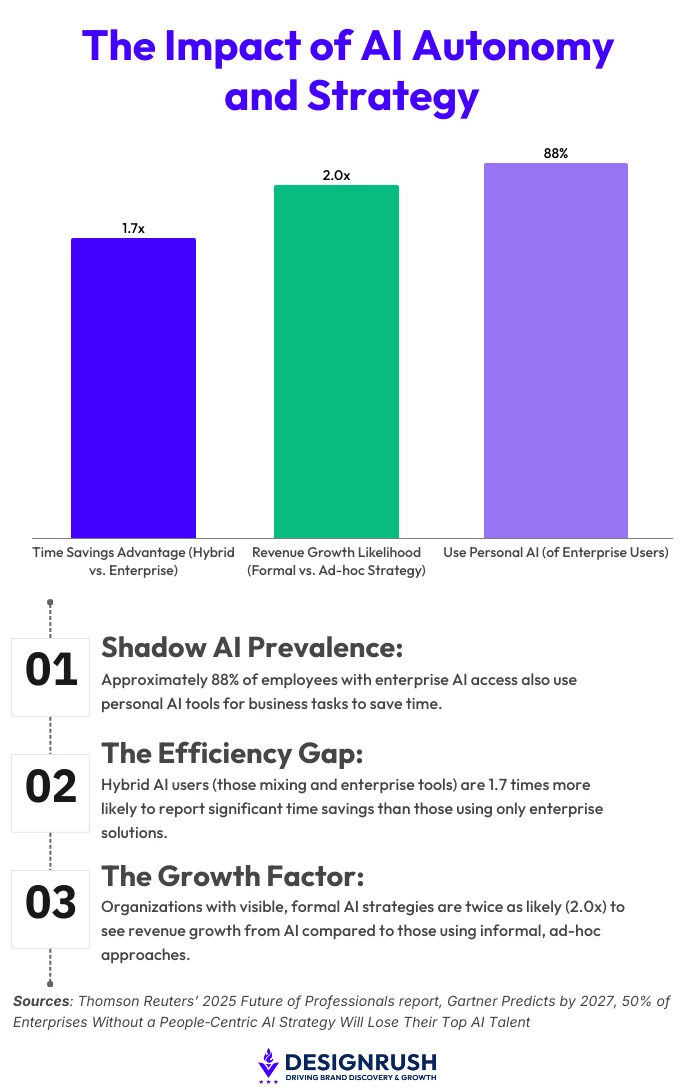
However, it also raises data risk and talent retention concerns, which says something about internal processes.
People will use the tools that help them move faster, whether leadership has a clean policy or not.
Thomson Reuters’ 2025 Future of Professionals report found that organizations with visible AI strategies are twice as likely to see revenue growth from AI as those using more informal, ad hoc approaches.
That fits Kshirsagar’s view.
“The successful teams are the ones that decide exactly what work they will never let a machine do, and they stick to that rule.”
Clear boundaries help teams protect strategic thinking, maintain creative quality, and avoid turning AI into a shortcut for weak decision-making.
More AI Output Doesn’t Mean Better Creative
One of the most common mistakes brands make is thinking that more output means better output.
Kshirsagar doesn’t buy that for a second.
“The first is mistaking volume for value. The assumption that if AI generates enough options, the right answer is somewhere in the pile. Perhaps it is. But you still need a human who can find it.”
AI can generate options all day. But human judgment is what indicates which one deserves to live.
“Which means the judgment was always the point,” he adds.
That is the part teams forget when they get dazzled by speed. Quantity only becomes useful when someone with taste and context can separate the passable from the real.
The same goes for emotional impact.
“People confuse looking real with being real.”
It’s why so much AI-assisted creative work feels hollow. It can imitate tone, texture, even emotion, but it can’t feel anything.
And audiences know the difference faster than most brands would like to admit.
Pew Research gives that skepticism some weight. In a 2025 survey, 53% of U.S. adults said AI will worsen people’s ability to think creatively, while 16% said it will improve it.
That’s not a warm vote of confidence, but it helps explain why audiences are quick to notice when work feels generic or over-produced.
People may not describe the problem in strategic language, but they can feel when a brand sounds borrowed.
AI Should Speed Up the Start and the End
Kshirsagar separates AI’s role in creative work into production and thinking.
“Use AI for preparation and production. Do not use it for thinking.”
That is the cleanest rule in the whole conversation, and one of the most useful for leaders trying to keep teams moving without flattening the work.
He notes how AI is very helpful for research, looking at competitors, understanding how audiences act, and checking briefs in the beginning.
In the final stages, it can handle resizing, versioning, file organization, and the repetitive production chores that slow everyone down. Those are useful tasks.
They are also tasks that can chew up hours that are better spent on insight, positioning, and creative direction.
“You are not letting the machine think for you. You are just making it easier to start thinking for yourself,” Kshirsagar says.
That balance is already reflected in how companies approach AI adoption.
Eighty percent of respondents say their companies use AI to improve efficiency, while the organizations seeing the most value also prioritize growth and innovation objectives, according to McKinsey’s 2025 global AI survey.
And that’s the business lesson here. Speed matters, but speed alone can’t build a stronger brand.
Instead, Kshirsagar recommends focusing on “the middle”.
“The actual moment of creative decision making. The insight that reframes the brief. The executional choice that makes something land differently than everything else in the category.”
Ideally, this should happen in a room with people who “have taste, context, and accountability”.
This is what clients pay for, even when they can’t always explain it cleanly.
The reason is simple.
A polished draft and a meaningful idea are very different assets. One saves time, the other changes the outcome.
Kshirsagar’s CGI-led production work shows where AI and digital tools save time in testing, versioning, and visual iteration before final creative decisions are locked.
He sees a pattern across brand communications.
“It's already happening. Look at brand communications right now, and you'll notice everything is starting to sound and look the same.”
That sameness is the danger. When every team uses the same tools in the same way, the work starts to converge.
There is a way out, though. But it requires discipline.
“Don't let AI decide for you. If you're asking AI for strategic directions before you've formed your own view, you're not using it as a tool; you are using it to think for you," Kshirsagar says.
“Your judgment is the most valuable thing you bring. Don't outsource it.”
That does not mean avoiding the tool. It means keeping judgment where it belongs.
A team that asks AI for direction before it has formed a view has already given away too much.
The second habit is to treat the output as raw material, not the final answer.
“The right question when you look at an AI-generated concept isn't ‘is this good enough?’ It's ‘what's wrong with this, and what would a braver version look like?’ That distance is what keeps you in control of the work,” he says.
That’s where many teams take the first decent result and stop.
The better move is to push harder, ask what feels off, and ask what would make the idea more surprising, more useful, or more memorable.
“Remember that good work comes from a team's culture, not just a set of rules,” Kshirsagar adds.
That is the part leaders should take seriously. A policy helps, but culture does more.
“The most important step is being honest about where AI was used. When you have to admit out loud that you just picked an AI option without changing it, you realize it isn't good enough. That feeling pushes the team to do better.”
Teams that can admit where the machine helped are more attuned to where the human value still needs to show up.
What the Next Few Years Will Demand
Kshirsagar believes that the current idea of AI as a collaborative 'co-pilot' is being stress tested, and its true role will become clearer over the next few years.
The real test is whether teams can use AI without losing the thinking that makes creative work matter.
“The skills that will become more valuable are real strategy and deep thinking,” he says.
That’s the business outcome leaders should care about.
AI can make average work easier to produce, but it also makes strong thinking more visible.
It also means the people who can frame the right problem, read the market, and understand human behavior will matter more.
The warning is the one that should stay with decision-makers.
“The real danger is that the industry might focus too much on how well people use the tools rather than how well they think,” he says.
“The risk isn't that AI takes jobs, but that we stop training humans to be truly creative.”
That’s the trap everyone needs to avoid. Software skills are useful, but judgment is what separates a decent output from a brand asset with actual staying power.
In the years ahead, companies that use AI to remove repetitive work while keeping human judgment at the center of creative decisions will produce stronger, more distinctive brands.
That’s a cleaner way to work, a smarter way to spend budget, and a far better way to avoid producing work that looks and sounds interchangeable.