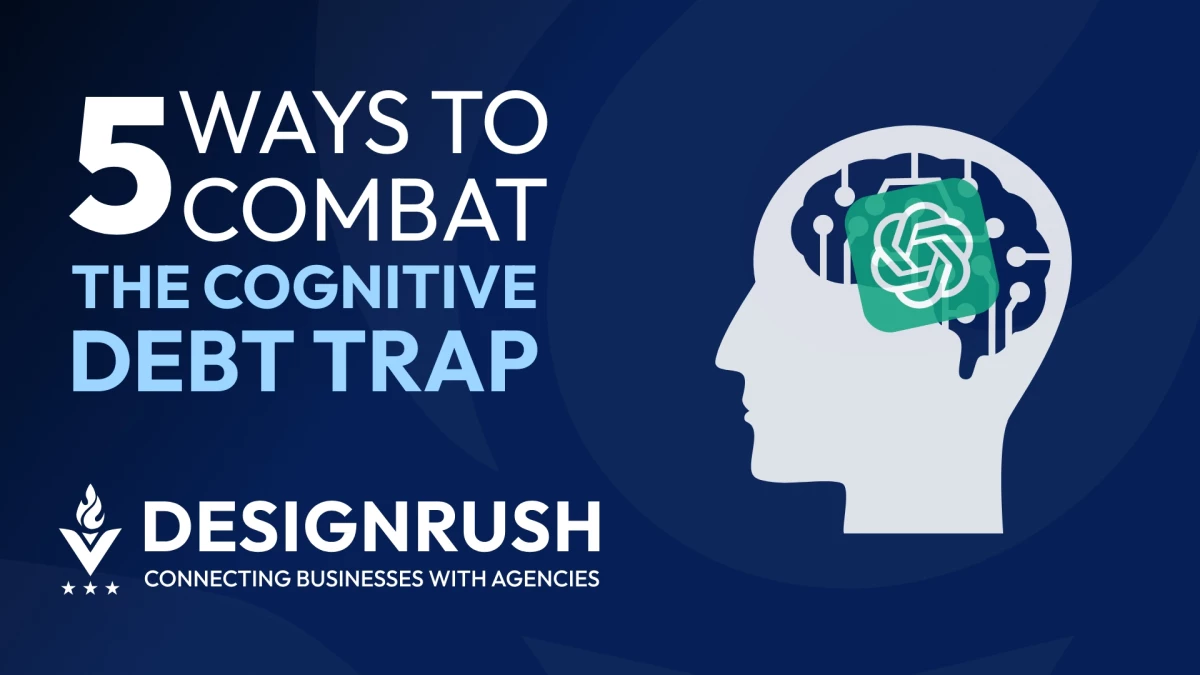

Avoiding Cognitive Debt and AI Overuse Takeaways
- A new MIT study finds that frequent use of AI writing tools leads to lower brain activity, reduced memory recall, and diminished creative ownership.
- Overdependence on generative AI may silently erode creative judgment, replacing instincts with prompts and originality with pattern repetition.
- The creative process suffers when speed overtakes substance. Automation without deliberation leads to shallower ideas and homogenized output.
- Agencies must recalibrate now by auditing AI usage, retraining for critical thinking, and protecting high-friction spaces where true creativity thrives.
A new study has quietly dropped a thunderclap on a creative industry in the midst of an AI boom.
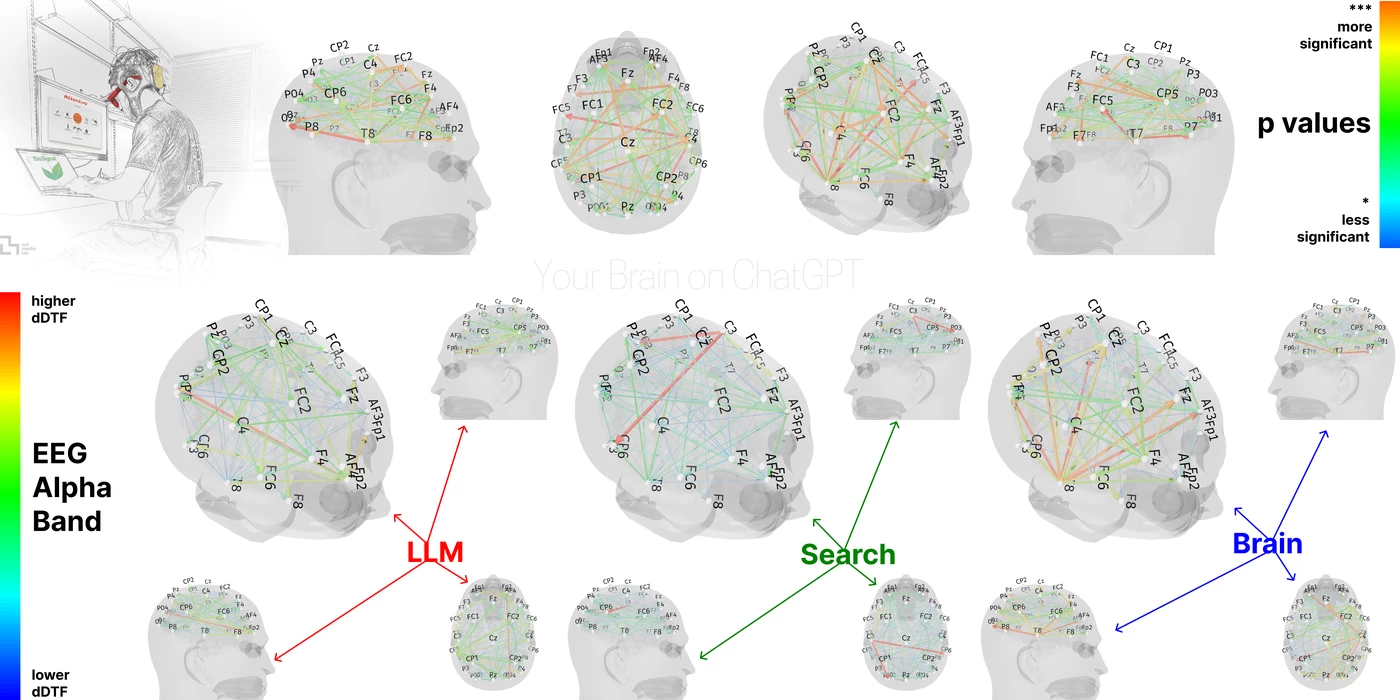
Individuals who routinely rely on large language models for writing tasks are showing signs of cognitive slowdown, according to the study from MIT.
This often manifested in:
- Lower brain activity
- Weaker memory recall
- Diminished originality
- Fading sense of authorship
In plainer terms: our brains might be getting lazy.
MIT researchers used EEG tracking and post-task performance evaluations to compare users who completed writing assignments unaided versus those assisted by AI.
The results?
AI users underperformed not just in language precision and memory, but also in how much they felt the work belonged to them.
Worse still, these effects lingered even after subjects returned to non-AI writing, suggesting the damage isn’t just temporary.
This may sound like academic handwringing. But for those working in marketing, advertising, and creative services, the implications hit uncomfortably close to home.
At first, AI tools promised relief from creative fatigue. Now, an overreliance on AI might be fueling it.
The Silent Tradeoff of Efficiency
The industry has long been obsessed with velocity — how fast ideas can be turned into headlines, scripts, assets, or campaigns.
In all honesty, I think that AI answered the call beautifully in the beginning. It offered up a solution that was faster, cheaper, and often shockingly good on the first try.
Copy decks arrived in seconds. Brainstorms became button clicks. The drudgery of blank pages caused by mental block all but vanished.
But convenience has its cost.
Creative work is more than just execution. It relies on judgment, tone, nuance, and the ability to read between lines. It requires thinking, connecting, and questioning.
Unfortunately, your creative muscles, just like real muscles, atrophy when underused.
A prompt might give you an outline. But a great strategist sees the white space.
A prompt might yield a tagline. But a real creative knows if it sings.
This is the crux of the MIT study’s findings: the overuse of AI doesn’t just change what we create. It changes how we think.
The results may not be obvious in campaign KPIs.
But they will show up in the erosion of originality, the flattening of voice, and the quiet disappearance of creative conviction.
The Rise of Cognitive Debt
The phrase “cognitive debt,” coined by MIT’s researchers, captures a quiet erosion that many agencies haven’t yet clocked. For years, the fear was centered around AI replacing jobs.
But if there’s something to take from the MIT study, it’s that we creatives should be more concerned about AI taking away our better judgment.
Writers, designers, and strategists accustomed to letting AI fill in the blanks may find it harder to develop ideas from scratch.
83.3% of ChatGPT users couldn't quote from essays they wrote minutes earlier.
— Alex Vacca (@itsalexvacca) June 18, 2025
Let that sink in.
You write something, hit save, and your brain has already forgotten it because ChatGPT did the thinking. pic.twitter.com/14bKDCDLF5
Over time, prompts replace instincts, and feedback loops turn into pattern recognition. Eventually, the creative floor gets lower — and so does the ceiling.
This leads to a body of work that’s more polished than purposeful, more efficient than effective.
For agencies, the threat will extend far beyond just bland copy or generic visuals.
If we aren’t careful, we might just end up with a generation of creatives losing their feel for tension, for weight, and for timing, all of which are qualities that separate good from unforgettable campaigns.
Don’t Forget The Minds Behind the Machine
There’s no off switch for AI. In my opinion, no one should really be asking for one.
But there is a growing need for creative agencies to adjust their internal mechanics before they mistake acceleration for progress.
If the goal is to keep creative work sharp, human, and worth paying for, then the systems around that work need to evolve just as fast as the tools themselves.
Here’s where to start:
- Start with usage audits
Most agencies don’t even realize how much work is already on AI autopilot. Start there. Trace where tools are being used, from decks to captions to data insights. Then ask: Are they helping you differentiate, or just helping you keep up? Are they sharpening your voice, or blurring it? - Rebuild creative stamina
Agencies have trained people to use prompts. Now they need to retrain them to push past prompts. That means developing internal exercises that reward original thinking, analog ideation, and the courage to rewrite what AI delivers. Think of it less as compliance and more like cross-training. - Protect high-friction zones
Not every process needs to be optimized. There’s value in creative friction, moments when ideas don’t come easy, when teams debate, when silence lasts longer than expected. Keep those zones AI-free. Guard them. That discomfort is where originality lives. - Make judgment a teachable skill
Many teams are learning how to prompt. Fewer are learning how to critique. Teach junior talent how to evaluate AI outputs beyond grammar and polish. Is the tone right? Does the insight hold up? Will the idea still resonate two months from now? Sharp ideas come from sharper judgment. - Treat AI fluency as a leadership skill
The people leading teams need to do more than approve AI use. They need to understand it. That means senior creatives and strategists should be experimenting, attending training, and asking the hard questions. If they’re not curious, no one else will be either.
Where Do We Go From Here?
Have you ever found yourself dreading moments that seem to go too smoothly? There’s a reason for that.
The promise of AI is speed. But speed without friction creates shallow ideas and outputs.
The more agencies let machines smooth the rough edges, the more they risk sanding off the qualities that make their work meaningful in the first place.
AI makes you dumber - or smarter... It's up to you. https://t.co/9dSND1kza8
— Markus Junginger (@greenrobot_de) June 19, 2025
As I’ve said before, automation should not replace deliberation. Yet, that’s precisely what this new wave of AI tools threatens to do.
Of course, it isn’t doing so maliciously. But it is inadvertently lowering the bar for “good enough” until no one remembers what “great” used to feel like.
To be more direct: agencies that treat AI as a shortcut will get shortcut results. And the longer that gap goes ignored, the harder it becomes to close.
After all, creativity in marketing isn’t honed by what was made. It gets sharpened by the process of creating.