

Key Findings:
- 1 in 3 solo founders cite inconsistent income as their top business challenge.
- Elmira, NY, ranks as the least profitable city for solopreneurs, with an average annual loss of –$7,796.
- A total of 22 U.S. cities show negative profitability for solo founders, meaning average business revenue fails to cover basic living costs.
- Over 25% of solo business owners are considering leaving solo work due to a lack of local support.
- Among the hardest cities to scale solo businesses are Watertown–Fort Drum, NY, Amherst–Northampton, MA, and Vallejo, CA.
Quick listen: The 7 U.S. cities solo founders should think twice about, in under 2 minutes.
Being your own boss still carries a lot of appeal in 2025.
There are about 29.8 million nonemployer businesses in the U.S. generating over $1.7 trillion in revenue.
Their contribution makes up approximately 6.8% of the national GDP.
Although co-founding a company is certainly a lot easier than doing it solo, these figures show that it does pay to start your own company.
"you need to have a co-founder"
— weisser (@julianweisser) April 15, 2025
"where's your co-founder?"
"who's your co-founder?"
Great co-founding teams build incredible companies.
But after working with thousands of founders in @joinodf, I've seen enough @solofounding successes to know there's another valid path. pic.twitter.com/LJffCkacze
However, a new DesignRush study reveals that it actually matters where you become a solo founder to succeed.
While the average solopreneur nets $18,500 after expenses, new findings from our Solopreneur Profitability Report reveal that in some metros, founders are operating at a loss.
This year’s analysis of 385 cities, using Census Bureau revenue data and Forbes’ 2025 Cost of Living Index, highlights a critical divide.
Some are affordable on paper, yet still undercut solo success due to:
- Weak demand
- Low revenue potential
- Missing freelance infrastructure
Where you live still shapes what you can earn and, increasingly, whether your business can survive at all.
The Least Scalable Cities for Solo Businesses
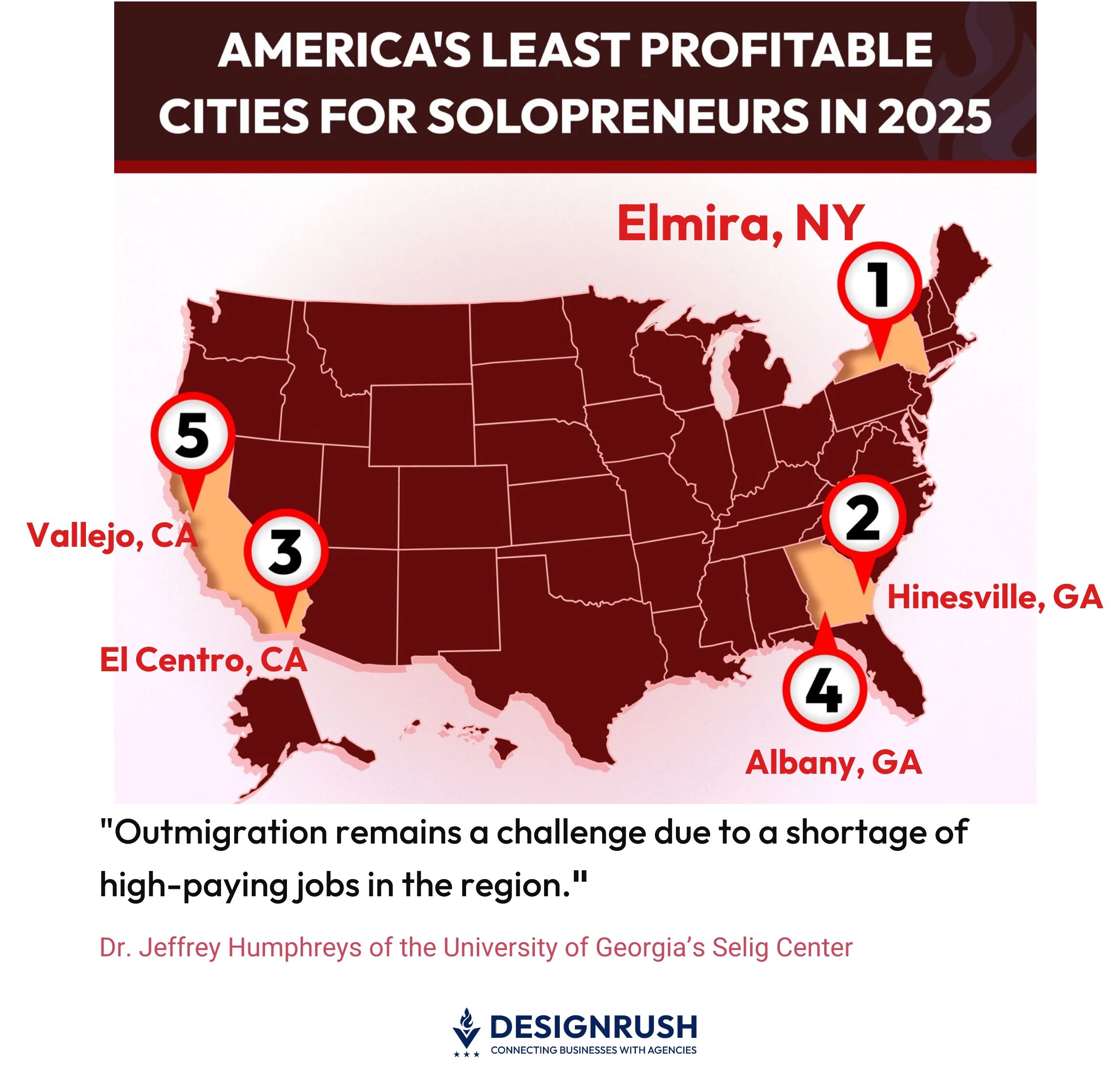
1. Elmira, NY: The U.S. City Where Solo Work Fails Most
Elmira ranks dead last in 2025. The average solo founder loses $7,796 yearly, the largest in the country.
There are only 4,339 nonemployer businesses in the city.
And based on income vs. cost ratios, nearly every single one is losing money.
Even skilled professionals can’t make it work here. In early 2025, a local orthodontist closed his practice without warning, leaving prepaid patients in limbo.
“Patients at Southern Tier Orthodontics in Elmira were notified via text message that owner Dr. Jason Horn declared bankruptcy and the business is now closed," WENY News reported.
"Some families tell WENY News they are now out thousands of dollars as a result.”
If highly specialized solo health businesses can’t survive in this city, general freelancers face even steeper odds.
Still, remote-first founders with outside client bases may find Elmira’s low-cost lifestyle an advantage.
2. Hinesville, GA: Underserved, Underpaid, Unscalable
Founders in Hinesville lose about $6,594 per year. With just 5,734 solo businesses in the region, the solo economy is small and deeply strained.
It has the lowest solo founder income in the entire country.
Due to high living costs, 121% of income goes toward basic survival.
Until late 2023, the city had no incubator or early-stage support system for solo entrepreneurs.
This gap left many relying on unstable government-adjacent work or commuting to nearby areas to stay afloat.
“This invaluable asset will serve as a wellspring of innovation and a cornerstone of growth for our community," City Mayor Allen Brown said during the launch of the Hinesville Business Incubator two years ago.
It is not merely a building; it is a symbol of the city’s commitment to fostering local talent."
While the support came late, this new infrastructure is opening doors for founders targeting public-sector or regional contracts.
3. El Centro, CA: 1 in 3 Solopreneurs Are Considering Leaving the State
Solo workers in El Centro bring in a decent amount of revenue per year.
It sounds like a good place to start a business, until you learn that 113% of it is spent on living costs, translating to $6,221 in annual losses.
With 10,887 solo founders, it becomes more than a niche issue.
It adds up to $67 million in collective losses every year across El Centro’s self-employed workforce.
Local reports say 1 in 3 founders is considering relocation, citing high taxes, inflation, and lack of infrastructure.
“Small business owners in El Centro say the state’s high taxes and inflationary pressures have pushed them to explore relocation options in states like Arizona and Nevada where costs are significantly lower,” Local Observer Daily reported.
Income isn’t the issue here, overhead is.
For those wanting to start their own company, it may be best to rethink doing it in El Centro.
4. Albany, GA: 1 in 3 Freelancers Report No Recurring Clients
The average solo business in Albany loses $6,033 per year, spending 118% of their income just to live.
There are 14,323 solo founders in Albany, which amounts to $86.4 million in aggregate solo revenue.
But over $86 million in living costs leaves almost no room for net gain at the city level.
Insights from Georgia freelance forums and business development boards point to a lack of recurring local contracts and slow-growing digital sectors.
This makes it difficult for solo operators to scale in place.
"Outmigration remains a challenge due to a shortage of high-paying jobs in the region, particularly for younger and highly educated workers," Dr. Jeffrey Humphreys, Director of the Selig Center for Economic Growth at the University of Georgia, said in a 2024 economic outlook.
Independent founders should consider targeting statewide or online markets to avoid the limits of a weak local economy.
5. Vallejo, CA: Cost of Living Wipes Out 100% of Solo Earnings
Despite sitting near one of the world’s most powerful innovation centers, solo founders in Vallejo are losing $5,805 annually.
They earn a decent $47,366, but spend $53,171 just to live, or 112% of their income.
“Despite proximity to the tech corridor, Vallejo’s solo workforce is facing higher unemployment and declining contract opportunities compared to neighboring regions,” Local Observer Daily wrote.
This aligns with U.S. Bureau of Labor Statistics data, which shows Vallejo–Fairfield’s unemployment rate hovering above 5%.
This is much higher than in adjacent Bay Area metros, according to TradingEconomics.
However, solo founders who tap into Bay Area networks remotely could still thrive while living at a lower cost in Vallejo.
6. Amherst–Northampton, MA: Where Freelancers Bleed $5K a Year
Independent company owners spend 110% of their income in this city, losing $5,020 per year.
Prestige and presence alone aren’t enough in Amherst–Northampton.
With 14,070 solo founders, this university-town economy is exporting talent, with most freelancers depending on out-of-market clients just to stay afloat.
A 2024 UMass Donahue Institute study found most freelancers rely on clients based in Boston, not locally.
This disconnect undercuts sustainability.
But for founders with Boston-based clients, this region offers lifestyle perks and top-tier talent access.
7. Watertown–Fort Drum, NY: 75% of Solo Work Depends on One Institution
Watertown ranked as the seventh worst U.S. city for solo founders in 2025, as they lose $4,233 every year.
There are just 6,098 solo businesses in the region, and nearly all remain dependent on Fort Drum.
Outside defense-adjacent roles, client variety and contract availability are extremely limited.
“Approximately 4,600 soldiers and military spouses transition out of Fort Drum each year […] but many relocate elsewhere," North Country Public Radio reported.
Watertown stands as a case study in economic overreliance.
However, specialists in government or military-adjacent services may still find consistent niche demand here.
-content-large-webp.webp)
What This Data Means for Solo Founders, Agencies & CMOs
For solo founders and boutique agency owners, these losses confirm that location directly affects viability.
Even with talent and drive, local conditions can still undercut success.
Here's what you can do to minimize the risk:
- Choose your city with intent. Relocating to a more affordable, opportunity-rich area can improve your bottom line more than landing another big client.
- Look beyond local clients. In slow-growth cities, build early ties to regional or national markets to avoid hitting a ceiling.
- Factor in geography when hiring. Freelancers in struggling cities may face pressures that affect their output. Know where your talent is based.
Solo success isn’t just about skills or effort. Sometimes, it has a lot to do with where you operate.
With the right startup plan, strategy, and environment, independent work can be both profitable and sustainable.
Methodology
This report analyzes the profitability of solopreneurs across all 50 U.S. states and major metro areas in 2025.
This is done by calculating the post-expense income of nonemployer businesses, individuals who run a business with no paid employees.
Data Sources
- Solopreneur Count & Revenue:
Sourced from the U.S. Census Bureau's Nonemployer Statistics Survey, which tracks the number of nonemployer establishments and their total revenue by state and metro. These figures represent individuals operating as sole proprietors, freelancers, consultants, and solo agency owners. - Cost of Living Data:
Sourced from Forbes’ 2025 Cost of Living Index, which estimates average annual expenses required for a modest lifestyle in each U.S. state and metro, including housing, utilities, food, transportation, and healthcare. - Revenue Per Solopreneur:
Calculated by dividing the total solopreneur revenue by the solopreneur count in each region. - Estimated Profit Per Solopreneur:
Calculated by subtracting each state’s or metro’s cost of living from its average solopreneur revenue, providing a practical estimate of what a solo business owner might retain after covering basic living expenses.
Growth is local. These firms help brands pinpoint the right markets to enter, invest in, or exit, using real-world data and not mere assumptions:


-Stressful-States-for-Male-Employees-in-2024-V2---details-preview-webp.webp)
-preview-webp.webp)
-preview-webp.webp)
-preview-webp.webp)