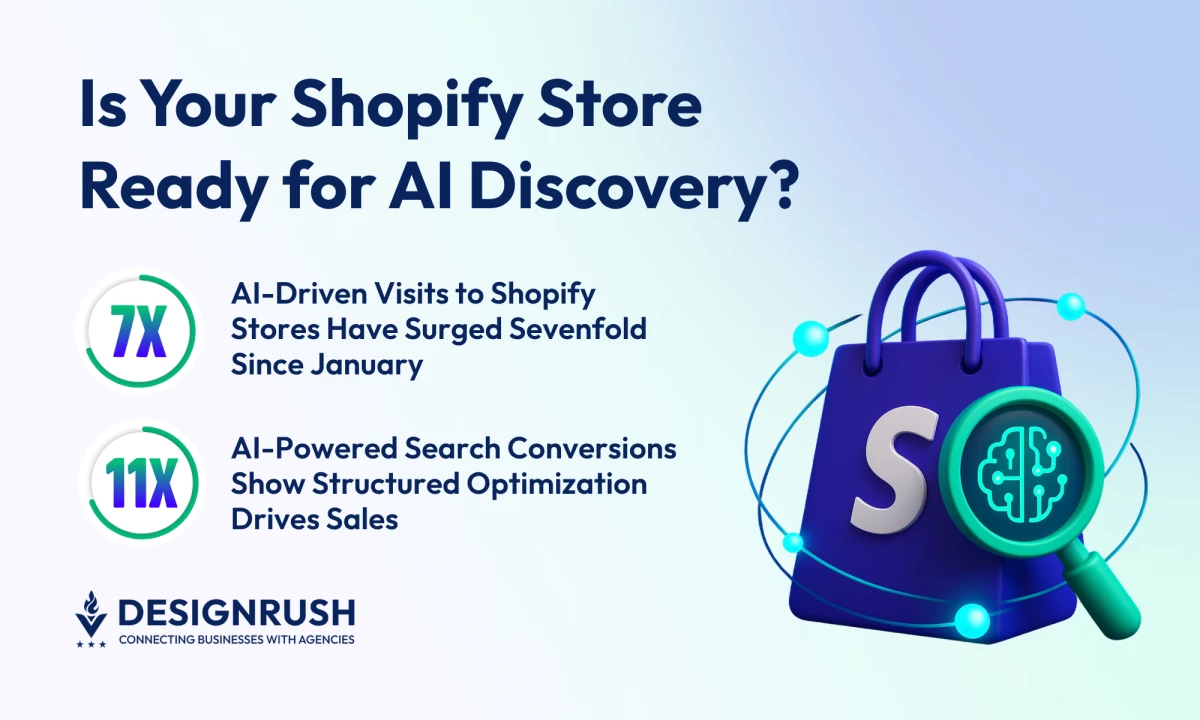

AI Discovery Shopify: Key Findings
- Structured metadata and clean product feeds help Shopify stores appear in AI recommendations, showing how brands can prep for agentic discovery.
- AI-driven traffic is up 7x and purchases 11x, demonstrating that optimizing for AI drives measurable growth.
- Testing AI visibility and refining feeds gives merchants an early mover advantage, offering a model for broader AI integration.
Shopify is betting big on AI shopping agents, calling them an “incredible tool” for entrepreneurs and the “biggest tech shift since the internet.”
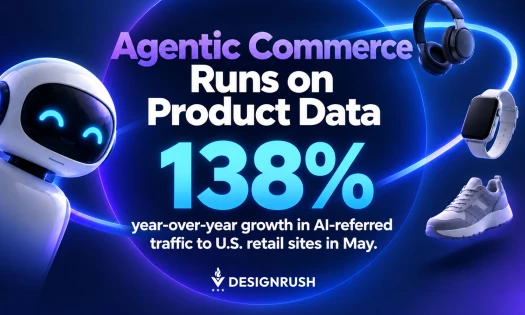
Since partnering with OpenAI in September, AI-driven traffic to its stores has surged seven times, and purchases from AI-powered search are up 11x, according to TechCrunch.
OpenAI has now added Shopify as a third-party search provider inside ChatGPT, which means products from Shopify merchants can surface directly in AI-driven shopping results.
Harley Finkelstein, president of Shopify, discussed how the company is integrating AI on its platform, describing it as “laying the rails for agentic commerce, building the infrastructure to build shopping into AI conversations:”
For Shopify merchants, this means preparing stores for AI discovery. That includes structured metadata, accurate product feeds, and a store designed for recommendation flows.
Digital Silk, an award-winning web design and development agency, helps brands optimize their stores for AI-driven discovery.
“AI is changing how shoppers find products. Merchants who structure their Shopify stores with clear metadata, accurate feeds, and mobile-first experiences will not only appear in AI recommendations but also convert more of that traffic into sales,” said Digital Silk CEO Gabriel Shaoolian.
“It’s about making your store readable for both humans and machines.”
Preparing Shopify Stores for AI-Driven Discovery
Digital Silk’s team designs custom UX and UI, manages migrations, integrates tools, and optimizes sites for conversions and search visibility.
Its approach focuses on making Shopify stores both user-friendly and technically robust, so products are easy to discover and purchase.
“As AI-driven shopping becomes a default discovery path in 2026, the merchants who benefit most will be the ones whose stores already meet these technical standards,” Shaoolian noted.
“The OpenAI integration gives Shopify brands a new visibility channel, but only the stores built with a clean structure and clear signals will earn placement inside agent conversations.”
AI-powered shopping is set to take off in 2026, and brands that get ahead now will grab more attention and sales as consumers turn to AI agents for recommendations.
- Merchants can adapt by ensuring product feeds are complete, metadata is consistent, and structured data like Schema is correctly implemented.
- Testing how products appear in AI-driven search will help fine-tune visibility.
Stores that follow these steps are more likely to appear in ChatGPT recommendations and capture agent-driven traffic.
This includes ensuring product pages are designed for recommendation pathways, so AI agents can not only find the products but also suggest them effectively to shoppers.
ChatGPT already helps millions of people find what to buy. Now it can help them buy it too.
— OpenAI (@OpenAI) September 29, 2025
We’re introducing Instant Checkout in ChatGPT with @Etsy and @Shopify, and open-sourcing the Agentic Commerce Protocol that powers it, built with @Stripe, so more merchants and developers… pic.twitter.com/9miGZr1Yn7
The impact of that structure becomes clear when you look at how OpenAI is now pulling product data.
OpenAI’s update wasn’t a headline announcement.
Search Engine Journal reported that it appeared quietly in the ChatGPT maker’s Search documentation, where Shopify now sits next to Bing as a data source for shopping results.
Early tests indicate that ChatGPT retrieves products from multiple platforms; however, Shopify listings tend to appear more frequently in image-rich results because their product data is generally cleaner.
ChatGPT relies on structured signals like prices, descriptions, and reviews, and it may rewrite titles or summaries based on the information it receives.
That makes the quality of a merchant’s feed even more important, since ranking depends on how well that data is interpreted. Stores on other platforms can still apply to be included, but Shopify sellers now start with a built-in advantage.
Optimize for Discovery, Not Decoration
Shopify merchants should treat AI optimization as a real business move, not just a tech checkbox.
Product feeds, metadata, and structured data aren’t just behind-the-scenes details. They shape how shoppers discover and choose your products before they even land on your site.
Your store’s structure and signals need to be built to guide AI agents so products can be accurately found and recommended.
That determines whether your products appear in ChatGPT’s AI-driven recommendations or get passed over for a competitor’s.