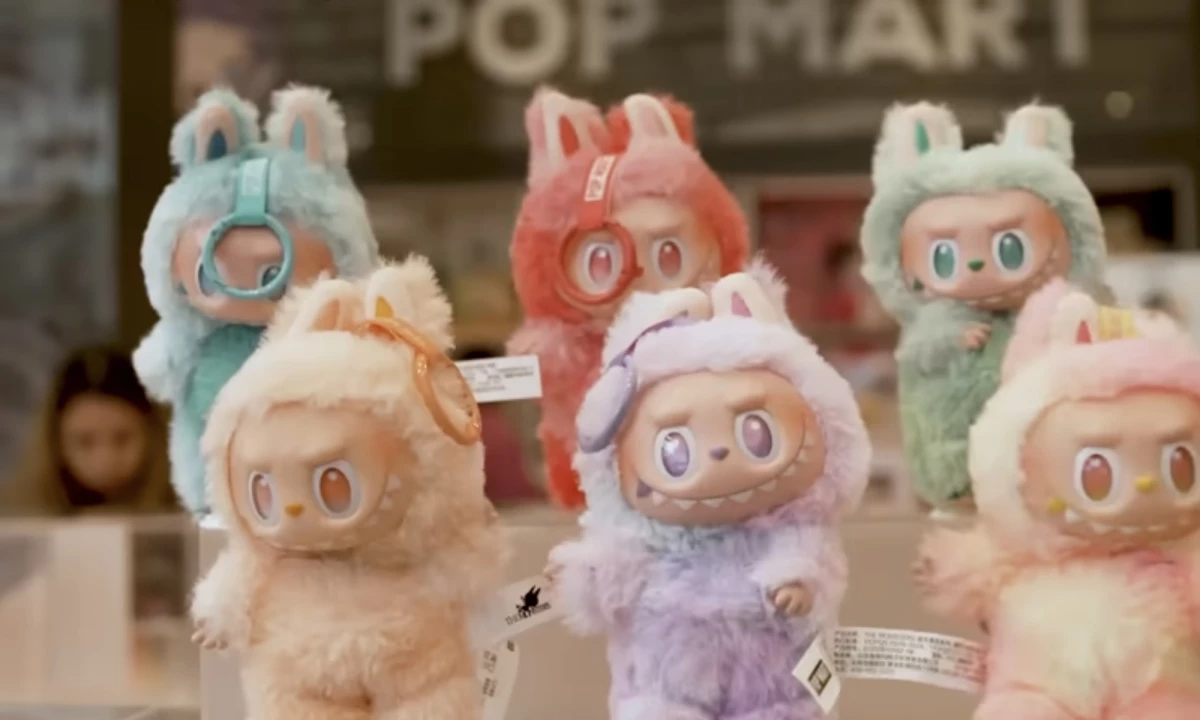

Pop Mart Expansion: Key Findings
- Pop Mart's $35 billion market cap exceeds Hasbro and Mattel combined, proving character collectibles can outpace traditional toy giants.
- The Americas' revenue surged 1,270% while shares dropped 40% from August highs, revealing tension between explosive growth and sustainability.
- The company scaled production 10-fold to 30 million monthly units while planning the Fifth Avenue flagship to diversify before Labubu peaks.
Chinese toymaker Pop Mart is expanding aggressively into global markets as it faces pressure to prove its viral Labubu character can continue its legacy.
The Beijing-based company is planning flagship stores on New York's Fifth Avenue and Times Square as part of dozens of expected U.S. openings, adding to its 60 branches in the country.
Pop Mart also opened a 600-square-meter store in Sydney this month, its largest in the southern hemisphere, and expects to increase its footprint in Europe and Japan.
The company's expansion shows how brands building momentum around single viral products need expansion strategies that don't depend on sustained hype.
Its global retail push shows how fast they're moving to diversify before Labubu's cultural moment passes.
Celebrities Fueled Pop Mart's Valuation Surge
Pop Mart's furry elf character Labubu became a cultural phenomenon after celebrities were spotted carrying the palm-sized plush toys.
These include Dua Lipa, Rihanna, Kim Kardashian, Blackpink's Lisa, and David Beckham.
The visibility drove Pop Mart's market cap to $35 billion, double that of U.S. toy giants Mattel ($6.5 billion) and Hasbro ($11.4 billion) combined, according to The Wall Street Journal.
Scuffles broke out in stores over limited editions as collectors rushed to complete sets.
They are sold through Pop Mart's "blind box" model, where customers don't know which specific character they've purchased until unboxing.
Pop Mart increased plush production 10-fold this year to approximately 30 million dolls monthly to meet this demand.
The company reported its Americas revenue increased 1,270% year-over-year in Q3 against overall revenue growth of 250%, with half-year revenues reaching RMB 13.9 billion (about $2 billion).
When celebrities organically endorse products, demand explodes faster than factories can keep up.
Pop Mart's production increase shows the company's scramble to turn a viral hit into something that lasts.
'Peak Labubu' Concerns Are Driving Strategic Pivots
Pop Mart's Hong Kong-listed shares have fallen approximately 40% from their August all-time high as resale prices for Labubu dolls decline.
Analysts point to the need for new products or characters to maintain momentum.
"Labubu doesn't actually have that much of a story behind it, it's just a strange-looking doll," Chris Pereira, founder of consultancy iMpact, told the Financial Times.
"The question is 'what next'? The direction I expect them to be looking at is cross-branding with Disney or with some other movie chain."
The debate over Pop Mart’s long-term prospects has also been centered on its ability to diversify beyond Labubu, according to Melinda Hu, an analyst at Bernstein.
"The bull-bear debate boils down to one question: can the company break free from Labubu dependency and spark growth through other intellectual properties?" she asked The Edge Singapore.
Three patterns from Pop Mart's expansion reveal how viral product brands should scale:
- Diversify before demand softens. Expanding markets and formats early reduces reliance on a single hit.
- Design systems that extend momentum. Scarcity mechanics and retail scale should support long-term portfolios.
- Build IP depth alongside distribution. New characters need narrative and visibility to transfer loyalty beyond the original success.
Brands that treat viral success as the time to build durable foundations are better positioned to sustain growth once attention moves elsewhere.
Our Take: Can Pop Mart Avoid the One-Hit-Wonder Trap?
I think Pop Mart's aggressive expansion shows it understands that Labubu won't stay viral forever.
The planned Fifth Avenue and Times Square flagship, along with Pop Mart’s broader global footprint, helps the company build infrastructure to support multiple characters over time.
However, I think the real test will come once it launches the next IP.
Will the retail network and collector base it has built transfer loyalty to new characters? Or will each viral moment require them to rebuild from scratch?
Brands that capture lightning in a bottle need distribution networks that outlast any single product's cultural moment.
In other news, Zara's closure of 60 stores while expanding budget brand Lefties shows how brands split portfolios when viral products can't sustain middle-market positioning.
Retail brands scaling viral products into sustained revenue need agencies that understand expansion strategy and brand positioning.
Take a look at the top retail marketing agencies in our directory.