
Key Takeaways
- Perplexity is entering the browser market with Comet, an AI-powered web browser aiming to compete with Google Chrome, Safari, and Microsoft Edge.
- The company is rapidly growing, handling over 100 million queries weekly and securing more than $500 million in funding from investors, including Jeff Bezos.
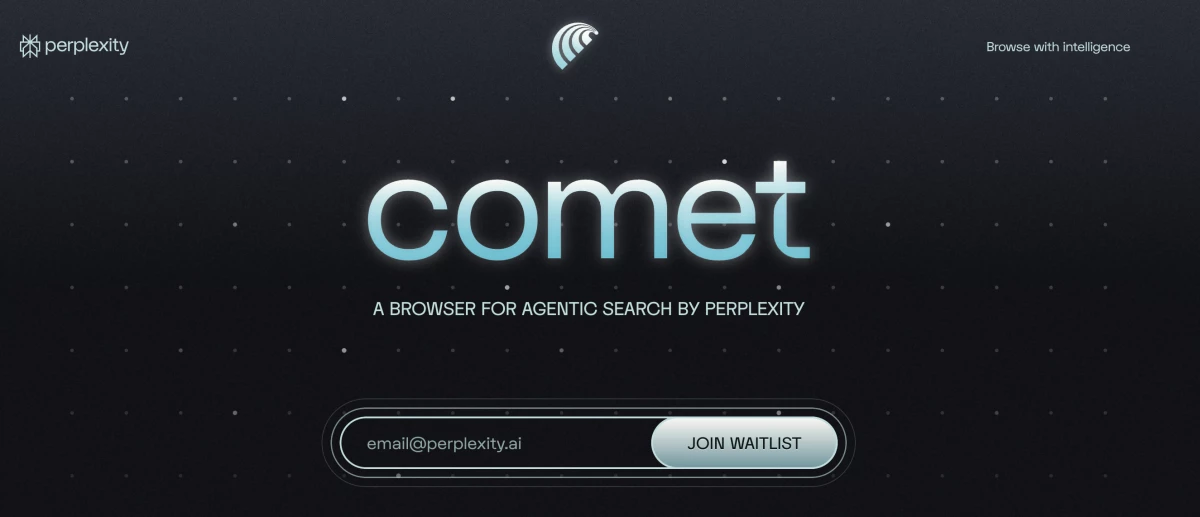
Perplexity is expanding beyond AI search with Comet, its upcoming AI-driven web browser, setting the stage to challenge industry giants like Google Chrome, Safari, and Microsoft Edge.
The $9 billion startup teased the new product on X, calling it an “agentic search” experience, but offered few details on how Comet will differentiate itself from existing browsers.
The company launched a signup list for early access, generating buzz among tech enthusiasts.
Comet: A Browser for Agentic Search by Perplexity
— Perplexity (@perplexity_ai) February 24, 2025
Coming soon. pic.twitter.com/SwVSwudgtN
Perplexity has seen rapid growth, fielding over 100 million queries each week and securing more than $500 million in funding from investors, including Jeff Bezos.
The company has been steadily expanding its monetization efforts through advertising and eCommerce integrations.
Comet represents its latest attempt to control more of the search experience.
Industry experts believe Perplexity’s AI-driven approach could introduce a fresh alternative to mainstream browsers.
Can't wait to check this out. It was about time for some AI competition for Chrome.
— Alex Miteva (@miteva_alex) February 25, 2025
Damian Rollison, director of market insights at SOCi, said the browser market may be crowded, but no company has successfully integrated AI in a way that resonates with consumers
If Perplexity seamlessly integrates its AI search engine into Comet, it could reduce reliance on traditional search results, potentially disrupting Google’s dominance in web navigation.
Comet’s launch signals a broader shift toward AI-powered ecosystems, where search, browsing, and discovery become more integrated and intuitive.



If successful, Perplexity could redefine how users interact with the web, moving away from traditional search models and toward a more predictive, conversational experience.
As AI-driven browsing gains traction, businesses may need to rethink SEO strategies, adapting to a future where AI curates information rather than relying on static search rankings.
Legal and Industry Challenges
While Perplexity is making bold moves in the AI space, it faces mounting legal challenges.
The New York Times has accused the company of unauthorized access to its premium content, while News Corp’s Dow Jones and the New York Post have filed lawsuits over copyright violations.
At the same time, Perplexity is trying to build bridges with media companies through its Publisher Program, which shares ad revenue when publishers’ content appears alongside ads.
The program recently expanded, adding partners such as The Independent, LA Times, and Blavity.
Beyond Comet, Perplexity has been ramping up AI-driven offerings, including an AI research tool called “deep research,” an Android-based AI assistant, and an API for AI-powered search.
Perplexity’s push into the browser market reflects a broader trend of AI-driven disruption across tech industries.
The company could challenge traditional ad-based search models and create new monetization opportunities through AI-driven web navigation.
Meanwhile, OpenAI launched its first AI agent, Operator, for U.S. ChatGPT Pro users, enabling autonomous execution of tasks.