
David Ellison is about to have one company selling access to two of Hollywood's biggest media portfolios.
Paramount and Warner Bros. Discovery become Skydance on October 6.
It brings CBS, CNN, Paramount+, HBO Max, Pluto TV, two major film studios, and extensive cable networks under one corporate parent.
A federal judge approved the states' settlement on September 30, clearing the last obstacle after 12 attorneys general sued to block the deal.
The settlement requires separate negotiations for Paramount and Warner Bros. basic cable channels.
The requirement covers basic cable alone, since the states alleged harm only in theatrical distribution, blockbuster releases, and cable licensing.
Streaming and broadcast stayed outside the complaint, leaving these markets free of any settlement terms.
The decree contains no comparable provision requiring separate advertising sales operations.
Skydance can enter the market with a larger collection of ad inventory while competitors face a newly consolidated seller.
Ellison has said that the company will preserve the two as distinct consumer brands.
But the corporate structure puts Paramount and Warner Bros.' commercial assets under one roof.
What once was the peak, is now just the beginning. Paramount and Warner Bros. shaped over a century of culture. By combining them, we aren't rewriting history — we're equipping these iconic studios with a more powerful engine. Together, we are Skydance: a creative-first home for bold, quality storytelling. We chose this name for a few important reasons. First and foremost, as we bring Paramount and Warner Bros. together, we wanted to preserve what has made each of these studios iconic. Both have distinct identities, extraordinary legacies and brands that have resonated with audiences for generations. We never wanted a new corporate identity to diminish, alter or overshadow either one. Instead, we wanted a name that would give the combined company an identity of its own while allowing Paramount and Warner Bros. — and all our extraordinary brands — to remain in the spotlight. We have big goals for Skydance, and we intend to pursue them with passion, imagination and a willingness to take smart risks. At the same time, we will honor what makes Paramount and Warner Bros. special — giving both studios the opportunity to grow, tell more great stories and bring those stories to even broader audiences around the world, powered by the scale and capabilities of Skydance. I couldn’t be more excited about what we’re going to build together.
— David Ellison (@davidellison) October 2, 2026
The merger was originally challenged over concerns that the combined company could substantially lessen competition or tend to create a monopoly in three markets.
The states ultimately settled on behavioral terms covering film output, cable carriage, and newsroom independence.
Advertisers will feel the change once two legacy portfolios start selling through one corporate sales structure.
Skydance Gives Paramount and Warner Bros. 1 Corporate Roof
Two of Hollywood's oldest studios are about to sit under a company that is only 20 years old.
Paramount traces its roots to 1912, while Warner Bros. was founded in 1923 by brothers Harry, Albert, Sam, and Jack Warner.
Their combined histories span more than a century of filmmaking and include some of the industry's most recognizable franchises.
Skydance began in 2006 when David Ellison launched the production company at age 23.
Its first film, "Flyboys," was a commercial failure.
But strategic partnerships with Paramount, Netflix, and Apple helped the company grow into a major producer.
The new Skydance will now oversee both studios after an approximately $111 billion deal for Warner Bros. Discovery.
The combined portfolio includes HBO Max, CNN, Nickelodeon, MTV, and Comedy Central.
Major franchises "Mission: Impossible," "Harry Potter," "Game of Thrones," and DC also fall under the conglomerate.
The corporate name makes Ellison's own brand the connective tissue between those properties.
The combined company will be called Skydance, while studios will retain the visual identities presented to audiences.
The company will change its legal name to Skydance Corporation on October 6 and will swap its ticker from PSKY to SKYD.
Ellison will lead strategy, creative direction, technology, talent relationships, partnerships, and capital allocation.
Former Mattel CEO Ynon Kreiz joins as co-CEO, overseeing day-to-day operations and integration.
This is brand strategy aimed at two audiences at once.
Advertisers buy the combined Skydance footprint while viewers keep seeing Paramount and Warner Bros.
Film Rules Lock In 30 Theatrical Releases a Year
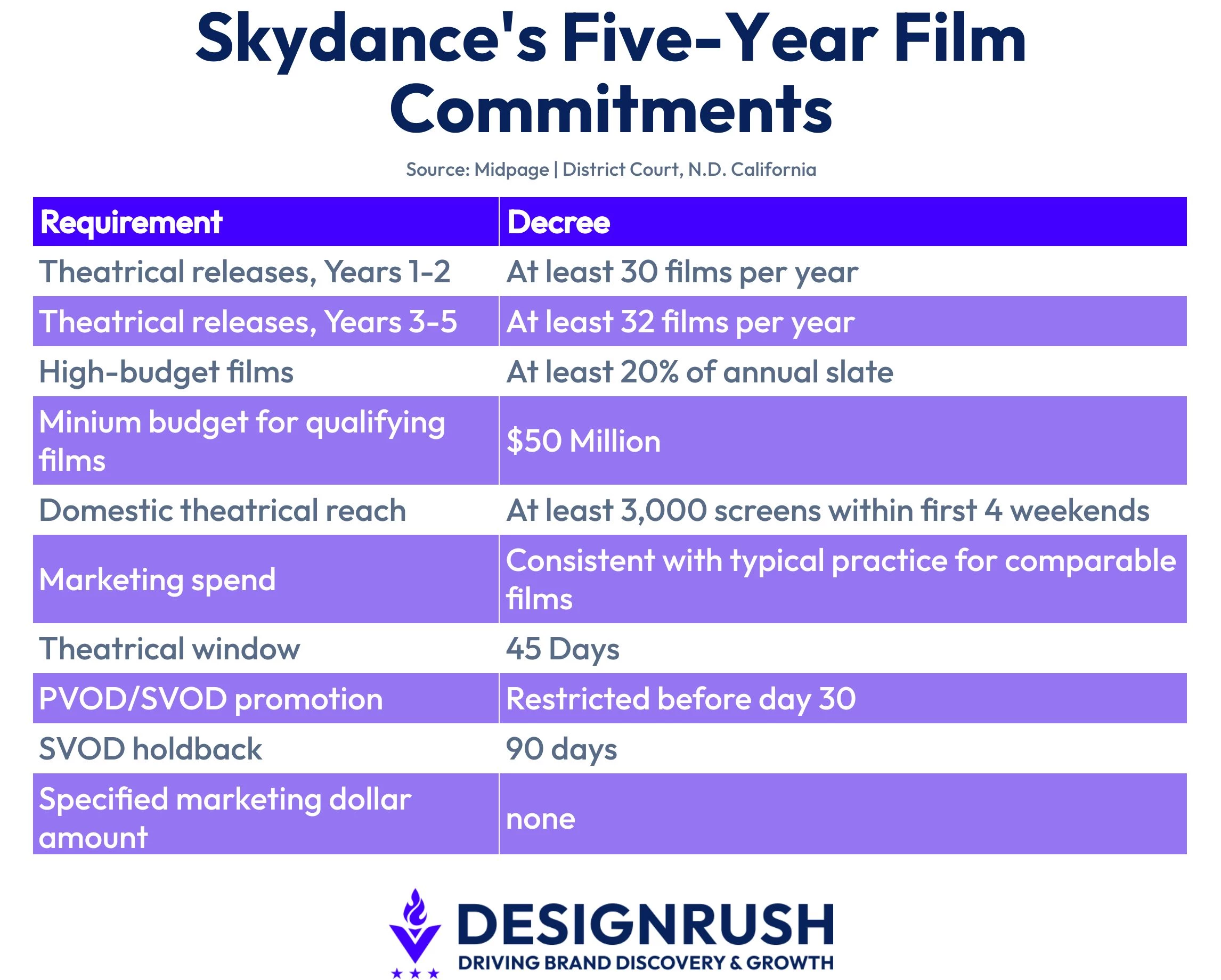
The merger settlement also gives Skydance five years of enforceable requirements covering theatrical releases and film marketing.
Skydance must release at least 30 theatrical films in each of the first two commitment years and 32 in each of the following three years.
Each qualifying film has to carry marketing spend consistent with typical practice for similar titles, though the decree never names a dollar figure.
The court-enforced baseline gives agencies, exhibitors, and media owners a clear view of Skydance's minimum theatrical obligations.
Five years of guaranteed output turns a studio slate into a media buying calendar that competitors can plan against.
The merger gives Skydance a larger commercial footprint, making scale a key factor in how media buyers evaluate its combined inventory.
- Scale provides more inventory to commercialize. Companies should organize assets into larger media packages to give advertisers more ways to reach audiences.
- Regulatory minimums can lock in output while leaving pricing wide open. Teams should track "typical practice" marketing requirements against competitors to demonstrate compliance and sustain demand.
- Content volume creates recurring advertising supply. Companies should use predictable media opportunities to help advertisers plan campaigns around releases.
The decree sets a floor for film output and marketing activity while leaving Skydance significant room to decide how its commercial inventory is sold.
Our Take: Can Competitors Keep Up With Skydance?
The states built their case on theaters and basic cable, which left advertising out of the settlement entirely.
We'd argue that competitors can match Skydance on content, but the ad bundle is probably where they lose ground.
One sales organization now controls CBS, CNN, HBO Max, Paramount+, Pluto TV, and a court-guaranteed 30-film theatrical slate.
Disney ran the same move after acquiring Fox, packaging ESPN, Hulu, and ABC into upfront deals that smaller sellers spent years answering.
Buyers will take the efficiency first and count their remaining walk-away options later.
We suggest you watch the 2027 upfronts for the first real price signal.
Need a media strategy that can compete against larger entertainment portfolios?
Explore these top media buying agencies to find teams built for complex, cross-channel campaigns.