
The Kraft Heinz Split: Key Findings
- Kraft Heinz will split into two independent public companies by late 2026 to streamline operations and sharpen brand strategy.
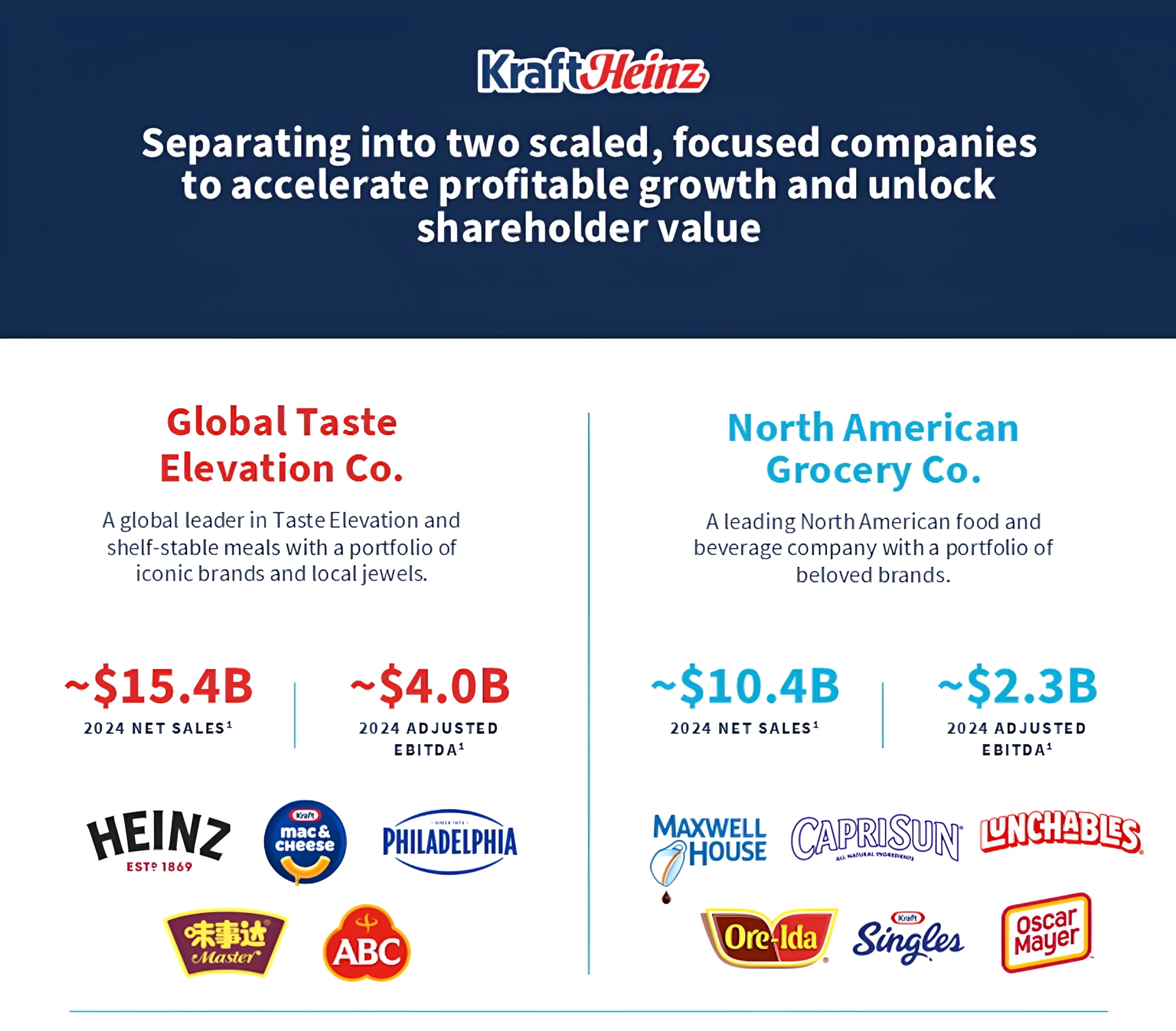
- Global Taste Elevation Co. will comprise brands like Heinz, Philadelphia, and Kraft Mac & Cheese.
- North American Grocery Co. will focus on staples including Oscar Mayer, Kraft Singles, and Lunchables.
- Leadership and structure are in place, with dividend levels maintained and the separation designed to be tax-free.
Quick listen: Kraft Heinz is undoing its decade-old merger, a move that shows why agility now beats size in consumer brands.
Kraft Heinz announced it will divide into two separate companies by the second half of 2026.
The spin-off is intended to reduce internal complexity and help each new business focus more directly on its brands and markets, according to the company's news release.
“The Board’s unanimous decision to separate into two independent companies came after careful consideration and a comprehensive evaluation of our options,” Jack Pope, lead director of the Kraft Heinz Board, said.
Kraft Heinz currently has over 200 brands under its umbrella in about 150 countries.
Global Taste Elevation Co. will take on the company’s faster-growing, higher-margin brands, including Heinz, Kraft Mac & Cheese, and Philadelphia.
This unit generated $15.4 billion in net sales and $4 billion in adjusted EBITDA in 2024.
It draws a significant portion of its revenue from emerging markets and foodservice channels.
North American Grocery Co. will manage iconic grocery staples like Oscar Mayer, Lunchables, and Kraft Singles.
With $10.4 billion in net sales and $2.3 billion in adjusted EBITDA, this business holds strong market share across several core categories.
The split will be tax-free and is expected to cost up to $300 million to complete.
Miguel Patricio will serve as Executive Chair, and Carlos Abrams-Rivera will lead the North American Grocery business.
“By separating into two companies, we can allocate the right level of attention and resources to unlock the potential of each brand to drive better performance and the creation of long-term shareholder value," Patricio explained.
A dedicated Separation Committee, chaired by John Cahill, will oversee execution.
Dividend levels will remain unchanged, and both companies are expected to maintain investment-grade credit profiles. Headquarters will stay in Chicago and Pittsburgh.
A Merger That Never Delivered
The decision marks a major shift for Kraft Heinz, more than a decade after Warren Buffett’s Berkshire Hathaway and 3G Capital engineered the original merger.
It created one of the largest food companies in North America. However, the combined entity:
- Struggled to modernize its portfolio
- Gradually lost value
- Failed to keep up with changing consumer preferences
Buffett, who remains the company’s largest shareholder, told CNBC he was disappointed in the outcome.
Buffett’s remarks carry weight not just because of his stake, but because he rarely criticizes deals this publicly.
He noted that while putting Kraft and Heinz together didn’t produce the results investors hoped for, simply pulling them apart won’t necessarily fix what’s broken.
The legendary businessman stopped short of opposing the decision, but made clear that deeper strategic issues remain.
Our Take: What Brand Leaders Should Take Away
This kind of structural reset doesn’t happen often.
Undoing a merger reflects a deeper shift in how legacy companies are rethinking scale, focus, and what it actually takes to compete in the modern market.
Here are some lessons worth noting:
- Simpler structures create room for focus. With two separate leadership teams, each brand portfolio can now operate with more tailored priorities.
- Agility matters more than scale. Kraft Heinz lost ground by staying too broad for too long. The split reflects a growing trend: specialization over consolidation.
- Clarity in change wins trust. Announcing leadership, dividend stability, and long-term vision early gives stakeholders the confidence to stick around.
The Kraft Heinz split is less about starting over and more about getting real about what wasn’t working.
As the two new companies take shape, it signals a push for sharper priorities and faster execution.
This clearly says that, sometimes, growth also depends on what you decide to let go.
At one point last year, Kraft Heinz was considering selling Oscar Mayer, but the sale never happened.
Instead, the company is carving a new path to reshape what stays.
Agility often outperforms size in today’s market. These consulting experts help organizations pivot, specialize, and compete with precision.