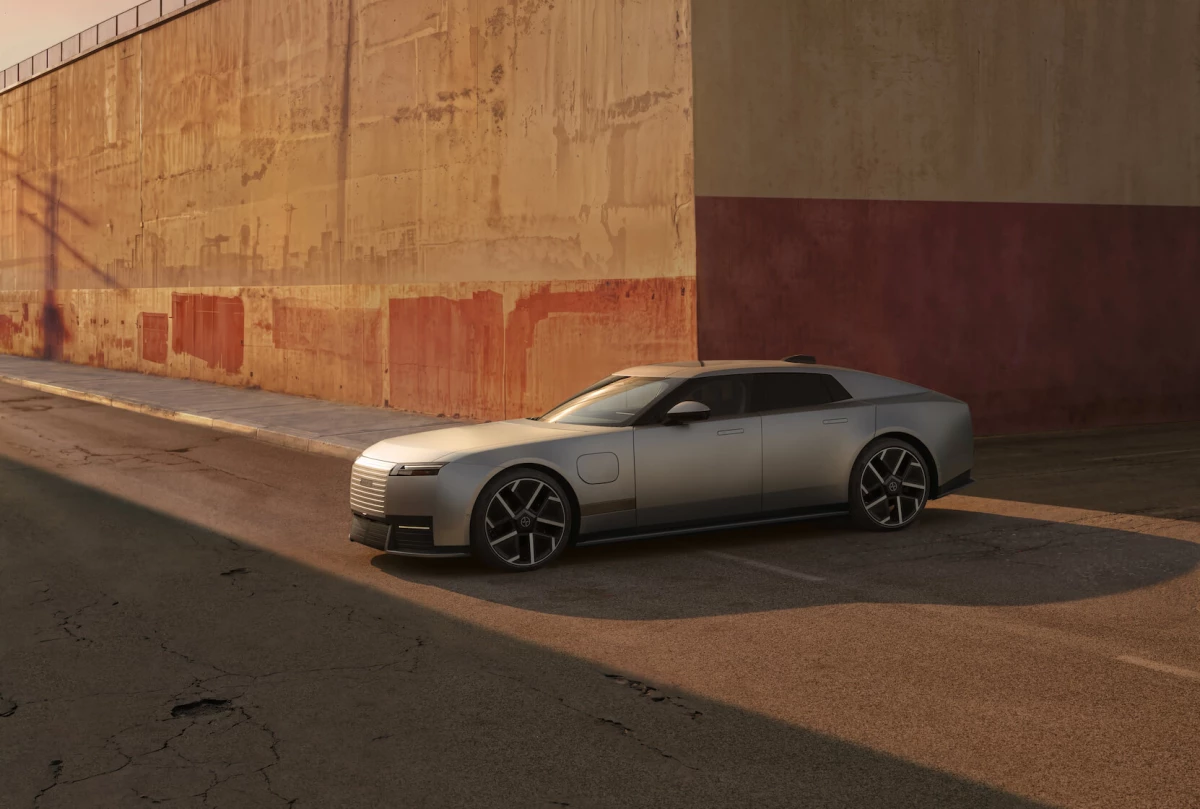

Two years after an ad that skipped the cars entirely, Jaguar Land Rover (JLR) has finally shown one off.
It revealed the "Type 01," an electric four-door GT, in New York City on Tuesday.
Pricing starts near £130,000 in the U.K. and $130,000 in the U.S., as confirmed by the brand to CNBC.
Order books don't open until early 2027, so the number that everyone keeps quoting has another year to sit there.
The debut follows a November 2024 rebrand that sent social media into an uproar and a 97.5% collapse in Jaguar's European registrations.
The "Copy Nothing" campaign's centerpiece was a half-minute video featuring fashion-styled models and slogans, with no vehicle shown.
The new Jaguar logo and its lowercase wordmark took as much heat as the ad itself.
The fallout reached the design studio, and chief creative officer Gerry McGovern left JLR in 2025 after two decades shaping the brand's look.
Sales then collapsed as the brand wound down its old range, and Jaguar logged only 49 new registrations across Europe in April 2025.
This figure is down from 1,961 a year earlier, according to the European Automobile Manufacturers' Association data.
Spending two years under this kind of spotlight, Jaguar's Type 01 reveal doubles as reputation management, with a real car now doing the talking.
Executives are positioning the car as the opening chapter of a larger lineup.
Autocar reports that a limousine and an SUV will follow on the same platform, though JLR has not confirmed either.
"Type 01 is the foundation of the brand, one that makes no compromise between design and engineering in our quest to reinvent Jaguar for the 21st century," Jaguar Managing Director Rawdon Glover said in a press release.
Meanwhile, JLR CEO PB Balaji linked the car to the kind of buyer Jaguar now wants.
He said the car reflects an ambition to "create objects of desire that will help us invite a new generation of clients into Jaguar's loyal and passionate customer base."
A pitch like this puts the weight on the product itself.
Jaguar spent as much effort detailing the engineering as it did the styling, treating product design as the proof the ad campaign never offered.
A Clean-Sheet Platform and 360 Patent Filings
The car design sets the tone this time.
Jaguar gave the Type 01 a low roofline, a short front overhang, a long bonnet, and 23-inch wheels.
And the bonnet is meant to recall the E-Type from the 1960s.
Exterior options include glossy paint or a satin finish, and the front fender carries Jaguar's leaping cat emblem.
The car rides on the new JEA platform, which Jaguar designed for electric models only and which has drawn more than 360 patent applications.
Three electric motors produce a peak of 1,030PS and 1,365Nm, and the car reaches 62mph in 3.2 seconds.
Rolling from 62mph to 112mph takes 4.0 seconds, and Jaguar credits lessons from its Formula E racing team for tuning the driving character.
Moving vanes and a spoiler that deploys in three stages bring the drag coefficient down to 0.23, a new low for the brand.
Range is the next question for shoppers weighing a switch.
The 118kWh battery and 850-volt electrical system are projected to deliver up to 400 miles of EPA range and 450 miles on the European WLTP cycle.
Sustained highway cruising brings the real-world figure closer to 320 miles.
A 350kW charger adds roughly 200 miles in 13 minutes, and Jaguar calls those numbers provisional until homologation wraps.
A central spine trimmed in brass-toned aluminum runs through the cabin, carving out four distinct zones.
Drivers get a 24-inch OLED display behind a single sheet of glass, while a smaller seven-inch screen holds everyday controls.
Sound comes from a Panoramic Soundbar that stretches the full width of the cabin.
Production starts in 2027 at JLR's Solihull plant, with drive units built in Wolverhampton and body panels in Halewood.
Orders open in early 2027, and first deliveries are expected around the middle of the year.
Specs this granular give a damaged name something testable to stand behind, which is what skeptics need before they will look and believe again.
A premium launch in New York buys the room for one night, and the product launch that follows decides whether curiosity turns into orders.
A 247,226-Unit Market and 50,000 Sign-Ups
Jaguar's specs arrive in an EV market that's still finding its footing.
Cox Automotive estimates that U.S. EV sales reached 247,226 units in the second quarter of 2026.
That's a 20.5% drop from the same period in 2025 and a 14.7% increase over the first quarter.
Cox Automotive linked the weaker numbers to the end of the $7,500 federal EV tax credit in September 2025.
Jaguar is not the only luxury marque testing whether its buyers will follow it into electric, and Ferrari got there first.
It launched the Luce in Rome in May, a four-door electric car with more than 1,000 hp and a $640,000 price.
Milan shares closed down 8.4% the next day as critics questioned whether the design still read as a Ferrari.
Jaguar is now competing with established luxury names for the same wealthy shoppers.
But early demand signals look healthier than the registration data suggests.
Glover said at a press preview that more than 50,000 people have registered interest in the Type 01, and 78% of them are new to Jaguar.
Registered interest is not the same as a signed order, and none of it reaches a sales report before 2027.
Reversing the 97.5% drop was never the plan anyway.
Jaguar retailed 48,445 vehicles worldwide in FY24/25, down 27.5% year-on-year, which JLR attributes to winding the brand down ahead of its relaunch.
At $130,000 a car, Jaguar is chasing a few thousand buyers a year and making its money on price instead of volume.
Three takeaways stand out for anyone relaunching a premium product after a public stumble:
- Lead with proof points: Hard numbers give skeptics something concrete to argue with, which beats asking an audience to take a vision on faith.
- Put the product in the frame early: Teasing an identity without the thing attached to it leaves the audience to write the story themselves.
- Answer the switching questions: Buyers weighing a category change need the ownership details upfront as unanswered practicalities stall interest early.
Attention bought by controversy expires the moment a real product shows up, and the brand strategy that follows has to convert curiosity into paperwork.
Our Take: Can One Car Undo Two Years of Brand Damage?
The Type 01 gives Jaguar its first fair shot at an honest verdict.
We think that it can't reverse the sales drop, because Jaguar said it walked away from that kind of volume deliberately.
The backlash grew out of a brand asking people to believe in a Type 00 concept car and a logo.
They left the confusion that the 2024 ad created sitting there unanswered.
Now there's a 1,030PS car that can be driven, photographed, and picked apart.
Harsh opinions beat confusion, even when they sting.
Luxury forgives slowly, though, and it takes a brand back long after it accepts the object.
We would keep an eye out for what follows the Type 01. Will there be a Type 02?
A second good car is what proves this one was the start of a plan.
Companies running a major identity reset need agencies that can align the visual change with the operational one so the work holds up over time.
Explore these top branding agencies in our directory.