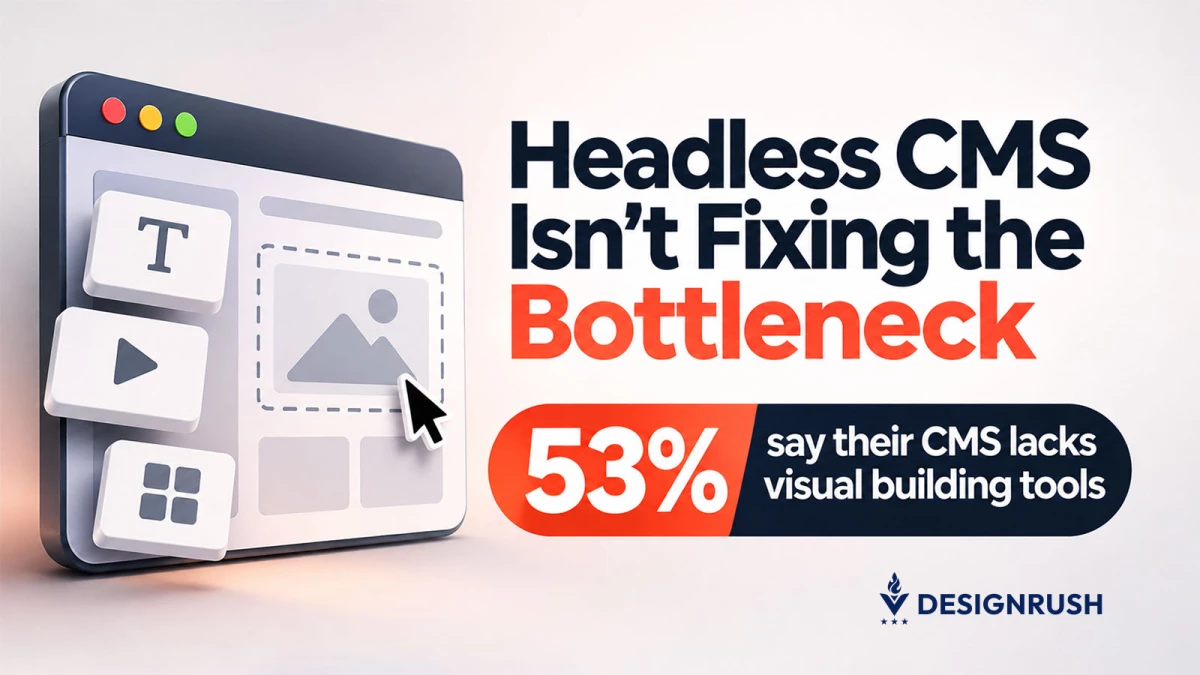

Contentstack’s 2026 CMS Modernization Report found that 53% of marketing respondents wanted visual building capabilities their current CMS lacked, while 51% cited development speed as a major frustration.
Those frustrations can remain after a company moves to a headless CMS.
Marketing still has to create campaign pages, update product content, publish resources, change layouts, and respond when something needs to go live quickly.
If routine requests still go through development, the migration hasn’t changed much about how marketing gets work live.
Plan Headless CMS Architecture Around Marketing Workflows
Most of the time, teams make early CMS decisions around schemas, integrations, components, and front-end requirements. Publishing work should be mapped at the same time.
Start with what marketing does every week.
Which pages does the team create? Which sections change often? What can an editor safely assemble without development support? And what changes affect code, integrations, or the wider design system?
The answers to those should influence the components, fields, and controls built into the CMS.
A marketer who can change copy and images but needs help to create every new page variation has limited control over publishing.
Components can create the same problem when they exist in the system but can’t accommodate the pages the team actually produces.
Visual building tools are useful when the available choices reflect that work. But adding more options does little if marketers can’t use them for the pages they need to publish.
Marketing should be able to handle day-to-day content work while technical teams retain control over changes that affect the underlying site.
Reusable CMS Templates Reduce Developer Dependence
Development and web design teams can decide which elements stay fixed while marketers control content, approved layouts, and repeatable page structures.
We dealt with this during ANML’s work on Salesloft’s website following its merger with Clari.
The project covered roughly 10,000 pages across two CMS platforms. As part of the Contentstack work, we refactored restrictive components and created reusable templates backed by design tokens.
Salesloft’s marketing team could then continue extending the website without bringing ANML back for regular page production.
The templates had to match the pages the team actually publishes. A campaign landing page needs different controls from a product page, while a resource page may require another set of fields.
When new requests regularly fall outside those patterns, marketers end up back with developers for work the CMS was meant to support.
Design tokens and fixed component rules can preserve consistency while still giving marketing room to assemble and update pages within agreed boundaries.
CMS Permissions Need Clear Content Ownership
Permissions should reflect who owns each type of content.
A campaign manager may need to assemble and publish approved page types, while an editor may only need access to copy, images, and existing modules.
Schemas, integrations, components, and front-end behavior can remain with technical teams.
When ownership is unclear, routine publishing decisions start drifting toward development.
Marketing teams may have the tools to edit content but still lack the authority to publish, while technical teams end up handling approvals that have little to do with engineering.
Teams should know who can make a change, who approves it, and when technical involvement is required before the CMS is in daily use.
Test Headless CMS Independence Before Launch
Before sign-off, marketing should be able to complete routine publishing work without unnecessary engineering help:
- Build a landing page using an approved template
- Add a section to an existing page
- Update campaign content
- Publish a new resource
- Create another page using an established format
Any task on that list that still needs engineering is worth examining.
Technical teams should remain involved in new functionality, structural changes, integrations, and work that affects the wider site.
The real test is whether marketing can handle the work it owns once the implementation team steps away.