
Global Growth: Key Findings (China as Case Study)
- Emerging markets remain resilient, with AI, EVs, and health leading growth. China illustrates this momentum most clearly.
- Success abroad requires localization, regulatory awareness, and phased rollouts — a lesson seen in China and other large markets.
- Treating markets as one is risky; companies in China and across Southeast Asia win by adapting to regional realities.
Quick listen: In 2025, global growth won’t come from scale, but from resilient sectors — with China offering the clearest case study. Here’s where to focus in under 3 minutes.
For companies expanding abroad, the biggest wins in 2025 won’t come from scale, but from resilient sectors that continue to unlock global growth.
AI, green tech, and health are leading the way, with China offering one of the clearest case studies.
Few markets have moved from factories to frontier technologies so quickly, and that momentum still draws international companies.
The World Bank expected China’s GDP growth to slow from 5% in 2024 to 4.5% in 2025, yet ARC Group reported a stronger 5.2% YoY rise in Q2.
This is proof that opportunities remain significant in the world’s second-largest economy.
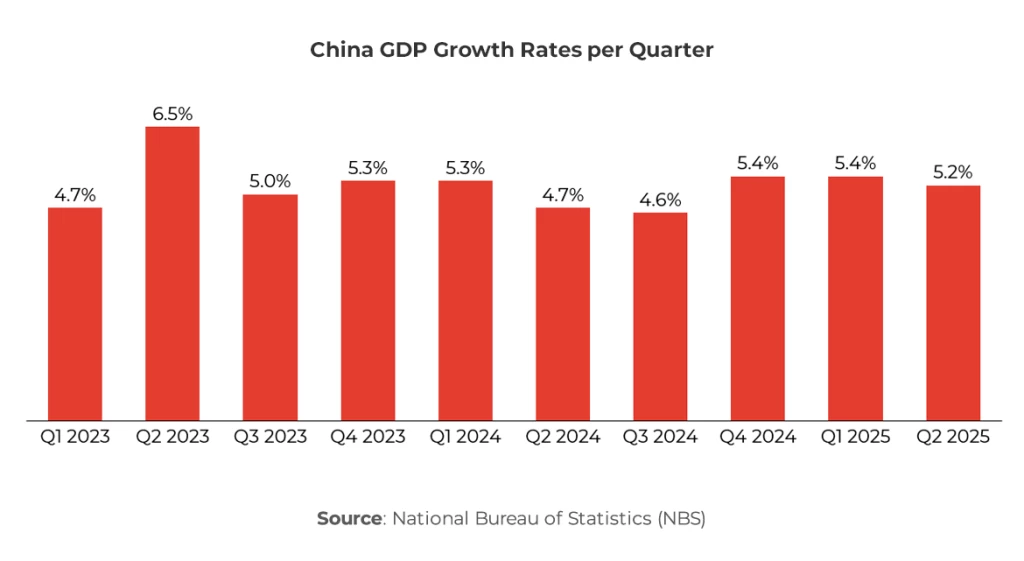
Clearly, this is not the profile of a country running out of steam, which is why it still attracts a ton of attention from foreign enterprises.
The challenge here is recognizing which industries are worth investing the necessary time, effort, and budget.
That said, here are three industries with massive growth potential:
Unlock Opportunities in Fast-Rising Sectors (Led by China)
1. Artificial Intelligence and Machine Learning
AI is fueling transformation worldwide, from personalized healthcare to supply chain automation. In China, the scale of investment makes it one of the most ambitious national projects
In fact, China made waves earlier this year with the release of incredible platforms like DeepSeek and Alibaba’s Qwen AI.
🚀 DeepSeek-R1 is here!
— DeepSeek (@deepseek_ai) January 20, 2025
⚡ Performance on par with OpenAI-o1
📖 Fully open-source model & technical report
🏆 MIT licensed: Distill & commercialize freely!
🌐 Website & API are live now! Try DeepThink at https://t.co/v1TFy7LHNy today!
🐋 1/n pic.twitter.com/7BlpWAPu6y
For foreign enterprises, the attraction here lies in the scale of AI and data. After all, few markets can generate the kind and amount of data that China does every day.
And anyone operating in the AI industry knows that data is the fuel that keeps the engine humming.
Now, imagine having access to a market that generates data faster and more abundantly than a firehose at full blast.
Companies entering this space are finding opportunities in cross-border collaborations, particularly in fields like healthcare diagnostics and supply chain automation.
While China shows the scale of what’s possible, AI opportunities are unfolding across markets worldwide, especially where data, healthcare, and logistics converge.
2. Electric Vehicles and New Energy
EV adoption is accelerating across global markets, from Europe to Southeast Asia. China, however, has surged miles ahead, making it the most advanced case study in this space.
It’s so far ahead that it’s actually easier to count the number of non-EV cars on the road, especially in China’s major cities.
China understands this advantage, which is why many factories that once churned out parts for foreign automakers are now retooling for batteries and charging infrastructure.
Foreign enterprises can play two roles here:
- Position themselves as technology partners offering advanced components and software that Chinese firms want to integrate.
- Enter the market as competitors willing to test their EVs in a mature market that has accepted EVs with open arms.
Going hand in hand with this push is China’s growing renewable energy sector.
Solar, wind, and storage technologies are expanding faster in China than anywhere else.
For businesses positioned in green tech, there are valuable lessons to be learned from Chinese companies, with potential government subsidies for foreign investors.
China may be the furthest ahead, but the lessons in EV adoption, renewable energy, and supply chains apply to every market transitioning toward clean mobility.
3. Health and Wellness
Health and wellness demand is rising everywhere as populations age and consumers spend more on prevention.
In China, these dynamics are magnified by a fast-growing, aging middle class.
That translates to a demand for everything from high-end fitness products to specialized medical devices.
Because of this, foreign firms are finding space in three areas:
- Preventive health
- Biotechnology
- Digital health services
Wearables are no longer novelties but household items. Personalized nutrition plans are finding as many takers as trendy meal kits once did.
Even hospitals and clinics are quietly striking partnerships with foreign providers for both tech and know-how.
All of this matters because health is more than just a trend in China. It’s become a demographic inevitability thanks to China’s rapidly aging population.
As such, companies that enter this market are stepping into a sector where demand will rise steadily for decades.
While China’s demographics amplify the trend, rising health awareness and aging populations mean the sector offers steady growth potential worldwide.
Entering Complex Markets: Lessons from China
Too many foreign firms treat China as one big prize, when in reality it’s a patchwork quilt of regions, tastes, and spending habits.
Shanghai and Chengdu may share a high-speed rail, but consumer preferences and behavior vary wildly.
That’s why companies that take a shortcut and use a cookie-cutter playbook that worked everywhere else stumble.
It’s a difficult lesson that even the biggest names like Uber, Best Buy, and Home Depot had to learn firsthand, resulting in quick market exits for each.
To avoid repeating the same mistake, here’s what foreign businesses should do:
- Localize deeply: Adapt products, services, and messaging to reflect regional preferences, not just “China” as a whole.
- Understand the rules: Regulations shift fast. Success hinges on reading the fine print before it changes.
- Test, then scale: Pilot in one market or city in China before rolling out nationally. This makes it easier to correct the course midway.
On top of these, it’s highly recommended to work with a local agency, like KOPI Studio, that specializes in helping foreign businesses penetrate the Chinese market.
In a market where one wrong step can trigger an avalanche, having the right agency is akin to having both the sherpa and the safety rope, keeping foreign brands steady as they climb.
Navigate Emerging Markets with Strategy
Emerging markets don’t reward speed over strategy.
China proves that scale delivers only when companies localize and move deliberately.
The same holds worldwide: success comes from choosing the right sectors and entering with the right approach.