-details-webp.webp)

Rebrand Framework Strategy: Key Findings
- HCLTech’s rebrand drove a 15.9% rise in brand value, a 25.7% stock increase, and a 75% lift in recall.
- When budgets, enterprise focus, and leadership alignment line up, a website rebrand becomes a growth driver instead of a facelift.
- Balancing SEO performance, internal alignment, and outcome-focused messaging is what turns a rebrand into a tool for winning larger deals.
Most CMOs see rebrands as cosmetic. They are not.
HCLTech proved it. Its rebrand lifted brand value 15.9% year over year, pushed its stock up 25.7%, and increased brand recall 75%, according to Forrester’s analysis.
That is not just a new look.
For CMOs at B2B companies, a website rebrand is one of the best moments to reset positioning and speak directly to enterprise buyers.
Rebrands are also common:
Forbes reported that 74% of S&P 100 companies rebranded within their first seven years. The problem is how many of those rebrands are cosmetic churn rather than strategic resets. When leadership treats a refresh as a facelift, the company wastes a prime moment to move upmarket.
Baunfire, a digital agency focused on growth, points to three signals that prove a company is ready for this move:
- A clear pivot toward enterprise accounts
- Budgets that support premium branding
- Leadership alignment on value and messaging
Without that alignment, the website risks looking refreshed but failing to sell differently.
The biggest red flag, though?
When there is no agreement on who the target buyer actually is.
But moving a brand upmarket doesn’t happen by accident. It takes a clear process.
Research, alignment, and structured steps ensure the site doesn’t just look refreshed but actually supports enterprise buyers, protects SEO, and keeps internal stakeholders on the same page.
Editor's Note: This is a sponsored article created in partnership with Baunfire.
The 5-Step Enterprise Rebrand Framework
To do this, Baunfire follows a disciplined sequence:
- Research before design: Benchmark competitors and interview buyers to understand their expectations regarding ROI, risk, and operational fit.
- Reframe positioning: Replace vague claims with narratives that highlight measurable business outcomes.
- Architect for trust and scale: Navigation, case studies, executive profiles, compliance, and security pages must all signal enterprise readiness.
- Match buying cycles: Enterprise buyers look for ROI-led case studies, executive briefs, problem-solution content, and RFP-ready materials.
- Protect SEO equity: High-value assets are preserved, redirects mapped in advance, and risks tracked before launch.
However, the agency stresses that brand elevation should never come at the expense of performance.
“Rebrands should open new opportunities without closing doors on what already works,” said Juan Sanchez, Head of Partnerships at Baunfire.
“Keeping SEO, content, and internal alignment intact is just as important as refreshing the look and messaging.”
In short, protecting rankings, visibility, and existing equity must happen alongside modernized messaging and updated site architecture.
Too often, brands rush a rebrand that looks nice but doesn’t actually change how they sell. They focus on visuals, miss what enterprise buyers really care about, and leave leadership out of sync, resulting in mixed messages.
Neglected content and SEO then drag down visibility and leads.
What CMOs Should Take Away
This is why a rebrand aimed at enterprise buyers should be treated as a full-scale effort, not a checklist.
Before design starts, run these checks to ensure your rebrand drives enterprise sales, not just produces a prettier homepage:
1. Treat a rebrand as a full-scale strategic effort.
Rebrands must have cross-functional ownership and clear, measurable outcomes. A new look without shared goals is cosmetic churn.
2. Run collaborative workshops early.
Bring product, sales, and brand together to agree on value and messaging before design starts.
As Sanchez put it: “Sitting everyone in the same room early ensures decisions are based on shared priorities, not assumptions.”
3. Focus messaging on predictable outcomes, not features.
Enterprise buyers care about ROI, risk reduction, and operational fit. If your homepage leads with features, you lose them.
4. Protect what already works.
Keep SEO equity, content structure, compliance pages, and CMS scalability intact while modernizing messaging and design.
5. Make alignment the north star.
When product, sales, and brand share the same language, the site becomes a growth engine rather than a showcase.
“When product, sales, and brand teams agree on messaging from the start, the site actually drives enterprise growth instead of just looking refreshed,” Sanchez added.
Put simply: enterprise buyers don’t want features; they want predictable outcomes.
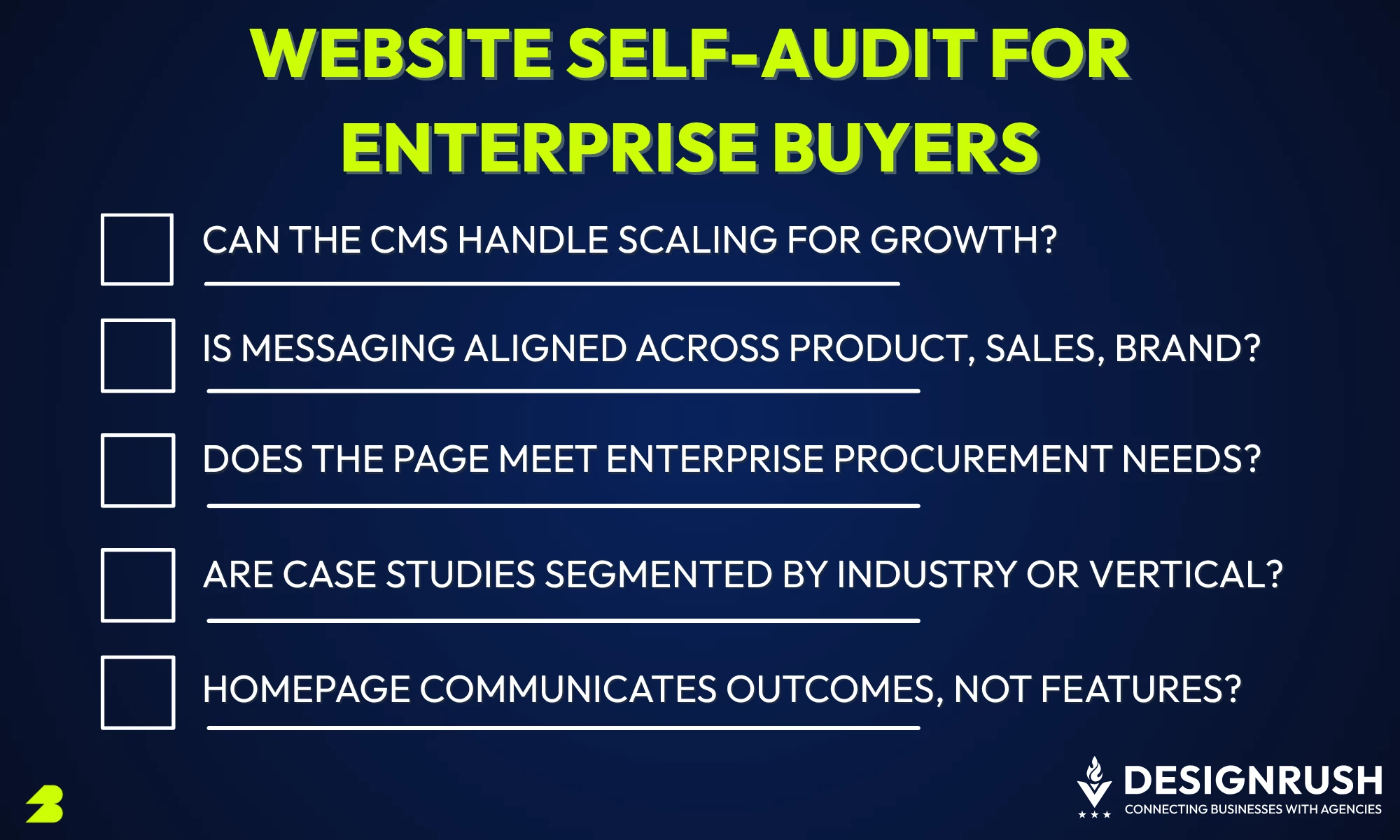
Use this quick self-audit to see if your website is ready to sell to enterprise buyers:
- Does your homepage communicate business outcomes instead of product features?
- Are your case studies segmented by industry or vertical to prove relevance?
- Do you have a security or compliance page that meets enterprise procurement needs?
- Is your messaging aligned across product, sales, and brand teams?
- Can your CMS handle scaling content for new offerings, markets, or regions?
When those pieces align, the rebrand supports real growth.
A website built on research, alignment, scalable architecture, and disciplined SEO migration does more than improve visuals. It drives larger deals.
Baunfire’s advice to agencies working with CMOs: help clients shift from describing features to proving impact.
CMOs who win enterprise deals all say the same thing. Show clear business value first and let features wait.
For example, when web-based interface design and prototyping tool Figma rebranded, it focused on all product builders and designers, showing how cross-functional teams could use its tools.
The refresh helped enterprise teams understand the value more quickly and move through onboarding more efficiently.
Future-Proofing Tip: “Design for Long-Term Scale”
An enterprise website should evolve.
Modular design systems and a flexible CMS let teams add new content, markets, or offerings without a full rebuild.
AI-powered tools and automation hooks keep the site relevant as buyer needs change.
The goal is a site that grows with the business, not one that becomes outdated the day it goes live.
It should also be ready for new channels and integrations, so nothing breaks as technology evolves.
When done right, a scalable site becomes a living asset that actually supports growth, strengthens conversion, and keeps the buyer journey moving forward.