
GPT-Driven Multichannel ROI: Key Findings
- 27% of CMOs report limited or no GenAI adoption in campaigns, revealing a significant maturity gap as AI shifts from experimentation to performance infrastructure.
- 66% of marketing and sales teams report revenue increases from GenAI use, confirming GPT’s ability to drive measurable top-line growth when operationalized effectively.
- Despite average GenAI investment reaching $1.9 million, fewer than 30% of CEOs are satisfied with returns, underscoring the growing pressure for accountable, repeatable AI-driven ROI.
GPT has made its way into countless industries across the world.
Once an idea (or an option), GPT is a business factor when evaluating budgets, revenue goals, and performance targets.
For marketing leaders in particular, the question is no longer whether to use AI. It’s whether it can consistently deliver measurable multichannel ROI.
Early adoption often lived in isolated wins, featuring faster blog drafts, more efficient ad variations, and smarter summaries of campaign reports.
And while this is useful, it’s not yet strategic.
As campaign complexity increases and media channels fragment, incremental efficiency alone will not move the needle.
In the video below, Baadsgaard says marketers must define who they are before letting AI accelerate execution:
Editor's Note: This is a sponsored article created in partnership with Disruptive Advertising.
How GPT Powers Multichannel Campaign Infrastructure
Jacob Baadsgaard is the founder and CEO of Disruptive Advertising, one of the top digital marketing agencies.
Baadsgaard says that the most advanced teams are treating GPT less like a creative shortcut and more like operational infrastructure.
“Instead of asking how AI can improve a single asset, they are embedding it into planning frameworks, channel coordination, testing cycles, and performance analysis,” Baadsgaard says.
Paid search informs social messaging, email performance shapes landing page variations, and creative insights feed back into targeting strategy.
When GPT connects those moving parts, it leads to a decrease in friction and an increase in speed.
Execution tightens, and multichannel campaigns begin to function as unified systems, rather than disconnected tactics.
And this is where ROI starts to compound.
How GPT Increases Cross-Channel Efficiency and ROI
Efficiency gains often appear modest at first.
A brief that takes 30 minutes instead of an hour. A testing framework built in days instead of weeks.
As a result, performance summaries are delivered in minutes rather than hours.
However, over time, those marginal improvements stack.
Faster briefs lead to broader testing. Broader testing sharpens insights. And sharper insights improve budget allocation.
Across search, social, email, and display, that compounding speed creates measurable lift.
And consumer discovery is changing just as quickly.
“As audiences increasingly interact with AI-influenced environments during research and purchase journeys, brands must maintain consistency across touchpoints,” Baadsgaard says.
“GPT helps ensure messaging and targeting stay aligned even as channels multiply.”
AI Marketing ROI Data and Performance Trends
While the strategic case for GPT integration may feel intuitive, the broader market signals are becoming difficult to ignore.
Across revenue performance, productivity, and investment levels, the data shows a marketing industry in transition:
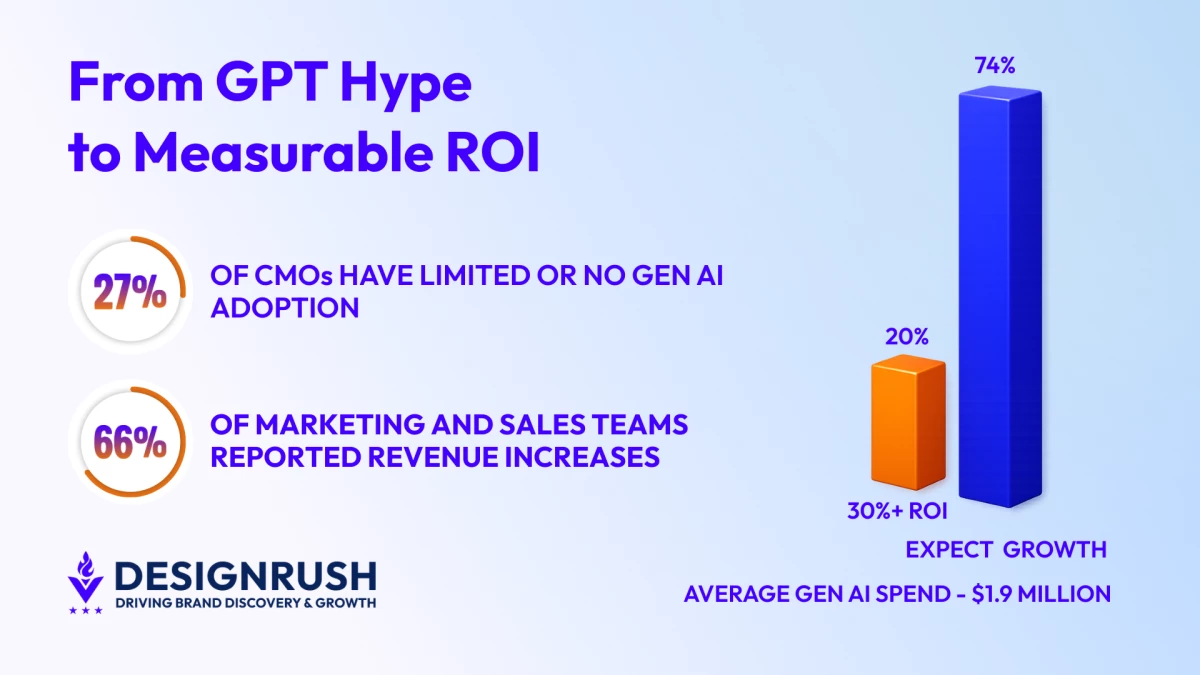
- 27% of CMOs report limited or no GenAI adoption in campaigns
- 66% of marketing and sales teams reported revenue increases from GenAI use in the second half of 2024
- 20% of organizations report ROI exceeding 30%, while 74% hope to increase revenue by using AI
- GenAI saves the equivalent of 1.6% of total work hours, leading to a 1.3% labor productivity increase since ChatGPT’s release
- Average spend on GenAI initiatives reached $1.9 million, yet fewer than 30% of CEOs were satisfied with returns
Together, these figures point to a market at an inflection point. Adoption remains uneven, yet measurable gains are emerging for teams that operationalize AI beyond isolated use cases.
“The real differentiator here won't be access to AI, but the discipline to turn it into repeatable performance,” Baadsgaard says.
AI Investment Growth and Rising ROI Pressure
AI budgets are growing, and so is executive scrutiny.
As investment increases, leadership teams are asking harder questions about profitability, efficiency, and sustained performance lift.
“Adoption metrics are no longer enough,” Baadsgaard says.
“CMOs and agency leaders are expected to show how AI influences margin, customer lifetime value, and long-term growth rather than short-term output.”
The conversation is now shifting from what GPT can produce to what it can prove.
Baadsgaard unpacks how purpose, performance, and AI can help marketers achieve optimal results in the video below:
How CMOs Win With GPT in 2026
Brands positioned to outperform this year won’t just work faster. They’ll move in sync.
“GPT is no longer an accessory layered onto marketing strategy. It is becoming the connective engine beneath it,” Baadsgaard says
“When treated as infrastructure rather than innovation theater, it strengthens planning, accelerates execution, and sharpens optimization across every channel.”
Ultimately, while GPT (and similar AI tools) opened the door to efficiency, accountability decides who walks through it.
Remember, that accountability is all about tying GPT outputs to revenue KPIs, while integrating cross-channel feedback loops.
And you can’t forget to move AI ownership from isolated content workflows to performance-driven teams.