
Google is making AI agents the center of its enterprise push as companies move from AI experimentation into workflow execution.
Reuters reported that Alphabet is deepening its push into enterprise software.
At Google’s annual cloud conference last April, the search giant clearly positioned AI agents as central to its strategy for monetizing artificial intelligence.
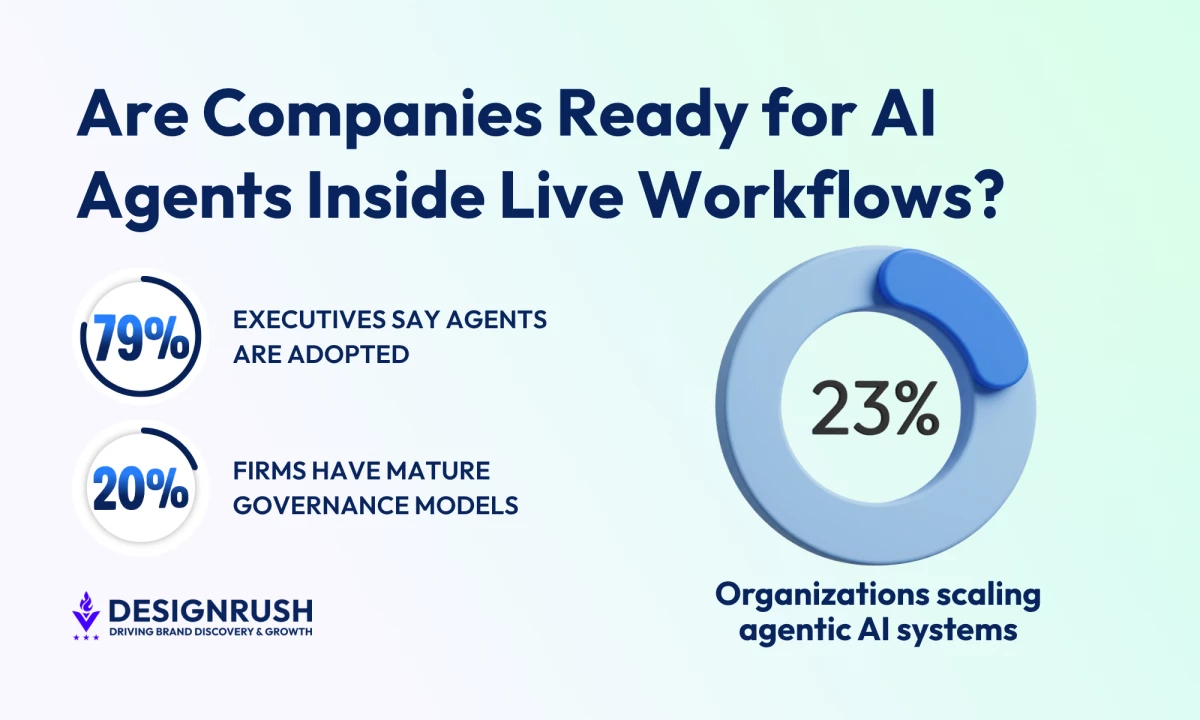
This push by Alphabet comes at a time when 79% of senior executives say AI agents are already being adopted in their organizations, according to survey data from PwC.
However, Deloitte found that only one in five companies report having a mature governance model for autonomous AI agents.
Together, those findings point to a mismatch between adoption and control.
Enterprises are now focused on how workflows are structured, how information is organized, and whether internal systems can support automated execution without breaking under complexity.
Isadora Agency works in this space, designing enterprise websites, digital products, and UX systems where structured user journeys and clear information systems support how digital platforms function in practice.
The agency’s president, Isadora Marlow-Morgan, says AI agents only work when the underlying experience is structured, the content is clear, and the workflow makes sense.
“Enterprises that want AI to execute real tasks need to design the foundation first,” she adds.
So, the real issue is whether internal systems can support execution at scale.
AI Agents Moving Into Enterprise Workflow Execution
Enterprise platforms are framing AI agents as systems that execute structured workflows across applications, services, and internal operations.
Google Cloud described this direction as a move toward “systems of action,” where agents move beyond recommendations and begin carrying out multi-step processes across enterprise environments.
That includes coordinating tasks, triggering actions, and operating across connected business functions.
Honeywell, an industrial technology company, shares how Google Cloud-powered AI agents have helped transform their business.
Nearly 75% of Google Cloud customers already use Google Cloud AI products in production environments, indicating that enterprises are moving beyond testing into active deployment.
McKinsey’s State of AI research reinforces the same pattern.
It found that 23% of organizations are already scaling agentic AI systems in at least one business function.
These systems are defined by their ability to plan and execute multiple steps within workflows, rather than completing isolated tasks.
The role of AI agents is changing inside enterprise architecture. They are being embedded directly into operational workflows rather than sitting as separate tools layered on top of them.
What Is Slowing Down Enterprise AI Agent Adoption?
Deloitte’s 2026 State of AI in the Enterprise report shows that only 20% of companies have mature governance frameworks for autonomous AI agents, even as adoption accelerates across industries.
This creates a practical constraint for deployment.
AI agents depend on consistent data structures, defined workflows, and stable system logic to function reliably at scale.
When those elements are inconsistent, automation reflects existing operational friction instead of resolving it.
At enterprise scale, this affects procurement decisions, internal rollout speed, and which teams are able to deploy AI agents beyond isolated pilots.
Vendors are increasingly evaluated on model capability and on how well their systems integrate into existing enterprise architecture without requiring major structural rewrites.
That’s why governance, interoperability, and workflow design are now part of both the buying conversation and implementation phase.
Enterprise UX Design for Reliable AI Agent Performance
As AI agents take on operational tasks, the structure behind digital systems starts affecting how consistently those systems perform.
“When it comes to integrating AI agents and automation, blind speed isn't the name of the game. To win, companies must make their systems understandable enough for humans and AI to work from the same source of truth,” says Marlow-Morgan.
Companies are starting to judge AI systems less on what the model can generate and more on whether the surrounding systems can support reliable execution.
It depends on whether internal systems are consistent enough for both humans and automated agents to operate against the same structure.
Google Cloud and Salesforce’s partnership, announced at Cloud Next, reinforces this direction.
The companies are enabling AI agents to operate across Slack, Google Workspace, Agentforce, and Gemini Enterprise with shared context and end-to-end workflow execution.
Erica Chuong of Google demonstrated these capabilities on stage at Google Cloud Next.
Overall, the goal of these integrations is to reduce fragmentation across tools while enabling agents to complete tasks across systems.
When agents operate across platforms, inconsistencies in UX structure, content organization, and workflow logic become execution risks rather than design issues.
“Before AI can execute the workflow, the workflow has to be worth executing,” adds Marlow-Morgan.
Enterprise Readiness Requirements for Scaling AI Agent Workflows
Isadora Agency’s work focuses on how users navigate enterprise systems and how information is organised behind the interface.
As AI agents become more integrated into enterprise workflows, those structures increasingly affect how consistently systems operate.
For enterprise teams, that creates three immediate priorities:
- Identify where workflows rely on inconsistent inputs or unclear ownership, since these points often create failures once processes become automated.
- Clean up information structures and workflow logic before adding new automation layers, particularly across teams that share responsibilities.
- Build governance rules directly into operational systems instead of treating them as separate policy documents.
Execution readiness depends on whether digital environments are organised clearly enough to support consistent behaviour under pressure.
Weak structure tends to surface quickly once automation is introduced.
When workflows and information structures are consistent, automated systems perform more reliably under pressure.