
At Google I/O 2026, the company announced they will be rolling out new AI-powered search experiences, agentic capabilities, and conversational interactions directly inside Search.
Acccording to Google’s Senior Vice President Nick Fox, the roll out will be the ““biggest reinvention of the search box in 25 years.”
The announcement builds on a year of rapid AI adoption inside Google's core products.
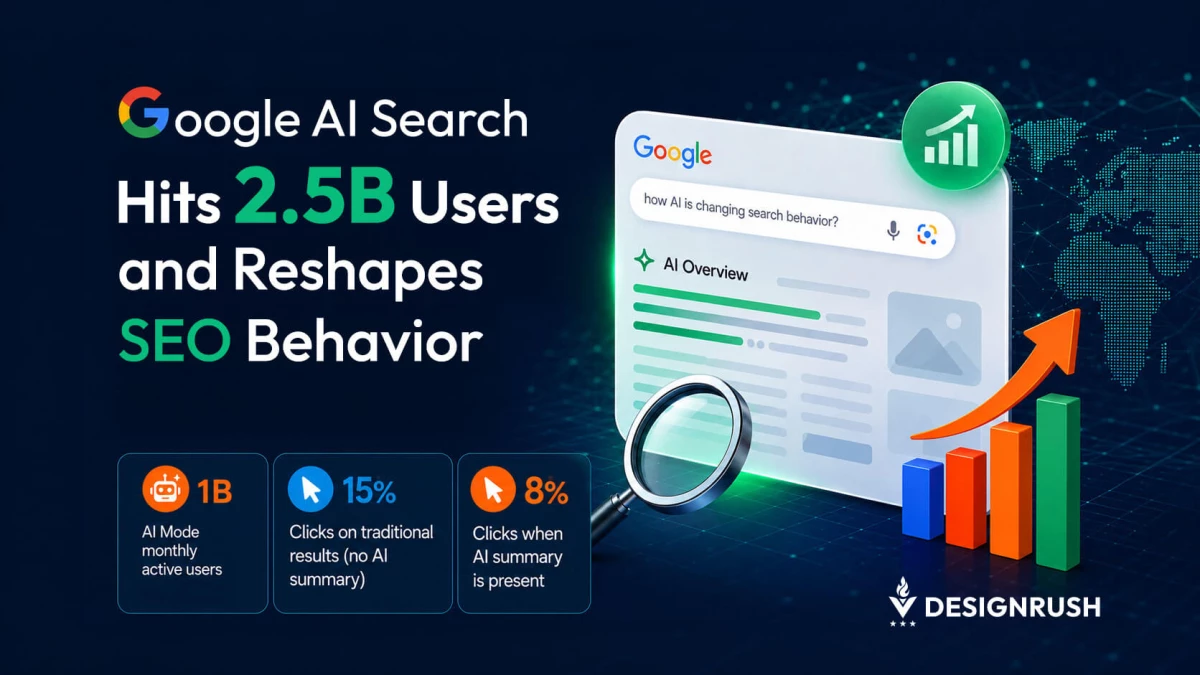
According to Google, AI Overviews now reach more than 2.5 billion monthly active users, and AI Mode itself has surpassed one billion users.
Users are increasingly using Search, asking longer questions and engaging in more complex interactions.
So if search behavior is changing, should SEO strategies change too?
Ken Braun, co-founder and chief brandtender of growth marketing and web design experts Lounge Lizard, says yes.
“Google's AI-first search experience changes what success looks like in SEO,” he tells DesignRush.
“Ranking well still matters, but businesses also need content that directly answers user questions, websites that create trust quickly, and user experiences that help visitors take action once they arrive.”
How AI Search And Voice Queries Are Changing Google Search Behavior In The U.S.
Google also said that more than one in six searches in the U.S. now involve voice or images.
Image searches are growing more than 40% month-over-month, while the average AI Mode query is three times longer than a traditional search query.
And planning-related AI Mode searches also increased 80% over the past six months.
A Gartner survey found that 51% of U.S. consumers said generative AI has changed how they search.
Among those respondents, 71% said they had changed how they phrase queries, including using more specific language, question-based searches, and conversational prompts.
“When people search with complete questions instead of short phrases, businesses need content that mirrors those conversations,” Braun says.
“The goal is to answer the next question before the visitor has to ask it.”
However, behavioral change is only one side of the equation, since platform rollouts are moving just as quickly.
Google reported in May 2025 that AI Overviews had expanded to more than 200 countries and territories, and over 40 languages.
During that time, AI Overviews drove a 10%+ increase in Google usage for the types of queries where the feature appeared in the U.S. and India.
AI Search Results And What The Latest Click Data Means
The increase in AI-generated answers has also renewed discussion about how search visibility translates into website traffic.
Research from Pew Research Center found that Google users clicked on a traditional search result in 15% of visits when no AI summary appeared.
When an AI-generated summary was present, the click rate fell to 8%.
Users also clicked a source link within the AI summary itself in only 1% of visits.
But this doesn’t mean that websites will universally lose traffic.
Search behavior varies across industries, query types, and user intent, but they do suggest that businesses may need to focus more on what happens after visitors arrive.
Google appears to recognize that publishers are adapting to a new environment, since it introduced new controls, reporting tools, performance insights, and updated guidance for website owners participating in generative AI search experiences.
According to Braun, businesses should view SEO, user experience, and conversion strategy as increasingly connected disciplines.
“If AI-generated answers reduce unnecessary clicks, the visits you do earn become more valuable.
“That means websites need stronger messaging, clearer navigation, and content that helps users make decisions quickly.”
What Determines Search Performance Once Users Land On A Website?
Search now sits inside the experience instead of just the results page.
Lounge Lizard’s practical focus is on intent-led content, technical performance, and UX that supports fast decision-making once users land.
That includes page structure that answers the query early, stable site performance, and content that reduces the need for backtracking or multiple searches.
Braun’s direction comes down to how the traffic behaves after the click:
- Look at entry pages with high impressions but weak downstream engagement.
- Check where users drop off in the first interaction.
- Tighten those pages so the core answer appears immediately, not after scrolling or interpretation.
- Then remove points of friction in navigation and layout that interrupt the path to conversion.
Search performance now depends on what happens after the click, not just what earns it.