
The European Parliament just made one of its clearest statements yet about digital independence.
Starting June 4, the European Parliament will replace Google with Qwant as the default search engine on its computers.
The move affects 720 lawmakers and thousands of assistants and administrative staff.
It arrives the same day the European Commission announced its own "Buy and Use European" tech sovereignty package covering AI, cloud services, and semiconductors.
Searches through Firefox and Edge now route through Qwant by default, though users can still switch back to Google manually.
Founded in 2013, the French company markets itself as a privacy-focused search engine that doesn't track users or build advertising profiles.
"It is part of a larger framework of actions aimed at reducing EP reliance on non-EU digital tools and promoting European-based, privacy-focused services," an EP spokesperson told Reuters.
Privacy expectations and geopolitical priorities now sit alongside product performance as criteria for institutional tech adoption.
Search as a Symbol of Sovereignty
This decision carries real political and commercial significance.
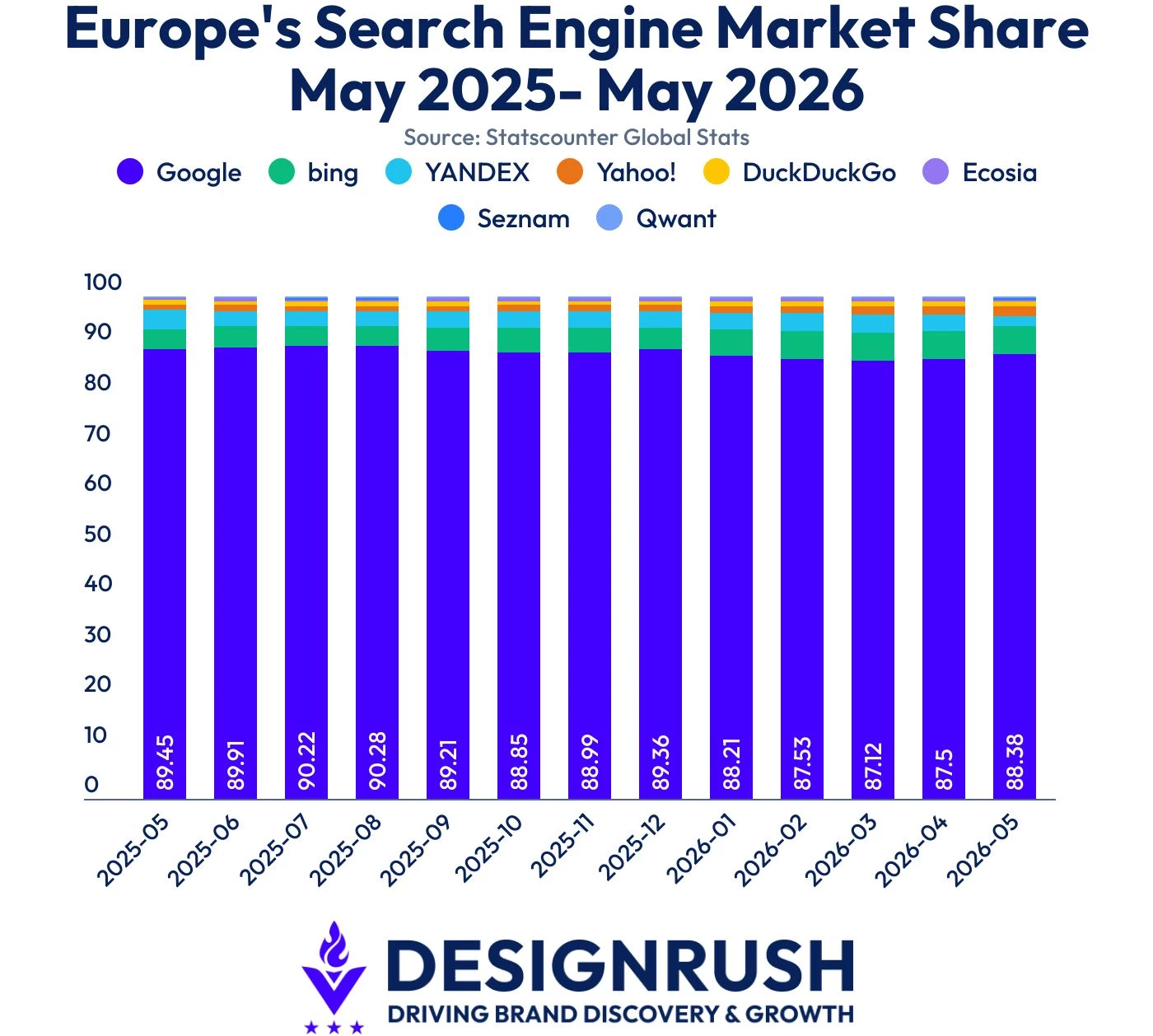
Google controls roughly 90% of Europe's search market, and any institutional move away from it is visible by definition.
The change follows a push from Members of the European Parliament (MEPs) last autumn.
Influential members across parliamentary groups called on leadership to reduce dependence on U.S. software, starting with Microsoft 365.
Comment
by u/Howaboutnopers from discussion
in degoogle
Microsoft Office remains deeply embedded across Parliament operations, so search was a practical first step.
Qwant's brand positioning also aligns closely with the Parliament's evolving regulatory priorities.
The company promotes itself as a search engine that avoids user tracking and personal data collection.
It is also developing European-owned search infrastructure through partnerships with other regional providers.
The switch illustrates how policy priorities create new opportunities for challenger brands when institutional values become purchasing criteria.
The Real Cost of Switching
Google owns the lion's share of European search, underscoring how difficult it is for competitors to gain traction even as policymakers seek greater tech independence.
The Parliament's decision gives Qwant a high-profile institutional endorsement and places a European alternative in front of thousands of daily users.
The decision highlights how government purchasing power can reshape competitive markets and influence technology adoption.
- The default setting creates a competitive advantage. Brands should secure this kind of placement to increase usage without requiring behavior change.
- Trust influences procurement. Companies should align product development with privacy and security priorities to improve institutional consideration.
- Local alternatives gain relevance. Organizations should diversify tech partnerships to reduce dependency risks and strengthen resilience.
Government tech decisions often create signals that influence future purchasing behavior across both public and private sectors.
Our Take: Is This the Start of Europe's Tech Divorce?
We think the search engine swap is a small move with a large implication.
The European Parliament is making a political statement with a purchasing decision, starting in a category where the cost of switching is low enough to follow through.
Qwant is not a better product than Google by most measures, and everyone in the Parliament knows it.
Comment
by u/Howaboutnopers from discussion
in degoogle
We believe the real hurdle is what comes next.
Replacing Microsoft Office, switching cloud infrastructure, and rebuilding procurement around European AI will take years and cost significantly more.
We'd argue this is Qwant's actual opportunity.
If it operates at an institutional scale without breaking anything, it becomes the proof of concept that makes every larger procurement debate easier to win.
Looking to adapt brand positioning to changing consumer expectations, regulatory environments, and market conditions.
Explore these top government marketing agencies in our directory.