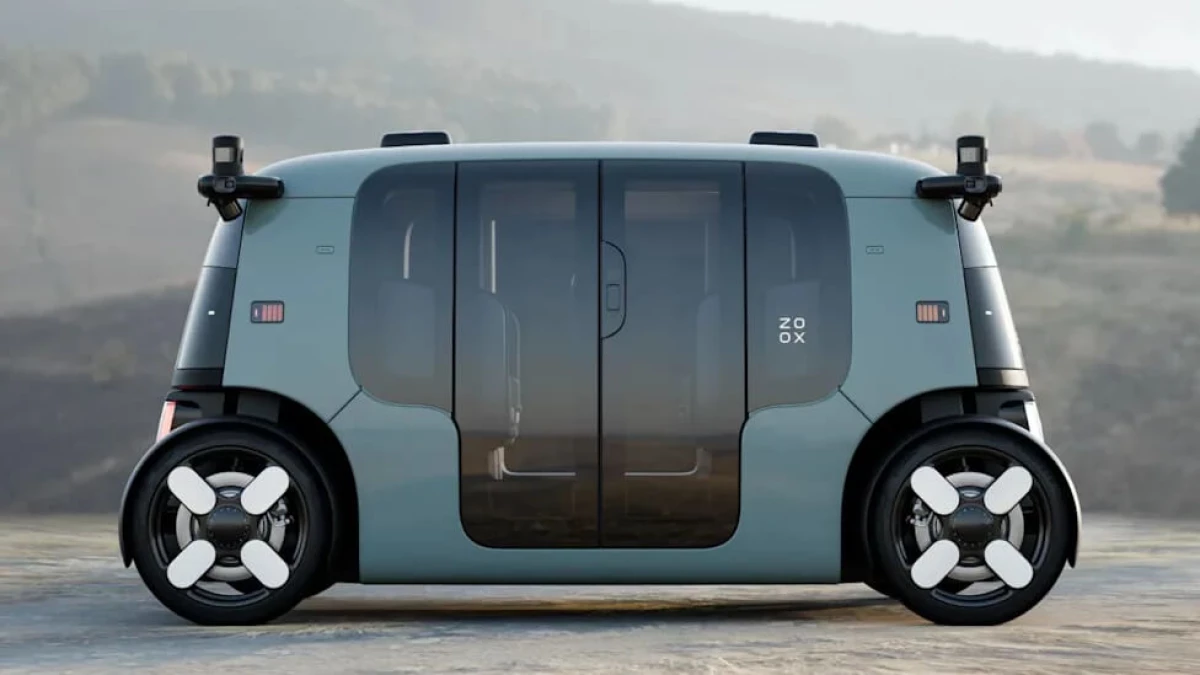

Amazon's self-driving unit just gave its boxy robotaxi a makeover.
Zoox unveiled what it calls the "next evolution" of its driverless vehicle on Wednesday.
The update covers a list of interior and exterior changes ahead of a wider U.S. launch later this year.
These include softer seats, redesigned headrests, larger cupholders, and a brighter touch screen.
They're all aimed at making the carriage-style cabin feel more like a finished product than a test pod.
Zoox also moved and enlarged the vehicle's bidirectional reflectors.
The lights help riders and bystanders tell which end of the symmetrical, toaster-shaped car is the front.
Since the car has no steering wheel, no pedals, and four inward-facing seats, this feature carries more weight than it would on a regular car.
Zoox said the redesign reflects feedback gathered from more than 500,000 passengers who used its free ride-hailing service in Las Vegas and San Francisco.
The goal, the company said, is a cabin where riders "can relax and enjoy the ride" instead of fixating on the unfamiliar experience of having no driver.
The changes come as Zoox prepares to start charging for rides, pending NHTSA sign-off to run up to 2,500 vehicles commercially.
This review is ongoing after public comments closed in early April.
And until approval comes through, Zoox can only offer free rides under federal research exemptions.
10,000 Robotaxis a Year
The redesigned vehicle is described internally as the "production intent" model.
It means that this is a version that has graduated from being a prototype and is the one Zoox plans to manufacture.
Large-scale production will begin at the company's Hayward facility in California.
And Zoox says it can soon build vehicles at a rate of 100 per week (or roughly 10,000 a year) at full capacity.
This manufacturing push lines up with Zoox's expansion plans.
It also has limited hailing zones in Miami and Austin, with testing underway in six additional cities.
Notably, a partnership struck with Uber in March also puts Zoox vehicles inside a much larger ride-hailing app in Las Vegas.
This gives the company a distribution channel it didn't have to build from scratch.
The exterior tweaks support this same expansion logic.
Clearer front-and-rear signaling becomes more important as Zoox vehicles spread across more cities.
This means more weather conditions, more interactions with pedestrians, cyclists, and law enforcement who have never seen the vehicle before.
Zoox remains well behind Alphabet's Waymo.
It recently passed 500,000 weekly paid rides across 10 U.S. cities and is preparing to launch in London and Tokyo.
But this redesign signals that Zoox is treating continuous product development as a means of closing the gap.
A self-driving vehicle redesign like this offers a few lessons for automotive marketing teams tracking the robotaxi race:
- Trust is built through small, visible details. Reflector placement and cabin comfort do quiet work in convincing riders that an unfamiliar product is safe and considered.
- Production readiness is itself a marketing signal. Calling a vehicle "production intent" tells investors and riders the company is moving past the demo phase.
- Real usage data should shape the next iteration. 500,000 rides' worth of feedback is a stronger design input compared to focus groups.
The robotaxi category is shifting from proving the technology works to showing that people actually want to ride in it.
Our Take: Does Comfort Win Trust?
We think the hardest sell in autonomous vehicles is the 10 minutes a stranger spends alone in a moving box with no driver in sight.
And Zoox seems to understand this fact better than its sheet of features lets on.
Bigger cupholders and softer headrests sound almost beside the point next to federal safety reviews, but they're doing real psychological work.
That's because it tells a nervous first-time rider that somebody thought about their actual body sitting in that seat.
We believe the company is quietly ensuring that comfort earns the consumer's trust faster than any regulatory approval ever will.
Riders decide how they feel about a robotaxi before they read a press release about an NHTSA clearance.
The real test comes once paid rides start, and Vegas tourists swap a free novelty ride for one they're paying for.
Comfort got people through the door for free, but price is what proves whether they actually wanted to be there.
Explore these top automotive branding agencies in our directory to turn cautious first-timers into riders who come back.