
Duolingo's 'Bad Bunny 101' Campaign: Key Findings
- Duolingo launches "Bad Bunny 101" during Championship Sunday broadcasts, giving fans two weeks to learn Spanish before the halftime show.
- The campaign promotes language learning as halftime show prep, teaching phrases from Bad Bunny's biggest hits.
- The multi-platform strategyspans TV, Spotify, Pandora, SiriusXM, the Grammy Awards, and NYC subway takeovers to reach Bad Bunny's fanbase.

Campaign Snapshot
Duolingo has addressed one of the key elements of Bad Bunny's upcoming Super Bowl LX halftime show.
The performance will likely be in Spanish, which will create a language barrier for millions of English-speaking viewers.
In response, the language-learning app has launched "Bad Bunny 101" to teach fans Spanish phrases from the Puerto Rican artist's catalog before his February 8 performance.
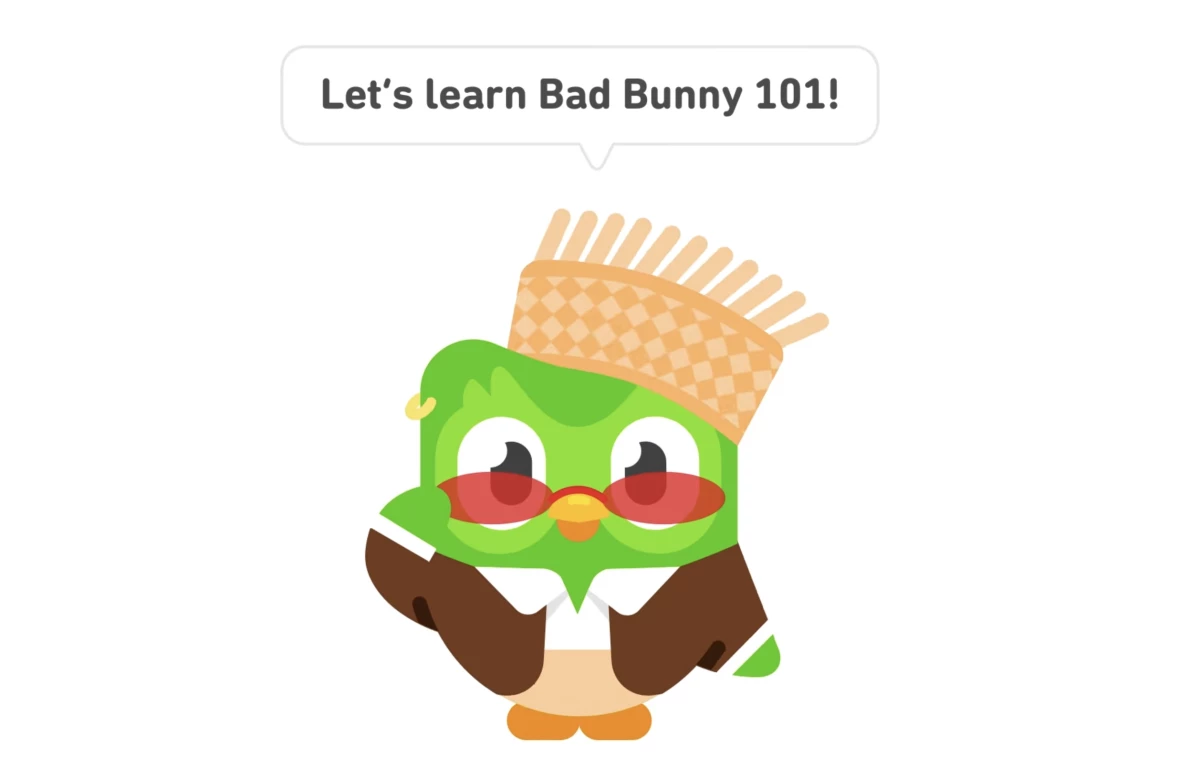
A 15-second spot features Duo the Owl dressed as Bad Bunny, walking viewers through phrases like "Perreo" (twerk) and "Tití Me Preguntó" (auntie asked me).
This move positions Duolingo as a cultural facilitator, stepping in with real service where curiosity meets friction.
It ties learning to anticipation, converting a one-night performance into a reason to engage with the platform ahead of the event itself.
A Broadcast Window for Language Prep
Duolingo started running the campaign during the AFC and NFC Championship broadcasts on January 25 on CBS and Fox in New York, San Francisco, Boston, and Los Angeles.
Championship Sunday delivers massive viewership without $7-8 million Super Bowl costs.
The two-week gap, on the other hand, gives viewers time to actually learn some Spanish before the halftime show.
Duolingo is also extending the campaign through Spotify, Pandora, SiriusXM, and SoundCloud.
These are mostly all the places where it can target Bad Bunny's existing fanbase.
The language-learning platform will also run reminder spots during the upcoming Grammy Awards on February 2.
For out-of-home activation, Duolingo has also wrapped NYC's S train shuttle with Spanish audio lessons featuring Bad Bunny lyrics.
A Global Halftime Stage
Bad Bunny's Super Bowl performance represents the NFL's commitment to global audiences.
Apple Music's halftime trailer shows the artist dancing through Puerto Rico with Spanish-language lyrics and no translation.
This signals confidence that global audiences want authentic representation.
Super Bowl LIX drew 62.5 million viewers outside the United States, up 10%.
Bad Bunny was also named Spotify's Global Top Artist in 2025 with 19.8 billion streams, which was his fourth time topping global charts.
His latest album "DeBÍ TiRAR MáS FOToS" also became the first 2025 album to surpass 7 billion Spotify streams.
To complement the upcoming show, the NFL is implementing a multilingual signing program incorporating Puerto Rican Sign Language, which will be led by Celimar Rivera Cosme.
When major cultural events commit to authentic representation without translation or compromise, they create opportunities for brands to serve audiences that traditional marketing often overlooks.
Bad Bunny's global reach dwarfs even the Super Bowl's massive U.S. viewership.
His 20 billion Spotify streams represent an audience 157 times larger than the Big Game's 127 million American viewers.
Three patterns emerge from how Duolingo has activated around the halftime show:
- Problem-solving beats interruption: Teaching Spanish phrases turns advertising into preparation, making the campaign useful before it's promotional.
- Strategic media timing maximizes learning windows: Championship Sunday placement delivers reach without Super Bowl costs while giving audiences two weeks to practice.
- Platform targeting reaches existing fandoms: Spotify and Pandora placements meet Bad Bunny fans where they already engage with his music.
Brands that identify audience needs, especially ones created by cultural moments, can position marketing as a solution and earn attention through utility.
Our Take: Can Other Brands Replicate This Approach?
I think Duolingo's campaign lands well because it has identified a genuine audience problem and offered a real solution.
Most U.S. Super Bowl viewers don't speak Spanish, and Bad Bunny's halftime show will be in his native language.
The two-week learning window between Championship Sunday and the Super Bowl gives the campaign functional value outside of just brand awareness.
Other brands can replicate this approach by looking for friction points in major events, where their product naturally solves a problem.
In other news, Smirnoff is skipping Super Bowl ads for fashion drops targeting Gen Z, showing how brands can win game-day attention with an alternative to broadcast placements.
Brands building culturally responsive campaigns need partners who understand how to identify audience needs within major events.
Take a look at the top creative agencies in our directory.