
Good Will Dunkin’ at Super Bowl LX: Key Findings
- Dunkin’s Big Game spot was styled as a never-aired 1995 sitcom, using Ben Affleck and a cast of ’90s TV icons to revisit its iced coffee origin story.
- It carries into Super Bowl Monday with 1.995 million free iced coffees, redeemable in the brand's app.
- Casting tapes, vintage merch, pop-ups, and live events extend the idea beyond the broadcast, keeping the story active after the game ends.

Campaign Snapshot
Dunkin’ chose Super Bowl LX as a chance to rewind.
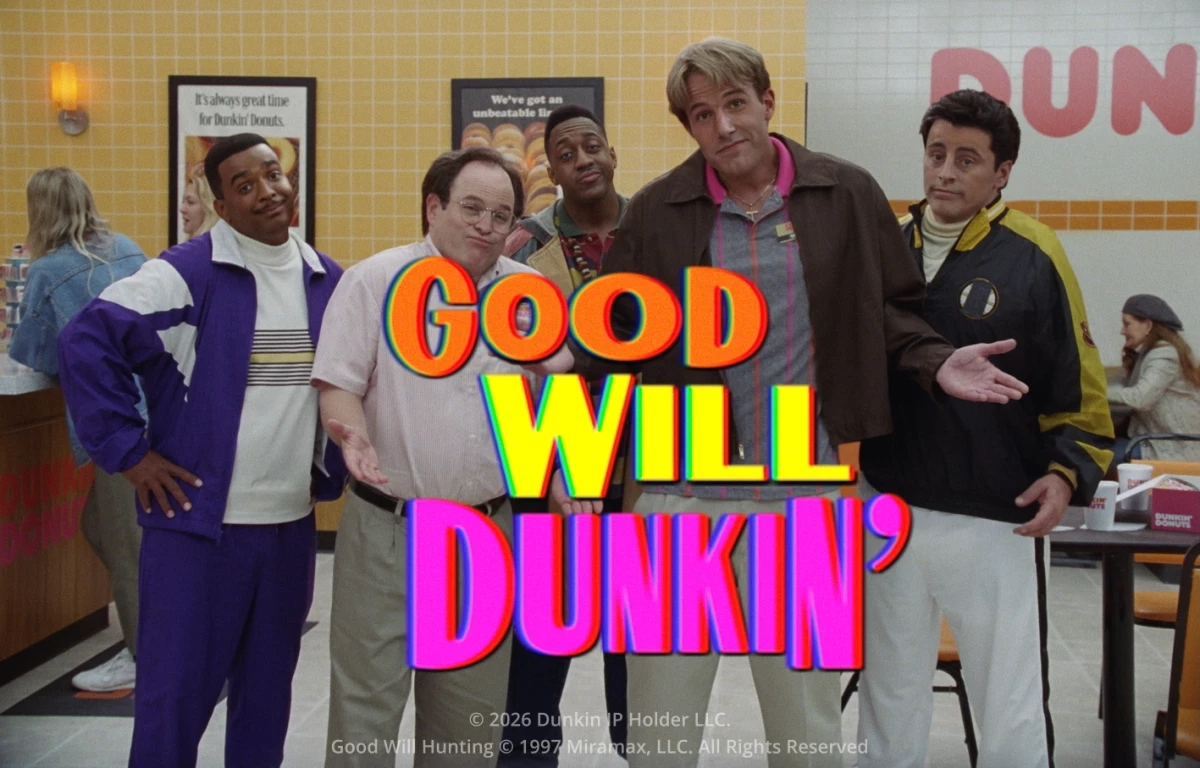
The brand’s Big Game spot, "Good Will Dunkin’," imagines a forgotten sitcom pilot set inside a Cambridge store in 1995, the same year iced coffee first appeared in the brand’s advertising.
"The ’90s gave us iconic sitcoms, and Dunkin’ gave the world iced coffee," Dunkin’ CMO Jill Nelson said in a statement.
"Good Will Dunkin’ brings us back in time to imagine the moment those worlds collided. It’s a reminder that Dunkin’ has always been part of everyday culture, and proof that it always will be."
The idea was first seeded through a Kevin McCarthy Instagram interview with Ben Affleck and Matt Damon, where a planted IMDb listing for a long-lost ’90s "Good Will Hunting" sitcom quietly surfaced.
The commercial aired during the game, following a buildup that included VHS-style teasers released around the Grammys.
Dunkin’ treated the spot, created with production studio Artists Equity, as the opening chapter of a campaign designed to keep unfolding after the Big Game.
The ‘Lost Sitcom' Pilot
The commercial opens like a VHS tape pulled from a box no one remembered owning, with the casting doing most of the heavy lifting in selling the premise.
- Ben Affleck (Good Will Hunting)
- Jennifer Aniston (Friends)
- Matt LeBlanc (Friends)
- Jason Alexander (Seinfeld)
- Ted Danson (Cheers)
- Alfonso Ribeiro (The Fresh Prince of Bel-Air)
- Jaleel White (Family Matters)
- Jasmine Guy (A Different World)
- Tom Brady as himself
Affleck appears as Will Hunting working a shift at Dunkin’ and scribbling equations across the front window between orders in Cambridge.
On the counter, MUNCHKINS Donut Hole Treats are supposed to be arranged in the Fibonacci sequence as demanded by the store manager, played by Alexander.
LeBlanc leans into the frame, Ribeiro and White drift through the background, and Guy and Danson appear naturally in casual moments.
The final beat happens outside the store, where Aniston steps into view, pulling Tom Brady into frame, closing the pilot with a Boston-specific wink, "How ya like these nuts?"
Good Will Dunkin's Extended Universe
Dunkin’ extends this premise into the real world with a math challenge inspired by the scene, created with MIT professor and former NFL player John Urschel.
It's centered on a whiteboard puzzle tied to Will Hunting’s on-screen genius, where one fan who solves it will receive free Dunkin’ coffee for a year, along with signed merch.
This reinforces brand equity by connecting Dunkin’s identity to routine, local culture, and a story people are inclined to revisit.
On Super Bowl Monday, Dunkin’ is giving away 1.995 million free iced coffees of any size, redeemable through its app with the promo code GOODWILLDUNKIN.
The timing shifts attention to the morning after the game, when iced coffee already fits naturally into how people reset their day.
On top of this, the coffee giant released unlisted casting tapes shot in a ’90s audition style, featuring Tiffani Thiessen and John Stamos reading for Good Will Dunkin’.
A limited run of vintage, '90s-inspired merch, sourced from Boston vintage shops and previewed at an MIT pop-up, adds an experiential layer that lets fans step inside the campaign.
Dunkin' also hosted a Super Bowl watch party at L Street Tavern, the South Boston bar featured in "Good Will Hunting," with specialty drinks, merch, and in-person programming.
These brand activations give more avenues for people to experience the universe.
Brands planning large cultural campaigns can take a few lessons from Dunkin's approach:
- Use nostalgia as an entry point. Familiar references work best when they lead into present-day behavior.
- Let activations match daily habits. Coffee giveaways and merch feel natural because they align with routines people already have.
- Create room for discovery. Side content gives audiences space to engage without asking them to commit all at once.
The campaign moves across media, retail, and culture with enough range to stay visible without wearing itself out.
Our Take: Is Building This Much Around One Ad Worth It?
I think it is, because the campaign respects how attention actually moves after the Super Bowl.
The star-studded ad sparks interest, then it lets people encounter the concept again on their own terms.
This strategy keeps the scale from feeling forced and lets the work stay present for longer than a single night.
In other news, Pepsi revived the blind taste test for the Big Game by putting Coca-Cola’s polar bear mascot at the center of a rivalry joke.
Campaigns of this magnitude often require creative partners who can extend one idea across film, retail, experiential, and culture without losing coherence.
Explore these top agencies experienced in large, multi-touchpoint launches, helping brands keep ambition high while execution stays grounded.