
Holiday Retail and eCommerce Sales: Key Points
- Deloitte projects steady holiday growth, with eCommerce expected to see up to 9% more in sales.
- 85.6% of consumers have completed an online purchase within the last 30 days.
- Consumers prioritize value and trust over discounts, making credibility and smart offers essential for winning online sales.
Deloitte has recently released its holiday retail forecast for the U.S.
The company predicts that the retail industry will likely see an increase between 2.9% and 3.4% from November 2025 to January 2026.
This equates to total sales of roughly $1.61 trillion to $1.62 trillion.
eCommerce is expected to lead the charge, with Deloitte forecasting sales between $305 billion and $310.7 billion this holiday season, a growth between 7% and 9% year over year.
In 2024, total eCommerce sales came in at an estimated $285 billion.
In a press release, Deloitte Insights Economist Akrur Barua says a growth in disposable personal income is a driving factor for the increases:
“We anticipate disposable personal income (DPI), a key driver of retail sales, to grow between 3.1% to 5.4% this holiday season…
"Steady growth in income can help offset some economic uncertainty, including any labor market weakness and the burden of high credit card and student debt on consumer spending.
While elevated inflation will likely weigh on the volume of retail sales growth, it will nevertheless be a tailwind for the dollar value spent on retail purchases in the holiday season.”
Likewise, Natalie Martini, vice chair and U.S. retail and consumer products leader at Deloitte, expressed optimism despite rising inflation:
“Our forecast anticipates that e-commerce sales will stay strong as consumers keep leveraging online deals to stretch their spending power.
Retailers who remain focused on delivering value throughout the season have a prime opportunity to drive growth during what continues to be a critical time for their businesses.”
Holiday forecasts like Deloitte’s are never just numbers. They are signposts, pointing to how households and companies are navigating the wider economy.
The 2.9% to 3.4% growth figure sounds modest, but in the face of stubborn inflation, these numbers suggest a level of consumer resilience that businesses should keep in mind.
What This Means for Businesses
For retailers, the message is twofold.
First off, consumers are becoming more deliberate with their purchases. They want value over plain discounts, and they aren’t afraid to compare prices across multiple sites before making their decision.
Second, shopping is no longer seen as an errand reserved for the weekend. Thanks to technology, online shopping is now a constant process.
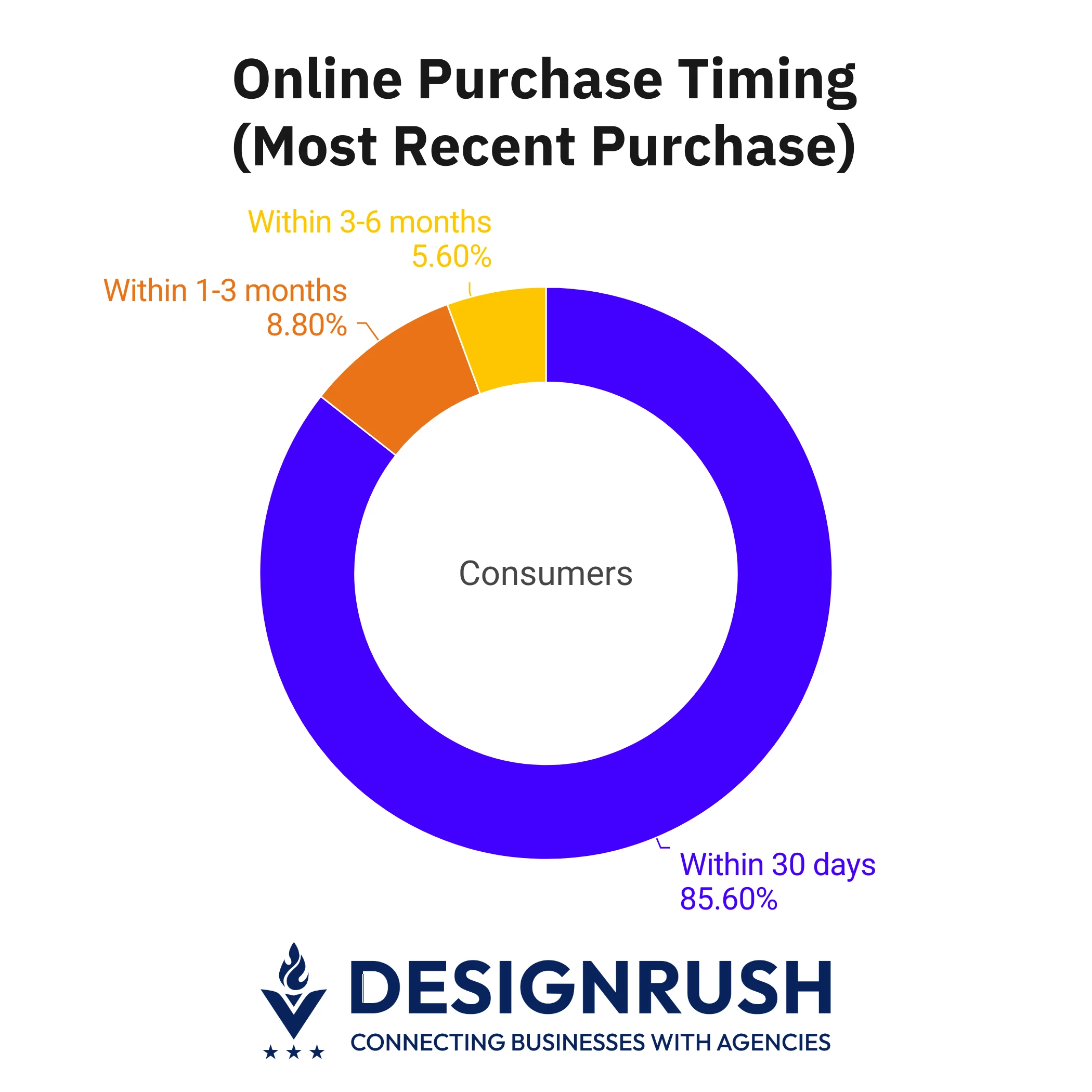
In fact, a Hostinger report claims that 85.6% of consumers have completed an online purchase within the last 30 days.
Meanwhile, only 8.8% made a purchase within the last 1-3 months, and only 5.6% have completed an online purchase within the last 3 to 6 months.
As such, businesses, especially those that rely heavily on eCommerce, must focus on two key areas:
- Value: It’s all about assuring customers that they are getting more for their money. This entails smarter offers rather than simply lower prices. Bundles, limited-time perks, and special repeat customer perks are a good place to start offering value.
- Trust: Building trust is vital for online retailers, especially as AI-generated reviews and counterfeit goods become prevalent issues. To build credibility, online retailers should highlight their reliable policies and exceptional customer service as part of the experience.
Seize the Holiday Rush with Smart Digital Moves
The holiday season may be short, but by no means is it a sprint. It’s more like a marathon, and the businesses that prepare themselves ahead of time are the ones who will win the race.
While Deloitte’s forecast suggests steady consumer spend, capturing that growth requires more than just your typical 10% discount.
These strategies stand out as both practical and forward-looking:
1. Create a holiday microsite with headless commerce
Creating a holiday microsite isn’t a new revolutionary idea, but why specifically use headless commerce?
It’s because this allows for the separation of the front end from the back end. This gives retailers the ability to adapt quickly, personalize for specific shopper groups, and even scale efficiently during traffic surges.
The result is one microsite that easily adapts to Cyber Monday, Christmas, and New Year deals while the core of the site runs smoothly.
"Headless commerce helps retailers stay ahead by removing the limits of traditional platforms.
As shoppers move to new channels like social, voice, and even ones we have not seen yet, headless makes it easy to adapt quickly without costly rebuilds or being held back by rigid systems," said Caleb Bradley, CEO and founder of Bighorn Web Solutions.
2. Optimize and test site performance
Nothing undermines holiday shopping than a clunky website.
After all, a slow-loading website with broken elements undermines the supposed convenience of eCommerce.
In fact, statistics from SiteBuilderReport.com show that 79% of online shoppers who are unhappy with a site’s performance are less likely to buy from the same website again.
This is why retailers should run stress tests ahead of key holiday shopping dates.
They should also set up monitoring systems that alert related teams the moment site performance dips below a certain threshold.
3. Integrate AI agents thoughtfully
Think beyond the typical chatbot.
AI agents can be designed to be customer service representatives or shopping assistants that can guide customers through product discovery or provide personalized recommendations.
Of course, this doesn’t mean that businesses should leave everything to AI and take a hands-off approach.
Instead, online retailers should pair these new AI agents with human backup, ensuring that if the agent cannot fulfill a request, a person can step in and provide quality customer service.
4. Implement retargeting and abandoned cart strategies
Most shoppers rarely buy on their first visit, especially if the final checkout price ends up more than they initially anticipated.
Retargeting ads or small incentives like free shipping on abandoned carts can gently push buyers back to finish what they started.
Even a quick email alerting them to further discounts on items in their carts can be an effective way to build goodwill and nudge them to finalize their purchase.
Our Take: Are Retailers Investing Enough in the Long Game?
Although forecasts offer a glimpse into what will likely happen over the next few months, their true value is in how businesses respond.
In other words, it’s in the shaping of habits, systems, and strategies that drive long-term growth.
From my perspective, the temptation to chase a seasonal sales spike is understandable.
In my work at various agencies, I’ve seen many brands treat the holidays as a make-or-break moment, only to realize that they invested too little in the necessary infrastructure to take full advantage of the season.
This leaves a challenge worth asking:
Will this year’s retailers use the holiday rush as a chance to invest in digital foundations that last? Or will they settle for chasing a momentary bump in revenue?
For me, the more interesting story is not who posts record sales this coming holiday season. It’s in who is still thriving when Deloitte issues its next forecast.
Meanwhile, the BBC offered a different perspective on holiday investment, enlisting Aardman’s Wallace and Gromit for seasonal idents that emphasized brand warmth and cultural connection.