
In 2026, opinions are cheap. Generative AI has flooded every outlet with hot takes and "rebrands" of things that have been regurgitated numerous times, and journalists, search engines, and buyers have all adjusted accordingly.
The teams winning links, citations, and audience right now are the ones publishing a number nobody else has.
DesignRush reviewed a set of verified studies spanning PR, SEO, and generative search to gauge how much of an edge data-led content has over opinion-only content in 2026, and where opinion still takes the advantage.
Key Findings
- 55% of journalists use data visualizations and other multimedia supplied with pitches, but 42% still say credibility is their biggest challenge, a gap original data helps close.
- Combining statistics, quotations, and cited sources can lift visibility in generative AI engines by up to 40%, with the largest gains showing up on "opinion"-style questions.
- Only 2.2% of content earns links from more than one site, and "why" or stats-driven posts consistently out-earn opinion and how-to pieces.
87% of Journalists Won't Touch a Pitch Without Data Attached
Why Opinion-Only Content Is Losing Attention in 2026
Every content strategy meeting in 2026 eventually asks the same question: is opinion content still worth the investment? Depends entirely on what you're optimizing for.
The Opinion Glut
GenAI tools have made publishing an opinion cost next to nothing.
Any team with a laptop and twenty spare minutes can produce a passable point of view, and thousands of teams do it.
They use the same handful of trending topics, every single day, which is part of why none of them stick anymore.
Opinion used to function as a moat.
Nowadays it's just what comes out when you hand an LLM a content brief.
Original data, on the other hand, is harder to counterfeit, especially in the B2B space, where everything is under a loupe.
What Are Journalists Looking For?
The clearest evidence here sits in newsroom survey data, not marketing theory. Cision's 2024 State of the Media report found that 55% of journalists use multimedia assets, like images, data visualizations, and videos, when they're supplied along with a pitch.
A year later, the same series found that 86% of journalists reject pitches immediately if they aren't aligned with their beat, meaning any data being pitched has to be both novel and genuinely relevant.
42% of journalists point to credibility and misinformation as their single biggest challenge right now. That's the exact problem a verifiable, well-sourced statistic is built to solve.
Where Opinion Still Wins
None of this means opinion content is dead, but the job it's being asked to do has changed.
Opinion is still essential for thought-leadership SERPs, executive bylines, founder-led LinkedIn growth, and building a distinct brand point of view.
Publishing opinion is not the mistake. Teams go wrong when they ask opinion to earn backlinks, journalist citations, and AI Overview placements, which is a data program's job.
The goal is to lead with a number instead of a narrative - when you can.
A pitch built around a stat tends to survive first contact with an editor better than one built purely on a story angle.
Content Over 3,000 Words Earns 77.2% More Referring Domain Links
If journalist preference makes the qualitative case for data-led content, link data makes the quantitative one, and it isn't close.
What Backlinko's 912-million-post Study Found
Backlinko and BuzzSumo analyzed 912 million articles, making it the largest content study published to date.
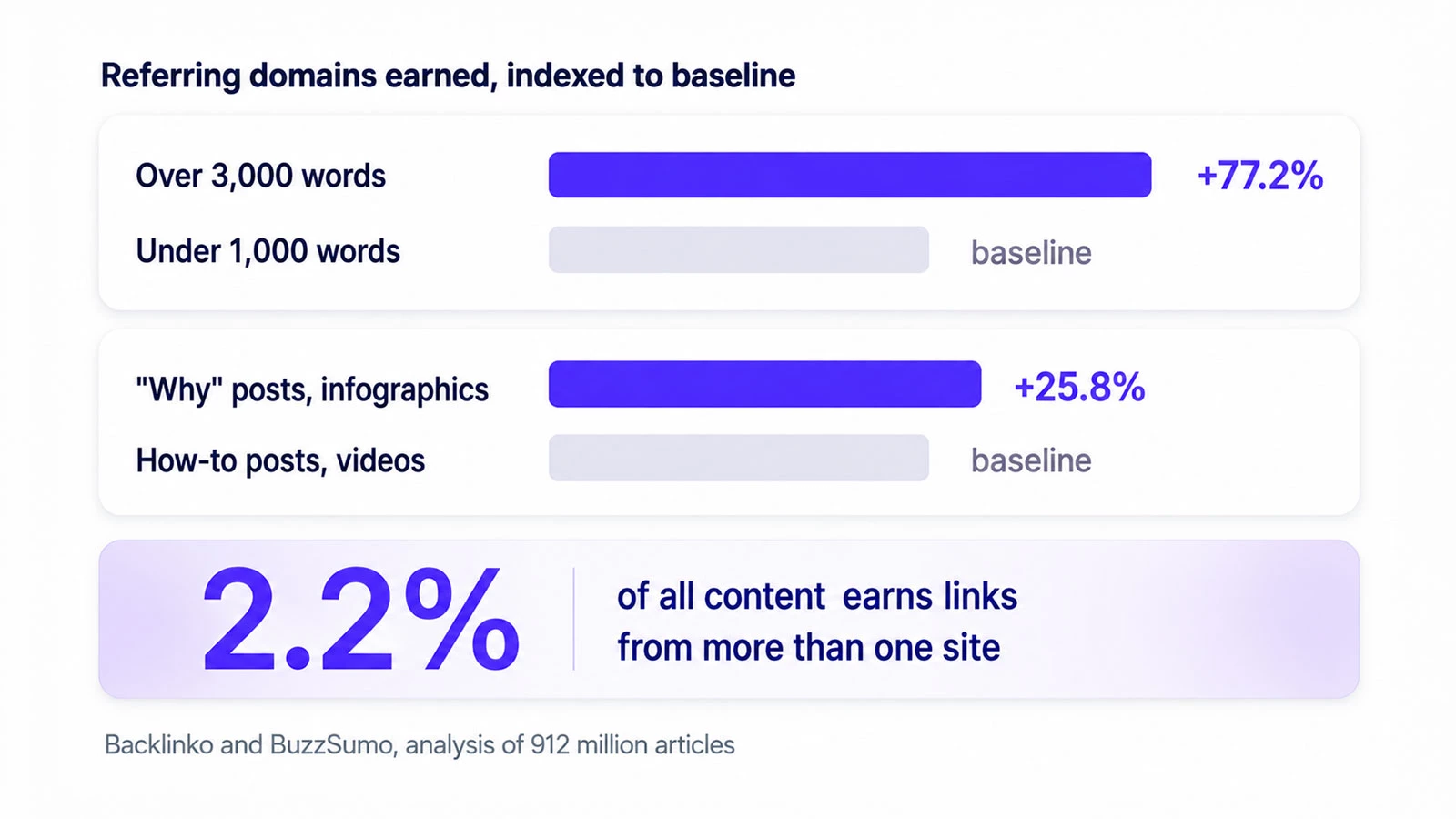
Only 2.2% of content earns links from more than one site (mixed B2B and B2C content), and 75% of all social shares come from just 1.3% of articles.
"Why" and "what" posts, along with infographics, earn 25.8% more referring-domain links than how-to posts and videos. List posts top the share counts, but they rank dead last for backlinks.
Content over 3,000 words earns 77.2% more referring domain links than content under 1,000 words.
Backlinks remain Google's number one third-party ranking signal, and both infographics and "why" posts lean on data scaffolding to earn them.
Pure opinion essays sit in the bottom link quintile of the Backlinko dataset.
The Stacker Effect
Stacker, which builds and distributes data-led editorial content at scale, reports that a distributed data-led story earns 50+ placements on trusted domains on average.
That figure comes from Stacker itself rather than an independent audit, so treat it as directional.
You can see the pattern in DesignRush's own content: our 70+ Email Marketing Statistics article, built the same way this article is, has earned coverage and interlinks across the DR ecosystem.
What this means practically: figure out the "why" before reaching for an opinion, since data-shaped reasoning earns links in a way a personal take almost never does.
If there's room in the budget for one visual per piece, spend it on an infographic, the single highest-earning link format in the Backlinko dataset, and if the underlying data can support it, push the piece past 3,000 words.
Statistics Can Lift AI Visibility by Up to 40%
Out of everything in this piece, this is the section I would bet on holding up a year from now, and it's also the one keeping most CMOs up at night in 2026.
The Princeton GEO Study Explained
A team from Princeton, the Allen Institute for AI, and IIT Delhi put out a paper called GEO: Generative Engine Optimization at KDD '24, an international data science and machine learning conference. It's one of the first real attempts to rigorously test what actually moves the needle inside a generative AI answer, instead of just guessing.
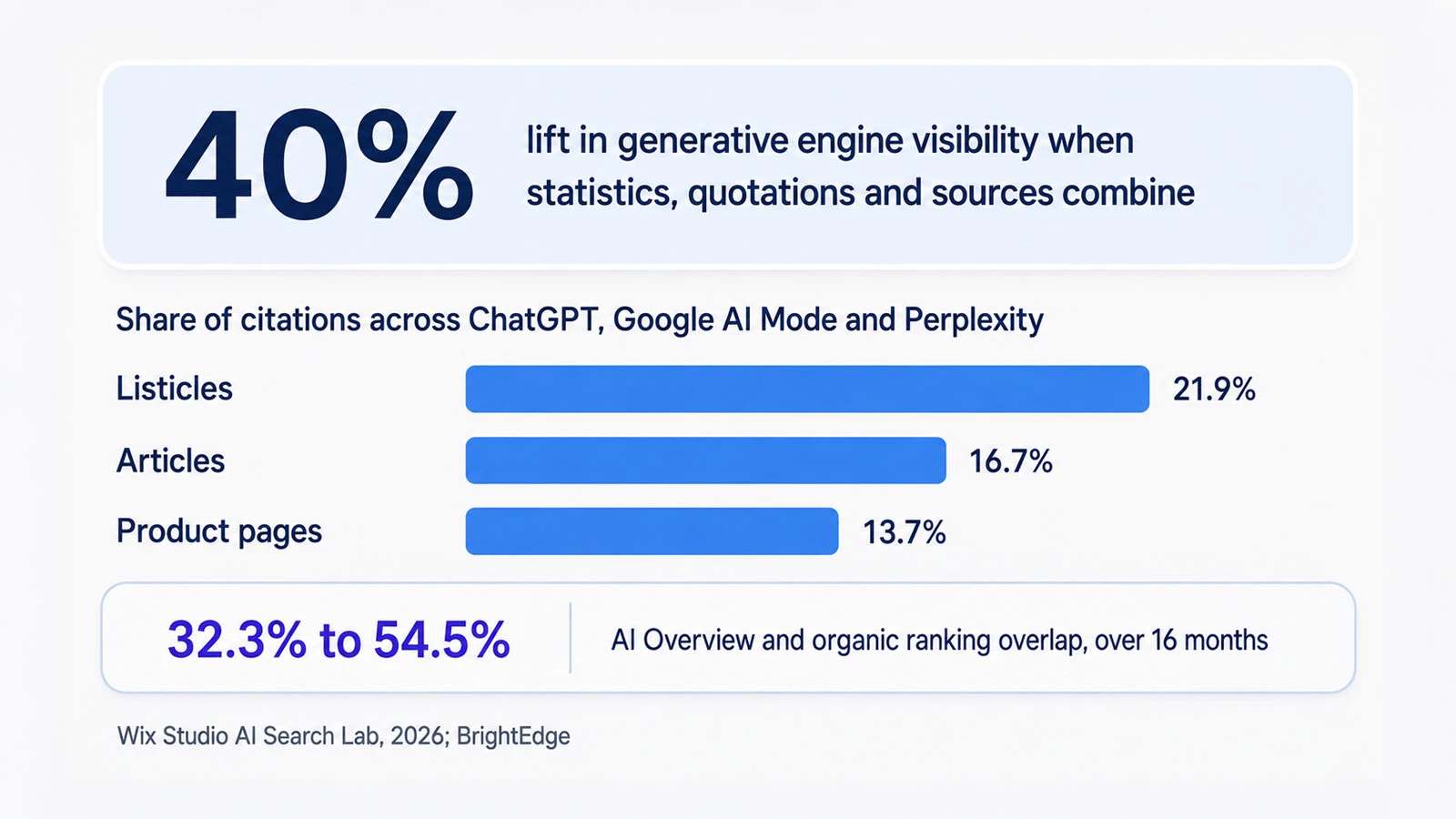
Their finding, roughly: stack statistics, quotations, and cited sources together in a piece of content, and visibility inside generative engines jumps between 30 and 40%. The biggest jump showed up on "opinion" question types specifically, and that's exactly the terrain statistics-injected content is now taking over.
What AI Overviews Cite
Listicles pull 21.9% of citations, articles pull 16.7%, and product pages pull 13.7%, making them the three most-cited content types across ChatGPT, Google AI Mode, and Perplexity. That's from a 2026 analysis of over a million citations by Wix Studio's AI Search Lab, so the sample size is real.
According to BrightEdge, AI Overview citation overlaps with pages ranking anywhere in organic results climbed from 32.3% to 54.5% over 16 months. Read that as the citation-and-ranking flywheel tightening, not loosening.
Why Opinion-only Pages Lose the Citation Race
AI doesn't cite takes; it cites numbers.
An LLM needs something attributable and structured to build a trustworthy answer, and opinion doesn't offer that.
It's either unattributable outright or attributable only to whoever wrote it, and most models have learned to avoid quoting an unverified point of view as though it were settled in fact.
Earned Distribution Multiplies AI Citations
In a March 2026 study spanning 87 articles across 30 brands, Stacker and Scrunch found a median 239% lift in brand citations inside AI search responses, but only when the data-led content got distributed through earned media instead of sitting on the brand's own domain.
Publishing the number is step one. Getting someone else's domain to repeat it is the part that actually moves AI visibility.
Strategic Takeaways for Brands
- Cite your own sources directly inside the piece. Stats plus quotes plus citations, combined, beat any single one of those tactics running alone.
- Push past 2,500 words if the topic can support it. AI Overviews pull from longer, source-dense pages more often than short ones.
- Lean on earned media, not just your own domain. Third-party pickup is what actually multiplies citation volume.
88% of B2B Marketing Teams Get Positive ROI From Original Research
This next part is the pivot from "why" to "how." It's the section a CMO actually needs to open when they're making the budget case.
What the ROI Numbers Show
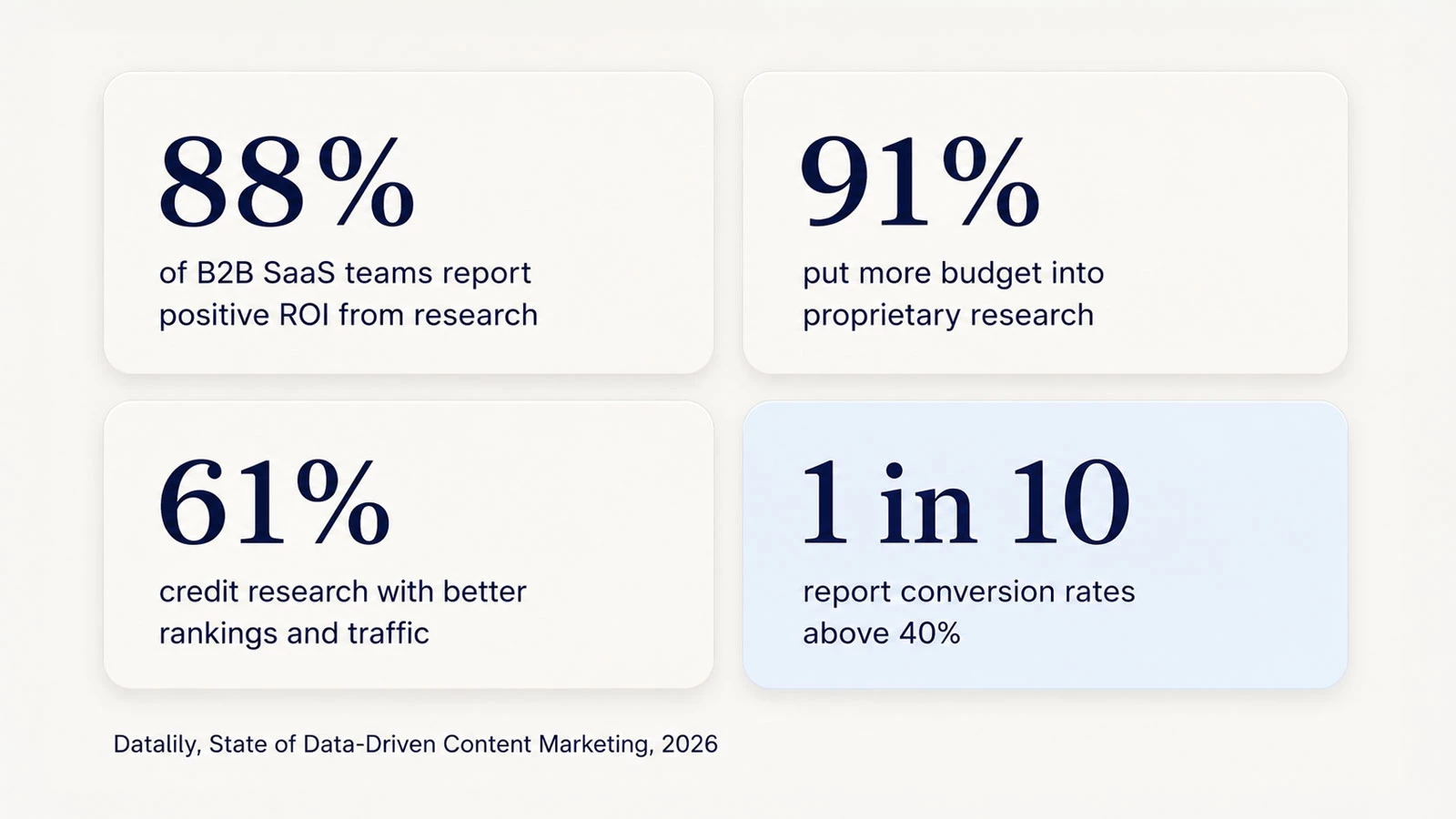
88% of B2B SaaS marketing teams say research-driven campaigns deliver positive ROI, and more than 1 in 10 are seeing conversion rates north of 40% according to Datalily, State of Data-Driven Content Marketing, 2026
91% have put more budget into proprietary research over the past year than they did the year before, and 61% credit publishing that research with a direct bump in search rankings and organic traffic.
93% of B2B marketers using original research-based content say it effectively drives engagement and leads, and 48% call it "very effective."
55% said original research generated leads for them directly, 88% palnned to publish more of it in the next 12 months, and 61% said the results met or beat what they expected going in.
Why Most "Data Content" Still Fails
Here's the failure mode that keeps showing up: a team publishes one stats roundup, hopes it earns links on its own, gets a modest bump, and quietly drifts back to opinion content within a quarter.
A better stats roundup doesn't fix that. Teams fix it by treating the original research as infrastructure instead of a campaign.
The teams winning in 2026 publish a survey or proprietary dataset on a fixed, repeating schedule, the same model behind DesignRush's own email marketing benchmark, Mantis Research, Stacker, and HubSpot's State of Marketing.
In practice, that means budgeting research the way you would budget paid media: an always-on line item, not a one-time project.
It means committing to a fixed annual cadence too, since a recurring benchmark earns authority a single report never will, no matter how good that one report is.
And it means tracking rankings and leads on two separate scoreboards instead of mashing them into one number. Both are real outcomes of a research program. They're just not the same outcome, and treating them like they are is how teams talk themselves out of next year's budget.
A Practical Playbook: How to Build Number-Driven Content in 2026
Five Formats That Consistently Outperform Opinion
These are the five that keep showing up whenever a stats-led piece actually earns links instead of just looking like it should.
- Original survey research - own a proprietary dataset, refresh it annually.
- Industry benchmarks - aggregate first-party performance data your customers contribute.
- Data journalism/Stacker-style story packages - number-led narrative plus visualization, distributed via earned media.
- Statistics roundups with verified primary sources - this article, and DesignRush's email statistics article, are working examples.
- Comparative data analyses - benchmark X versus Y with real numbers.
How to Structure Each Piece for Both Backlinks and AI Citation
Hand this checklist to a writer before they start drafting:
- Stat-led H2s - put the number in the headline.
- One citable claim per paragraph.
- Named primary sources, hyperlinked inline.
- 2,500+ words for AI Overview eligibility, 3,000+ if backlinks are the priority.
- Schema markup: Article and Dataset where applicable.
- One, preferably more, named expert quote with title and LinkedIn URL.
- A methodology note at the close.
- Distribute via earned media, not just owned channels.
Data Wins Attention - Louder Isn't the Same as Citable
AI Overviews, journalists, and search engines all landed on the same preference without coordinating: attributable numbers, pulled from primary sources.
The cheapest path to more links, more citations, and more pipeline is usually the one most teams skip entirely - commission the survey, build the benchmark, ship the data piece.
A single stats roundup is a content asset with an expected shelf life, while an annual benchmark is a distribution channel that compounds a little more every year it keeps running.
Opinion content still has a home, however it's just not the one fighting for backlinks anymore.
CMOs face a straightforward trade in 2026.
Publish fewer opinions and make sure the stats you do publish can stand on their own without you in the room to defend them.
Our team ranks agencies worldwide to help you find the right fit, and content marketing is just one category. Visit our Agency Directory for that list, plus:
- Top Digital Marketing Agencies
- Top Digital PR Agencies
- Top Content Marketing Agencies
- Latest Digital Marketing Trends
Data-Driven Content Marketing Statistics FAQs
1. What is Data-driven Content Marketing?
Data-driven content marketing means building articles, reports, and campaigns around original or verified statistics, survey data, proprietary benchmarks, third-party research, rather than leaning on opinion by itself. The goal is citable, attributable numbers that earn backlinks, journalist pickup, and AI Overview citations, not just reader attention.
2. What is Digital PR?
Digital PR is how brands earn coverage, backlinks, and mentions from online publications, by pitching original data or a genuinely newsworthy angle to journalists, rather than paying for the placement outright. It's the main distribution channel for every data-led format covered in this article.
3. What is Original Research?
Original research is data a brand collects and publishes on its own, through surveys, proprietary datasets, or its own aggregated performance data, instead of citing someone else's findings and calling it a day.
4. How Do You Measure Content Marketing ROI?
Content marketing ROI usually gets measured through organic traffic growth, referring domains earned, leads attributed to specific content, and the conversion rate on content-driven traffic. By those measures, 88% of B2B teams running research-driven content report positive ROI. (Datalily, 2026)
5. How Can Content Marketing Help with SEO?
Content marketing supports SEO mostly through earned backlinks and AI Overview citations, and both of those reward number-driven, citable content over opinion pretty consistently. Long-form content over 2,500 words earns meaningfully more referring-domain links than a shorter, opinion-only post ever will.
6. Is Content Marketing Dead?
No. Content marketing is not dead, but opinion-only content is losing steam fast as generative AI floods every channel with the same handful of takes. Content built around original data and statistics is still earning links, citations, and AI Overview placements at a noticeably higher rate.