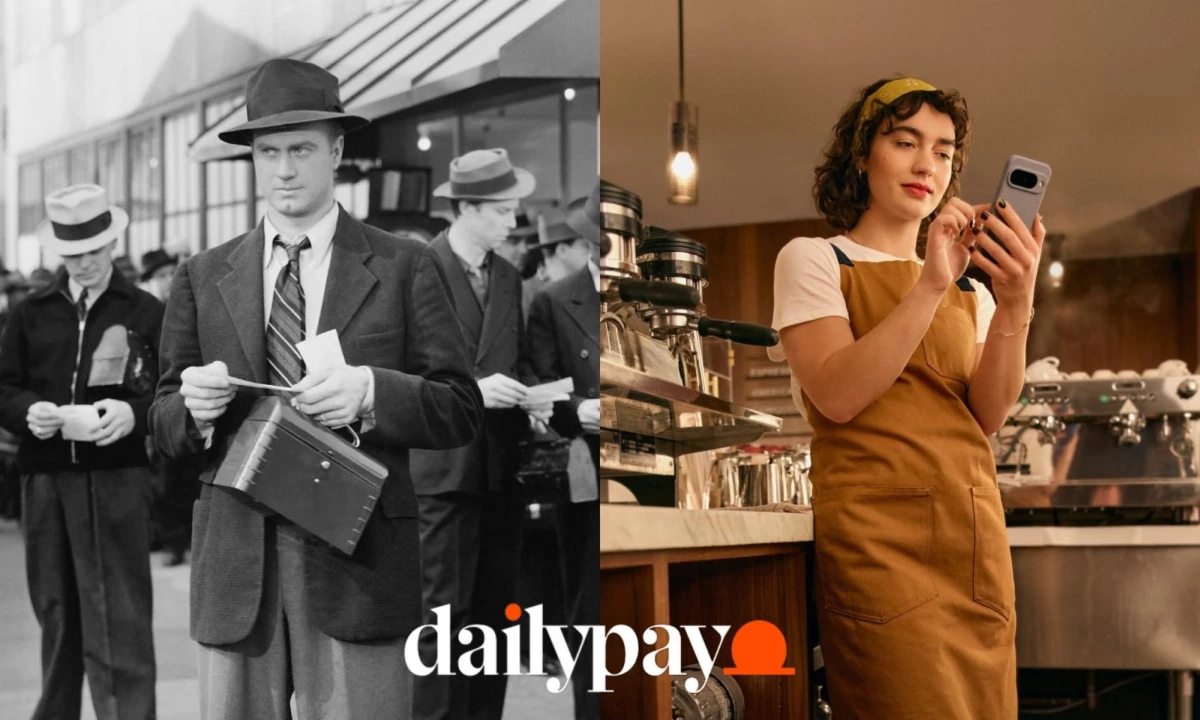

Millions of workers can stream, shop, and send money in seconds, yet payroll still follows a schedule rooted in 1938.
This contradiction is the focus of DailyPay's first national campaign, created with global communication firm Edelman.
Narrated by legendary actor Christopher Lloyd, the film opens in 1938, where the two-week pay cycle is introduced as a system that worked.
If things feel outdated, they probably are. Payday shouldn't be one of them.#DailyPay#OnDemandPay#EarnedWageAccesspic.twitter.com/sHuhkNxIof
— DailyPay (@DailyPay) June 3, 2026
It then cuts to a world that now operates in real time.
Supercomputers, highways, and on-demand services appear in rapid succession, followed by a direct challenge.
"At its core, this campaign is built around a simple idea: the world has moved to real time, but the way people get paid has not," Caitlin Allen, chief brand & communications officer at DailyPay, told DesignRush.
"The creative challenge was finding a way to get people to look differently at a system most of us have accepted for decades."
The spot closes with the company positioning on demand access to earned wages as a correction to that gap.
"We get everything on demand except our pay. That ends now," Lloyd narrates.
Alongside the campaign, the brand is introducing a refreshed brand identity, redesigned app experience, and brand voice.
Doc Brown Sells the Future
The creative uses the "Back to the Future" actor's link to time travel to cast payroll as a relic.
Lloyd, who played Doc Brown in the iconic trilogy, is the rare face who can make a 1938 pay cycle read as both a punchline and a real problem.
"I've spent a lot of my career talking about the past and the future," the actor said in a press release.
"This campaign shines a light on a system people have accepted for generations and asks whether it's finally time for something better."
"Christopher Lloyd gave us a memorable way to bring that idea to life and ask a question that feels increasingly relevant: why hasn't the pay system evolved with the rest of modern life?
'The Future of Pay' is our way of bringing that conversation into the open," Allen shared with DesignRush.
The campaign runs across digital video, social, streaming audio, YouTube, LinkedIn, Reddit, and connected TV.
DailyPay's brand refresh carries the same message into the product, with a redesigned app and a new voice built to match.
The whole approach sells the feeling of a broken system before it ever explains earned wage access.
A familiar face and one simple question pull more attention than a feature list ever could.
This instinct, story first and mechanics later, is one of the smartest brand storytelling moves available to a category most people find boring.
6 Million Workers Already Buy In
The campaign frames payday as a system problem, and DailyPay's adoption numbers show the demand behind it is already real.
According to the company, it serves more than 1,900 employers and over 6 million employees.
It ranked as the No. 1 adopted financial wellness benefit, outperforming 401(k) programs, flexible schedules, and other workplace perks.
Beating a 401(k) for adoption shows workers already treat fast access to their pay as essential.
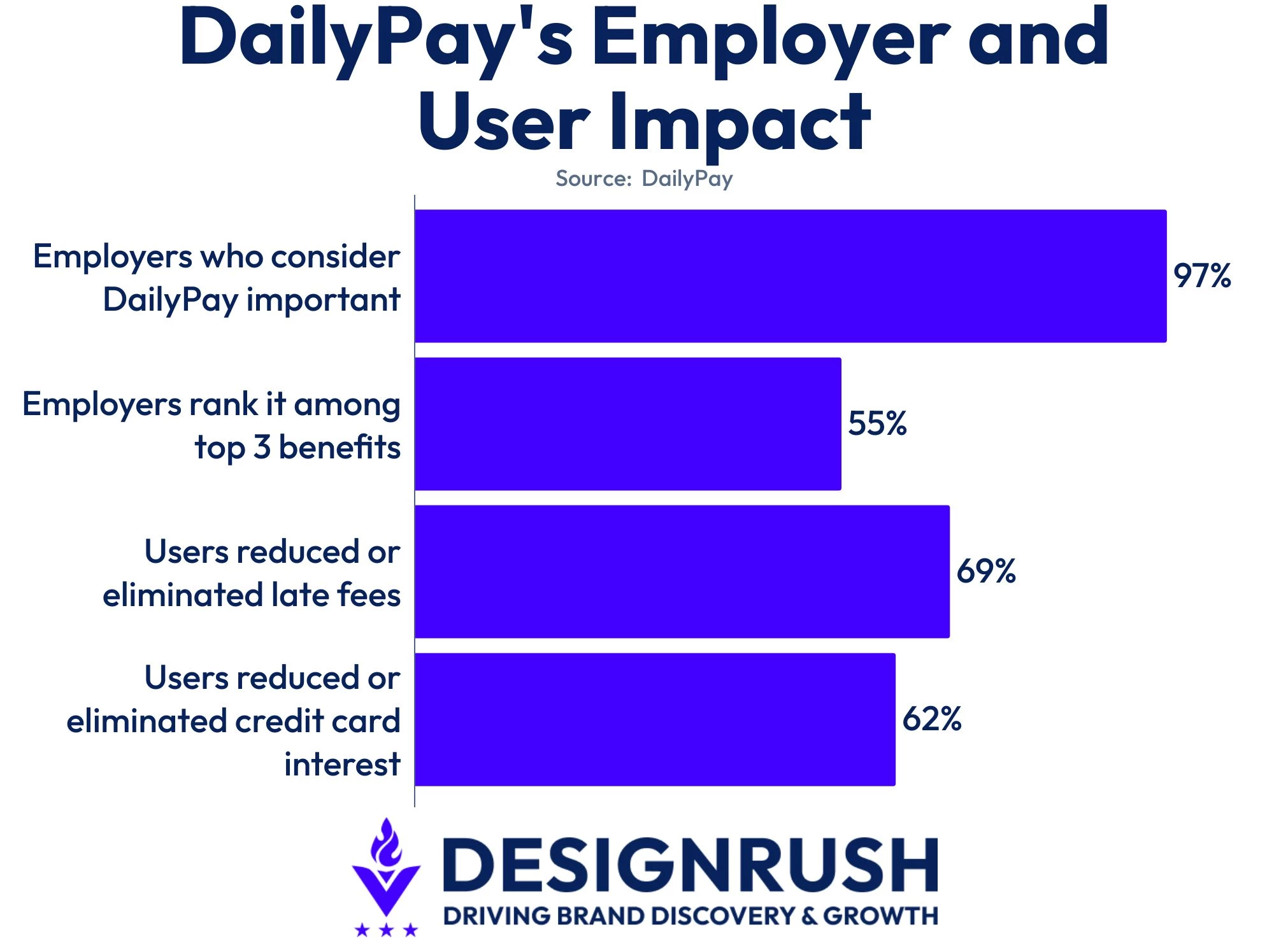
Employers back the trend, with 97% calling it an important financial wellness tool and 55% ranking it among their top three most engaged benefits.
DailyPay's campaign shows brands how to turn an accepted norm into a problem worth fixing.
- Convenience resets expectations. Brands should evaluate legacy processes regularly to keep pace with how employees already live.
- Benefits increasingly compete on flexibility. Employers should position tools around control and accessibility to strengthen retention efforts.
- System friction creates marketing opportunities. Marketers should identify outdated practices and frame them as solvable problems.
The hardest part is getting people to see the problem at all.
Once a norm is flagged as broken, people start to question it, and this is the first crack in the consumer behavior that kept the old system in place.
Our Take: Will Payday Become a Hiring Perk?
DailyPay's real achievement is making a payday schedule feel like a choice rather than a fact of life, and Lloyd put the absurdity plainly.
"When DailyPay asked why people in 2026 are still getting paid like it's 1938, the same year I was born, I thought that was a pretty good question."
We think the campaign's lasting effect will be felt in hiring, not branding or advertising.
Once workers see pay timing as a benefit, they start weighing it against healthcare and flexible schedules when they choose a job.
This puts employers who still pay every two weeks at a quiet disadvantage in a tight labor market.
The "that's how it's always been done" defense gets weaker every time a competitor offers something faster.
DailyPay wins either way, since it sells the tool that closes this gap.
DailyPay is honored to be recognized on @TIME's list of America’s Top WorkTech Companies!
— DailyPay (@DailyPay) June 10, 2026
This is a testament to the hard work, innovation, and dedication of our incredible team. Thank you to everyone who is helping us shape the future of pay.
See the full list of honorees… pic.twitter.com/AZmVQu69vU
The open question now is how fast workers start treating payday as a reason to pick one employer over another.
DailyPay isn't the only fintech brand turning to familiar faces to simplify a complex category.
Paze recently enlisted Gabrielle Union and Elizabeth Banks to make online checkout security feel more approachable in "It Checks Out."
More fintech marketers are using entertainment-driven storytelling to explain everyday financial behaviors.
Explore these top fintech digital marketing agencies specializing in financial services, UX, and performance-driven storytelling.