
Apple vs. Xiaomi EV Pivot: Key Findings
- Apple spent $10 billion over 10 years and never shipped a car, while Xiaomi launched two EVs in under two years with profitability expected in 2025.
- Xiaomi secured nearly 300K preorders in one hour by pricing aggressively with active brand promotion.
- Apple failed due to secrecy, leadership shifts, and overengineering; Xiaomi succeeded by moving publicly, quickly, and with customer-aligned execution.
Want to listen to an in-depth conversation, instead of reading? Tune in on-the-go here:
How does a brand better known for budget phones and rice cookers end up beating Apple in a billion-dollar market pivot?
Xiaomi, a Chinese tech corporation, did it in under two years.
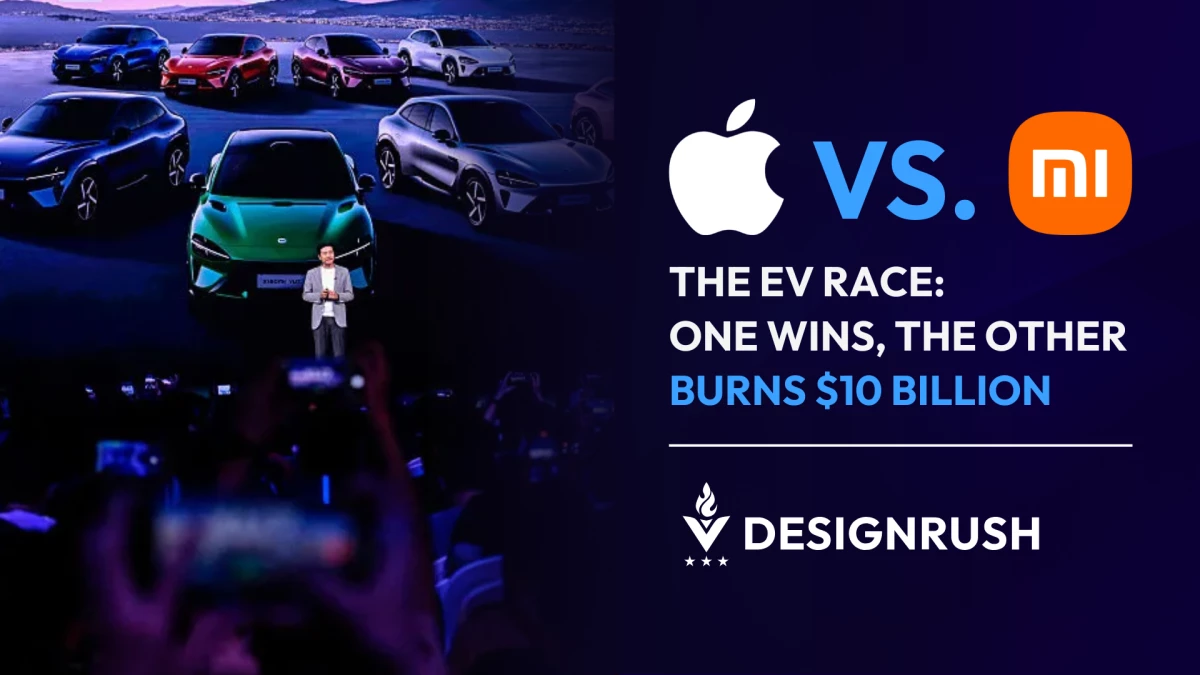
In 2021, the company, primarily known for smartphones, software, and consumer electronics, entered the electric vehicle (EV) space with a bold $10 billion investment.
By Dec. 2023, its first EV launched and it secured nearly 300,000 preorders in one hour. Then, in June 2025, Xiaomi CEO Lei Jun projected profitability in the second half of 2025.
By contrast, Apple entered the EV market in 2014, also investing $10 billion over 10 years developing a car that never shipped.
In 2024, its top-secret initiative, ‘Project Titan’, quietly folded, leaving behind internal shakeups, sunk costs, and no product to show.
So what was Apple’s costly $10-billion mistake?
It wasn’t a lack of capital, talent, or ambition. It was building in isolation — with no feedback, no public storytelling, and no alignment with market realities.
This is the billion-dollar mistake brands must avoid when pivoting into new sectors.
Apple vs. Xiaomi: $10 Billion EV Flop vs. Profitable Pivot
Before analyzing these brands’ pivoting strategies, we already provide one piece of encouraging advice, and that is:
A failed market shift, even from a brand as powerful as Apple, doesn’t necessarily mean barrier-to-entry for another.
This means, brands eyeing a market requiring a bold pivot should still go for it, even if a larger company tried and didn’t succeed.
For brands, big and small, Xiaomi’s story is a signal: strategy and speed still win.
3 Real-World Lessons for Brands Looking to Expand
Why did Apple experience such a high-profile failure, while Xiaomi pulled off a fast-track success?
Here are three key lessons summarizing brand expansion advice, based on these two tech companies’ unique, yet bold business shifts into the auto industry.
- Don’t Gatekeep, Promote Your Work
- Get Clear on Your Positioning
- Do Research to Learn & Adapt Quickly
Let’s take a closer look to see how these learning apply.
Lesson #1: Don’t Gatekeep, Promote Your Work
Apple EV cars not only never left the driveway; they were also barely mentioned.
As of early 2024, Apple CEO Tim Cook had never acknowledged Apple’s car project publicly, only referring to it as work on “autonomous systems.”
For a decade, Apple kept a code of silence around its EV development.
This strategy to create without consumer feedback was a risky decision for Apple, especially as competitors, such as Xiaomi, entered the scene.
Meanwhile, Xiaomi treated its car launch like a high-profile tech product drop.
From day one, it openly promoted its activities by:
- Holding public launch events to reveal new EVs.
- Generating buzz online after securing over 240,000 orders in the first 18 hours, demonstrating the public's immediate interest in the EVs.
- Announcing pricing and specs of models, comparing them to competitors, such as Tesla.
“Tesla previously said, 'Go ahead and compare,' and we at Xiaomi just won't accept defeat,” said Lei at a recent launch event. “Today we officially take up Tesla's invite to compare.”
By contrast, Apple maintained its undercover approach. While not detrimental to the brand, it did causes internal and external issues, such as:
- Confusion for the public
- Over-engineering for internal teams
- Lost insights on critical learnings, such as market readiness
The sparse communication prompted industry discourse, with some calling the project a “failure of leadership.” While a 2024 Bloomberg newsletter states: it“now seems clear that the project was doomed nearly from the start.”
The best approach to controlling the narrative is of course case by case. But for Apple, and its top-secret EV project, keeping quiet doesn’t seem to have won them any brownie points.
Lesson #2: Get Clear on Your Positioning to Ease Market Entry
When it comes to pricing and research, Apple appears to have also missed the mark.
Pricing Strategy
As of 2024, Apple’s EV was projected to cost at least $100,000 to turn a slim profit.
Since the mid-2010s, auto competitors, such as Tesla, BYD, and Hyundai, started to scale vehicles at lower prices.
For example, Tesla’s Model 3 launched in 2016 for under $70,000, setting a new industry benchmark — while also making Apple’s higher pricing strategy increasingly uncompetitive.
Apple’s inability to match the pricing curve contributed to the company’s 2024 announcement, stating it’d be "winding down" Project Titan, as its vision became economically outdated against rapidly scaling competitors.
As for Xiaomi, it took a different (more competitive) approach to pricing and timing.
The YU7 SUV has a starting price of around $35,000 — a far cry from Apple’s $100K price tag.
It was a smart move by Xiaomi, as its competitive prices directly challenge more established players, like Tesla and BYD, while surging preorders.
As the industry took note and orders hit record highs, Xiaomi expertly positioned itself as a more affordable alternative to luxury EVs.
Brand Takeaway: When entering new markets, transparency, competitive pricing, and rapid consumer feedback are essential.
Lesson #3: Do Research to Learn & Adapt Quickly
To launch fast, Xiaomi employed an open, iterative, research-backed process.
CEO Lei Jun and his team held over pre-launch 80 meetings with more than 200 auto industry experts, soaking in insights from legacy automakers, according to a report from Ainvest.
During development phases, it took a public-facing approach. This meant sharing prototypes, updates, and specs early, allowing for real-time external feedback.
Coupled with its massive 500+ million user base for collecting user insights, Xiaomi’s approach is a blueprint for launching swiftly and with clarity.
As for Apple’s Project Titan’s process, I am curious as to why they declined to collect external data. And it may be as simple as wanting to protect intellectual property or maintain a competitive age.
Either way, developing without feedback can create blindspots, which — in addition to Apple’s pricing issues — could have led to the project ending.
Additionally, Apple may have struggled to move away from its core competencies, such as consumer electronics, toward complex EV-specific topics, such as charging infrastructure or automotive regulations.
Of course, the tech Behemoth can surely hire top auto experts to tackle these. But knowing Apple, its focus is consistently put toward cutting-edge design.
So, it’s safe to say Apple car designs (and their accompanying campaigns) would win the road in terms of aesthetics.
As for the performance of the cars? Since Apple exited EV, this remains to be seen.
Your Brand Checklist to Nail Speed & Strategy Like Xiaomi
Want to expand your business into new categories, sectors, or markets? Refer to this abbreviated brand expansion checklist to guide your process.
From research to development, promotion, and pricing, it will remind you of the most important factors as you strategize.
The Brand Expansion Checklist
- Start with external research: Engage industry experts and study proven players before you build.
- Test in public: Share updates, prototypes, and product details early to build credibility and gather feedback.
- Price to compete: Match or undercut industry benchmarks and speed up your your process using market research tools.
- Communicate like a brand, not a lab: Promote your move as a strategic lifestyle shift, not just a product experiment.
- Integrate with your ecosystem: Ensure your new offering connects seamlessly with what your brand already does well.
- Align leadership early: Ensure internal teams share a clear vision to avoid execution breakdowns.
- Ship fast, refine later: Speed to market builds relevance — iteration keeps it.
Finally, the burning question for every brand leader: If you had to pivot your business tomorrow — would your strategy look more like Apple’s or Xiaomi’s?